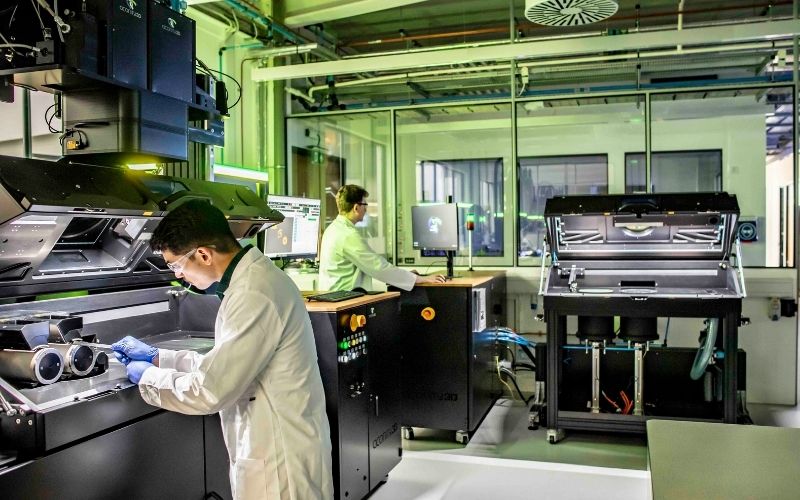
Europe’s security debate still treats industrial capacity as a background condition, something measured in aggregate statistics and invoked after a crisis begins. That habit is becoming costly. The practical constraint on deterrence and sustained support to partners is not only budgets or doctrine. It is production, repair, and replenishment at speed. In that environment, additive manufacturing is less interesting as a set of machines than as a way of reorganising manufacturing power, especially among small and medium-sized enterprises.
For SMEs, the promise of additive manufacturing has often been framed in familiar commercial terms: faster prototyping, reduced waste, and design flexibility. Those benefits are real, but they are not the main story. The strategic story is about readiness in a fractured economy: the ability to keep systems running when inputs are delayed, when suppliers are constrained, and when the state’s demand shifts quickly. Additive manufacturing matters because it changes who can respond, how quickly, and under what constraints.
The return of the “industrial timeline”
In the long post Cold War period, European industry optimised for cost and predictability. Security policy optimised for expeditionary operations and small inventories. Both approaches assumed stable logistics, open markets, and long planning horizons.
That settlement is eroding. Conflict in Europe, instability in maritime trade routes, tighter technology controls, and the politicisation of supply chains have pushed industrial timelines back into strategic calculations. A defence ministry can commit funds quickly. It cannot conjure qualified suppliers, validated processes, and trained technicians at the same pace. Additive manufacturing sits directly in this gap. Its advantage is not a universal cost edge. It is time and substitutability. It can bypass tooling bottlenecks, reduce dependence on long external supply chains for certain categories of parts, and shorten redesign cycles when requirements change. Those are wartime and crisis attributes, even when used in peacetime.
Why SMEs are the decisive layer?
Europe’s industrial base is dense, but it is also segmented. Prime contractors have visibility and political access. They also have bureaucratic procurement interfaces and long qualification cycles. SMEs, by contrast, are often where production actually happens: specialist machining, surface treatments, assemblies, repairs, and small batch components that keep larger systems functional.
This matters for two reasons:
First, resilience is distributed. When a single large supplier fails, the effects are visible. When hundreds of small suppliers are unable to deliver because of one missing tool, one unavailable alloy, or one delayed casting, the effects are equally damaging but harder to diagnose. Additive manufacturing offers a route to reduce some of these chokepoints, particularly where the binding constraint is tooling or geometric complexity.
Second, SMEs are where the mobilisation problem becomes real. In a crisis, governments do not need another strategy document. They need capacity that can be redirected and scaled. SMEs can do that only if the technology is embedded into their production model, not parked in an innovation corner.
In Denmark, adoption indicators point to this shift. Nationally compiled figures suggest that the share of manufacturing companies using additive manufacturing rose from roughly 16 percent in 2018 to about 30 percent by 2025. The key point is not the exact percentage. It is the direction, and the fact that the increase is broadening beyond early adopters. The strategic question is how to convert usage into industrial capability that can be relied upon under pressure.
To treat additive manufacturing as readiness infrastructure is to focus on the surrounding system, not the printer. Four elements determine whether additive manufacturing contributes to national resilience.
Qualification and standards. Defence and critical infrastructure cannot rely on ad hoc production. A part is not “the same” because it matches a CAD file. Material properties, process parameters, post processing, inspection, and traceability define whether a part can be trusted. SMEs struggle here because qualification is expensive and slow, and standards are often interpreted differently across customers and borders.
A secure digital thread. Additive manufacturing shifts value into data: design files, process recipes, inspection records, and material certificates. That is an opportunity because it can turn inventory into a digital asset. It is also a vulnerability because manipulation of a file or parameter set can change part performance without obvious external signs. For SMEs, cybersecurity and data governance become manufacturing issues, not IT issues.
Workforce and engineering culture. Additive manufacturing is not a drop in replacement for conventional production. Design for additive manufacturing requires different instincts, and quality control requires familiarity with new defect modes and inspection regimes. Without in house competence, SMEs remain dependent on external service providers and capture limited value.
Post processing capacity. The political narrative often focuses on printers. The industrial reality is that bottlenecks shift to heat treatment, surface finishing, metrology, and certification workflows. If these capabilities are scarce, additive manufacturing becomes another queue rather than a solution.
A state that wants additive manufacturing to contribute to readiness must treat these elements as a single system. Otherwise adoption remains shallow and unreliable.
SMEs do not make long term investments based on patriotic appeals. They respond to demand signals. Defence markets send weak and inconsistent signals to smaller firms for structural reasons: long procurement cycles, complex bidding rules, fragmented requirements, and limited transparency about future orders.
That creates a predictable pattern. SMEs experiment with additive manufacturing for commercial work, then hesitate to invest in defence grade qualification because the payoff is unclear. The result is a gap between what governments assume exists and what industry is prepared to deliver.
Closing this gap does not require the state to micromanage technology choices. It requires credible procurement pathways that reward readiness.
Three procurement tools are particularly relevant.
Framework contracts for surge and spares. Rather than buying only parts, governments can contract for certified capacity, including predefined families of parts and agreed lead times under contingency conditions.
Shared qualification funding. Qualification is a public good for security relevant manufacturing. Co funding standards development, testing, and certification infrastructure reduces the barrier for SMEs without distorting the market toward a single supplier.
Dual use incentives. Many of the most valuable defence applications are dual use: repair parts, connectors, housings, thermal management components, and specialised tooling. Defence procurement can be designed to support these capabilities without creating a closed, inefficient system.
The Nordic and Baltic security context
For smaller states, the logic is sharper. A country cannot stockpile every spare part, nor can it assume access to external suppliers in a crisis. The Nordics and Baltics face a specific set of constraints: proximity to potential conflict, reliance on maritime logistics, and limited depth in heavy industry compared with larger European economies.
Additive manufacturing fits this context because it supports distributed production. In practical terms, this means certified nodes that can produce and validate parts locally, and digital inventories that can be shared across trusted networks.
But this also raises governance questions that are typically treated as secondary.
Who owns the design authority for a part in a multinational system? Under what conditions can a digital file be transferred across borders? How are export controls applied to production recipes or parameter sets? What does “sovereignty” mean when a part can be produced domestically but only from a file held by a foreign prime contractor?
These questions move additive manufacturing into the realm of alliance politics and industrial diplomacy. A small state can gain resilience, but it can also trade one dependency for another, swapping dependence on physical supply chains for dependence on digital permissions.
AI, process control, and the concentration risk
The integration of AI into additive workflows is often described in promotional language. The more relevant point is that AI enables repeatability and scale. It can improve process monitoring, defect detection, and predictive maintenance. It can also accelerate design optimisation in ways that reduce material use and consolidate assemblies.
For SMEs, this could lower the skill barrier and reduce scrap costs. It could also produce concentration risk if the enabling software, monitoring systems, and data platforms consolidate in a small number of vendors. The strategic hazard is a familiar one: Europe expands capacity on paper, while key dependencies sit in proprietary platforms, cloud services, and opaque algorithms.
If additive manufacturing is to contribute to national readiness, governments and industry will need a more deliberate approach to digital sovereignty. That does not require autarky. It requires clarity about what must remain auditable, what must be locally controllable, and what can be safely outsourced.
What “industrial adoption” actually means
Adoption is often measured by whether a firm has used additive manufacturing at least once. That is a weak metric. Strategic capability requires something stronger.
A useful definition of industrial adoption for SMEs would include four conditions:
- The firm can identify a set of parts where additive manufacturing is the preferred option, not an experiment.
- The firm has a documented workflow from design through post processing and inspection.
- The firm can produce repeatably within agreed tolerances and material properties.
- The firm can demonstrate traceability and data integrity for customers with high assurance requirements.
This is the threshold at which additive manufacturing stops being a novelty and becomes part of a nation’s usable industrial capacity.
Policy priorities for a serious SME strategy
A credible strategy should start with constraints, not slogans.
Build shared certification infrastructure. SMEs need access to testing, metrology, and qualification support that would be irrational to duplicate firm by firm. This can be organised through national institutes, regional hubs, and cross border arrangements among trusted partners.
Create secure digital inventories for critical parts. Governments and primes should identify categories of components that are suitable for additive manufacturing and develop certified digital libraries with clear rules on access, licensing, and contingency use.
Align defence procurement with readiness outcomes. Contracts should reward lead time, surge capacity, and quality assurance, not only lowest price. For additive manufacturing, readiness is the product.
Treat cyber integrity as part quality. Security standards for digital files, parameter sets, and machine logs should be integrated into qualification regimes. For high assurance parts, tamper evidence and audit trails should be non negotiable.
Invest in training that connects design and production. The bottleneck is often design competence, not machine access. SMEs benefit most when engineers and technicians share an additive manufacturing vocabulary and can iterate quickly.
If these pieces are put in place, the payoff is not simply faster production of niche components. It is a change in industrial posture.
For SMEs, additive manufacturing can move them up the value chain, from machining to co development, from subcontracting to design authority in specific niches. For governments, it can add depth to the defence industrial base without relying solely on a handful of primes. For alliances, it can support distributed sustainment models that reduce pressure on single points of failure.
There is also a second order effect that matters for small states. A country that can sustain and repair complex systems domestically has more freedom of action. It can support partners more credibly. It can absorb shocks with less political drama. It can bargain from a stronger position in procurement and industrial cooperation.
Additive manufacturing will not resolve Europe’s industrial constraints on its own. It will not replace mass production where volume is the central requirement. But in a period when the binding constraint is often time, qualification, and resilience, it offers something that is rare in European industrial policy: a plausible path to more readiness without building a parallel state owned industry.
The question is whether policymakers treat it as an innovation story, or as a security and industrial governance problem. The difference will determine whether SMEs become a source of strategic depth, or another fragile layer in an already stressed production system.