Israel entered the present wars with one of the world’s most established unmanned-aircraft industries. It had long-endurance surveillance aircraft, mature electro-optical payloads, satellite communications, loitering weapons and decades of operational experience. The fighting since October 2023 nevertheless exposed a gap that had received far less investment: cheap drones produced in large numbers and controlled directly by small ground units.
By 2026, Israel was trying to combine three industrial models that operate according to different rules. The first is aerospace manufacturing, represented by Israel Aerospace Industries and Elbit Systems, where aircraft are developed over years, certified carefully and supported for decades. The second is missile production, represented by Rafael and UVision, where the drone is a precision-guided weapon with a military seeker, certified warhead and formal chain of command. The third is the commercial FPV economy, where airframes are expendable, components change every few months and battlefield users modify equipment faster than conventional procurement offices can approve it.
The IDF needs all three. Its difficulty lies in cost, scale and command structure.
Israel’s strongest companies remain concentrated in the upper levels of the drone market. Its urgent battlefield requirements now sit closer to the bottom: thousands of small reconnaissance and attack drones, replacement batteries, encrypted video links, night cameras, electronic-warfare protection and operators distributed across infantry and armored formations.
The military has reacted with large tenders, emergency procurement, accelerated work with startups and even plans for an army-run FPV factory. This activity represents a real change in force design. It also reveals how late the institutional response has been.
A procurement shock
The first major indication came in 2025, when XTEND won a Ministry of Defense tender to supply around 5,000 FPV attack drones to the Ground Forces. The reported contract value was approximately NIS 20 million, with a price near NIS 3,500 per drone and an option for another 5,000. The package also covered control equipment, operator goggles and training.
That order treated the FPV as a relatively cheap, expendable weapon. The 2026 procurement was different.
In April, Israeli reporting described a proposed order for as many as 12,000 Israeli-made attack drones. The expected price was NIS 20,000 to NIS 25,000 per system. A full purchase at those figures would cost between NIS 240 million and NIS 300 million. XTEND, Robotican and Ondas were among the reported competitors. Requirements included night capability and reduced dependence on Chinese electronics.
The new price was almost six to seven times the reported price of the earlier XTEND drone. Part of the increase can be explained by thermal or low-light cameras, hardened communications, more secure supply chains, warhead integration, operator equipment and support. It still creates an uncomfortable cost comparison.
Hezbollah’s fiber-optic FPV drones have reportedly cost roughly $300 to $400. An Israeli system costing NIS 20,000 to NIS 25,000 is approximately $6,000 to $7,500 before the wider costs of training, maintenance and ammunition integration. A direct comparison is imperfect because the Israeli tender appears to demand a more complete military system. The exchange ratio still matters. An army cannot sustain attritional drone warfare if every lost aircraft is treated as a specialized procurement item.
The IDF’s plan to create a military FPV factory makes this tension more visible. According to May 2026 reporting, the factory is intended to produce thousands of drones and employ around 200 ultra-Orthodox soldiers. Military production can provide emergency capacity and retain technical knowledge inside the force. It can also duplicate private production, weaken price transparency and leave the army manufacturing designs that commercial firms may improve more quickly.
The factory suggests that the Ministry of Defense does not yet trust the domestic market to deliver the required quantity, price and component security at the same time.
The emerging force structure
Israel is developing several drone fleets rather than one integrated category. Their missions, costs and users differ considerably.
Long-endurance aircraft
The upper layer remains under air-force control. These aircraft provide persistent surveillance, communications relay, signals intelligence, radar coverage and support for long-range operations.
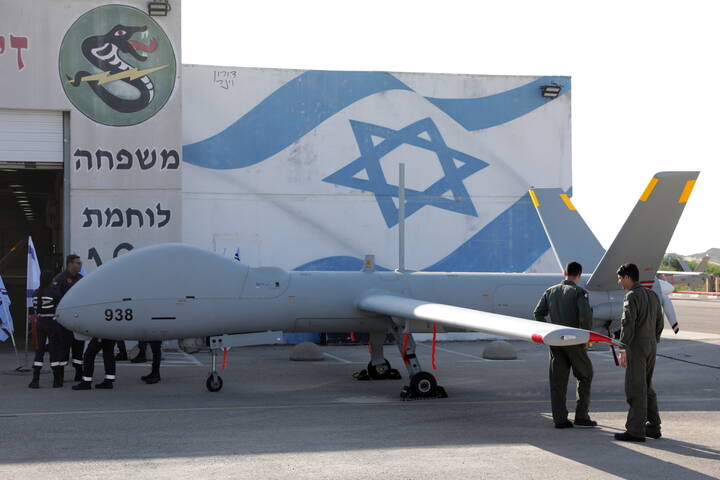
Israel Aerospace Industries’ Heron Mk II has a maximum takeoff weight of 1,430 kilograms and a stated payload capacity of up to 490 kilograms. Its published endurance is as high as 45 hours. Line-of-sight mission radius is below 250 kilometres, while satellite communications extend operations beyond 1,000 kilometres. The aircraft can carry several sensors simultaneously, including electro-optical equipment, radar, communications intelligence and electronic-intelligence payloads.
The Israeli Air Force began forming a new Heron Mk II squadron at Hatzor in 2026, with initial deliveries expected during the year. The decision indicates that Israel is still investing heavily in large unmanned aircraft despite the attention given to FPVs. These systems serve Iran-related, maritime and regional surveillance missions that small drones cannot perform.
Elbit’s competing Hermes 900 has a stated endurance of up to 36 hours, a maximum payload of 350 kilograms and a service ceiling of 30,000 feet. Elbit’s advantage lies in combining the aircraft with its own sensors, electronic warfare, communications and ground-force command systems.
The Heron-Hermes competition is therefore broader than aircraft performance. IAI offers greater published payload and endurance figures in the latest Heron configuration. Elbit offers a highly integrated ecosystem stretching from the aircraft to tactical command networks and smaller Skylark drones.
These large systems also face limitations. They require runways, trained crews, expensive payloads and centralized tasking. Their satellite and data links can be contested. In heavily defended airspace they often operate from stand-off positions, which increases the importance of sensor resolution, communications bandwidth and cooperation with other intelligence sources.
Tactical fixed-wing drones
The next layer provides brigade and battalion commanders with longer endurance than a quadcopter without requiring a full air-force squadron.
Elbit’s Skylark family occupies much of this segment. The Skylark I-LEX is man-portable and provides day-and-night video over a stated line-of-sight communications range of up to 40 kilometres. Skylark 3 is intended to give division, brigade and battalion headquarters an organic intelligence capability.
IAI addresses the same market through BlueBird Aero Systems, in which it owns 50 percent. BlueBird produces the WanderB and ThunderB families and has expanded into loitering weapons. Its hydrogen-fuel-cell WanderB demonstrator has a stated maximum takeoff weight of 18 kilograms and endurance exceeding six hours. The technology could extend tactical surveillance time, although hydrogen storage, field refuelling and maintenance remain significant obstacles to wide military deployment.
This category is likely to grow because it sits between short-range quadcopters and air-force aircraft. A fixed-wing or hybrid vertical-takeoff drone can monitor roads, borders and artillery areas for several hours. It cannot enter a building, hover beside a window or follow troops through narrow urban terrain.
Close-range reconnaissance
Small multicopters are becoming standard equipment for maneuvering units. Their missions include checking roofs, looking into courtyards, inspecting tunnels, following suspicious movement and watching the area immediately ahead of a patrol.
Their military value depends heavily on availability. A highly capable drone stored at brigade headquarters cannot replace a less sophisticated aircraft already carried by a platoon.
The Gaza war accelerated the use of DJI, Autel and other commercial systems because soldiers, reservists and donors could acquire them immediately. Their cameras, stabilization and user interfaces were already mature. The military could modify some communications and software functions, yet it did not control the full hardware and firmware chain.
Israeli replacements must match the usability of commercial drones while adding secure communications, offline operation, repairability and military payloads. That is harder than producing a domestic frame. The flight controller, video transmitter, camera, battery cells, electric motors and processors may still come from foreign suppliers.
Robotican’s Rooster offers a more specialized solution. It can fly, roll across floors and stop in place as a stationary sensor. A typical kit contains three vehicles and a control station. The design conserves battery power inside buildings and permits mesh communications through structures or underground spaces. Its reported maximum hovering time is about 12 minutes, while combined rolling and observation can support longer missions.
That makes Rooster valuable for tunnels and damaged buildings. It does not automatically make it suitable as a general-purpose FPV weapon. Robotican’s future depends on whether the IDF separates indoor reconnaissance from the larger attack-drone tender or demands one common platform for both.
FPV attack drones
FPVs turn the drone into a remotely guided munition. The operator normally flies through a live video feed and directs the aircraft into the target.
Their attraction is economic and tactical. They allow a small unit to attack from behind cover, approach from unusual angles and strike targets that would otherwise require artillery, a guided missile or direct exposure of soldiers. Payloads can also be altered quickly.
The limitations are equally serious. Battery endurance is short. Video links may be jammed or detected. Operators require sustained practice. Wind, dust, rain, urban interference and restricted visibility reduce reliability. A drone that works during a demonstration can fail when its communications spectrum is crowded by dozens of friendly and hostile systems.
Israel’s 2026 requirements suggest that the IDF is moving beyond manually piloted commercial designs. Night cameras, secure communications and navigation in disrupted environments raise costs, but they also move the FPV toward a formal military weapon.
The risk is over-engineering. Adding encrypted radios, artificial-intelligence processors, thermal cameras, anti-jam navigation and certified warhead systems can produce a capable aircraft that commanders hesitate to expend. The cheaper enemy system may continue to offer the better attritional exchange.
Loitering munitions
Israel already possesses a large loitering-munition industry. These systems are more expensive than improvised FPVs and generally offer greater range, endurance, seeker quality and warhead reliability.
Rafael’s L-SPIKE 1X weighs 2.2 kilograms, has a stated range of five kilometres and can loiter for around 15 minutes with a warhead or 30 minutes in a reconnaissance configuration. It is designed to operate where satellite navigation is unavailable.
Rafael’s older FireFly weighs around three kilograms per munition and has a published engagement range of approximately 500 metres in dense urban terrain and 1,500 metres in open terrain. The system was developed for infantry units requiring an organic weapon beyond direct line of sight.
UVision’s Hero 30 occupies a heavier category. The complete munition weighs up to 7.8 kilograms, carries a 0.5-kilogram warhead, reaches up to ten kilometres and has endurance of up to 30 minutes. The Hero 120 weighs up to 24 kilograms, carries a 4.5-kilogram warhead and has published range and endurance figures of 60 kilometres and 60 minutes.
BlueBird’s SpyX weighs about ten kilograms, carries a 2.5-kilogram warhead and has a claimed range of 50 kilometres with mission endurance of roughly 90 minutes. It is designed to work with the company’s reconnaissance drones, allowing one platform to find a target and another to attack it.
SpearUAV has concentrated on drones stored and launched from sealed capsules. Its Viper family can be mounted on vehicles, ships and other platforms. UVision acquired SpearUAV in late 2025, bringing hovering and capsule-launched systems into the same group as the Hero fixed-wing family. This consolidation gives UVision a broader portfolio and places it in closer competition with Rafael.
The line separating an FPV drone from a loitering munition is becoming less clear. The meaningful differences are increasingly found in the seeker, communications security, warhead certification, navigation, ability to abort, integration with command systems and price.
Company passports
Israel Aerospace Industries
IAI is state-owned and remains Israel’s principal strategic unmanned-aircraft manufacturer. Its strongest position is in medium-altitude, long-endurance aircraft, large payloads, radar, satellite communications and national-level intelligence systems.
The Heron Mk II squadron provides IAI with a new domestic reference customer. Its 50 percent holding in BlueBird gives it access to smaller tactical drones and loitering weapons without forcing its main aviation divisions to compete directly in every low-cost category.
IAI entered 2026 with considerable financial strength. Its order backlog reached about $29 billion at the end of 2025 and approximately $33 billion by the end of the first quarter of 2026. First-quarter sales were around $2.1 billion.
Its weakness is institutional weight. A company designed to produce satellites, missiles, radars and large aircraft is unlikely to become the lowest-cost supplier of disposable FPVs. The BlueBird relationship partly addresses that problem.
Elbit Systems
Elbit is publicly traded and offers the broadest vertical integration. It produces Hermes aircraft, Skylark tactical drones, sensors, communications equipment, electronic warfare and the digital systems used to connect ground formations.
Its first-quarter 2026 revenue was approximately $2.19 billion, with a backlog of $30.2 billion. Around 71 percent of that backlog came from customers outside Israel.
Elbit’s position gives it control over the connection between sensor, commander and weapon. That is commercially powerful because the IDF may prefer tactical drones that already connect with its wider command network.
It also raises accountability questions. Elbit stated that its Tzayad digital command system identified around 850,000 potential real-time targets or target indications in Gaza and Lebanon between October 2023 and the end of 2025. The company later clarified that the figure did not represent 850,000 confirmed targets or strikes. The number still illustrates the scale at which information can be generated and circulated. Faster detection does not guarantee accurate identification or lawful engagement.
Rafael
Rafael is state-owned and is strongest where drones overlap with guided missiles, seekers, warheads and air defense. FireFly and L-SPIKE address the infantry and short-range loitering market. Rafael’s sensors, electronic warfare and interceptor programs also make it central to the counter-drone response.
The company reported 2025 sales of about $6.8 billion and an order backlog of approximately $23.3 billion. Roughly half of that backlog was linked to exports.
Rafael’s design culture produces reliable military weapons, though usually at prices above improvised FPV systems. Its challenge is creating low-cost effects without turning every drone into another premium missile.
XTEND
XTEND is the most prominent new entrant in the tactical-drone market. It was founded in 2018 and initially built small systems for close-range and indoor missions. Its central asset is the XOS operating environment, which combines automated navigation with human control and is intended to work across several unmanned platforms.
The 5,000-drone IDF contract gave XTEND an important domestic position. The company has also expanded in the United States, opened production facilities in Tampa and pursued Pentagon programs for affordable attack drones and multi-drone operations.
In February 2026, XTEND agreed to a proposed $1.5 billion all-stock merger with Florida-based JFB Construction Holdings, with plans to list the combined company in the United States. The transaction included investments associated with Eric Trump and Unusual Machines. XTEND subsequently announced European and Middle Eastern orders worth several million dollars.
The valuation is far larger than the disclosed value of its recent contracts. That reflects expectations about future American drone procurement and autonomy markets. It also creates pressure for rapid revenue growth. XTEND must prove that its software-led model can support mass production without becoming dependent on a small number of politically influenced programs.
UVision and SpearUAV
UVision is a private company focused on the Hero family of loitering weapons. Its strength lies in offering several ranges and warhead classes under a common control architecture.
The acquisition of SpearUAV in late 2025 expanded that range downward and added capsule-launched multicopters. The combined portfolio can now compete for dismounted, vehicle-mounted, naval and longer-range requirements.
This is one of the clearest examples of consolidation in the sector. Smaller specialists may struggle to finance overseas factories, warhead certification and large inventories independently. UVision gains technology and Spear gains access to a larger sales and production structure.
Robotican
Robotican is a privately held company based in Omer. It specializes in hybrid robots, indoor reconnaissance and autonomous drone interception. Its products address narrow operational problems rather than the full drone market.
Rooster gives it a distinct position in tunnels and buildings. Goshawk uses a net to capture hostile drones and move them to a controlled location. This approach may be useful around airports, bases and civilian infrastructure where explosive interception is undesirable.
Its size is both an advantage and a constraint. Robotican can modify systems quickly. It may have difficulty funding production of thousands of aircraft and maintaining a large support organization unless it wins a major contract or partners with a prime contractor.
Ondas, Airobotics and Sentrycs
Ondas is a US-listed company assembling a portfolio of Israeli autonomous-systems businesses. Its subsidiaries include Airobotics, which operates automated drone bases, and Sentrycs, which develops cyber-based drone detection and takeover technology. It has also expanded into ground robots and demining through acquisitions.
Airobotics received a $20 million initial purchase order in March 2026 under a government border-protection program intended to deploy large numbers of autonomous drones. Ondas also secured a demining program along the Israel-Syria border with an initial value of $30 million and possible follow-on phases.
Its strategic proposition differs from XTEND’s. Ondas is building an autonomous security network combining persistent surveillance, automated bases, cyber takeover, physical interception and ground robotics. Its main risk is integration. Acquiring several companies does not automatically produce a coherent military architecture.
BlueBird Aero Systems
BlueBird is jointly owned by its existing shareholders and IAI, which acquired 50 percent in 2020. It operates in tactical fixed-wing, vertical-takeoff and loitering systems.
Its position between a startup and a state-owned prime may become increasingly useful. It can offer tactical products while relying on IAI for international marketing, integration and government relationships. Its production partnerships in India, Morocco and Korea also show that Israeli drone companies increasingly accept local manufacturing as the price of gaining export contracts.
Heven AeroTech
Heven AeroTech is pursuing hydrogen-powered drones rather than the short-duration FPV market. Its H2D55 has published endurance of around 100 to 120 minutes, depending on configuration and payload.
Hydrogen offers greater energy density than conventional batteries and could support long surveillance or logistics missions. Field deployment requires compressed hydrogen supply, specialized maintenance and safety procedures. It is more likely to complement battery drones than replace them in small-unit combat.
The counter-FPV failure
The most serious challenge to Israel’s drone strategy has come from the other side of the battlefield.
During 2026, Hezbollah expanded its use of low-cost FPV drones in southern Lebanon. Some carried control signals through fiber-optic cables. These aircraft do not emit the normal radio-control link that electronic-warfare systems expect to detect or jam.
Reports described strikes against soldiers, armored vehicles and engineering equipment. Israeli units used small arms and improvised nets while the Ground Forces searched for a systematic response. In May, Ground Forces commander Nadav Lotan appointed a brigadier general from the Strike Division to coordinate the effort.
The timing is damaging for claims of technological readiness. Fiber-optic FPVs had already appeared in Ukraine. Their spread was foreseeable. Israel invested heavily in missile defense, radar and electronic warfare while the defense of individual squads and vehicles against a $300 aircraft remained weak.
There is no single technical answer.
Electronic warfare can disrupt conventional radio-controlled drones but has little effect on a fiber-optic link. Radar can detect some small aircraft, though ground clutter, birds, terrain and the low radar cross-section of plastic drones create false alarms. Electro-optical systems require clear lines of sight. Acoustic sensors have limited range in noisy combat environments. Machine guns and rifles can destroy the aircraft, but detection and aiming must occur within seconds.
Interceptor drones provide another option. Robotican’s Goshawk, Ondas’s Iron Drone Raider and Spear’s Viper interceptor represent different approaches. Smart Shooter and Israel Weapon Industries are developing fire-control systems that help soldiers track and fire at small aerial targets. Smart Shooter received a $10.7 million follow-on US Army order and a $1.8 million US Navy contract in 2026, indicating broader demand for rifle-based counter-drone equipment.
The likely IDF solution will combine sensors, jamming, automatic gun systems, protective nets, interceptor drones and attacks on launch teams. The expensive part is distributing these defenses widely. A system protecting an airbase does not protect an infantry squad moving through a village.
Supply-chain sovereignty
The argument over Chinese drones is often framed too narrowly. Removing DJI and Autel aircraft from military units would reduce certain software, data and geopolitical risks. It would not make Israel’s drone supply chain independent.
China remains deeply involved in the production of lithium battery cells, electric motors, permanent magnets, cameras, commercial processors, flight-control boards, video transmitters and electronic components. An Israeli airframe can therefore remain dependent on Chinese production.
The 2025 FPV tender reportedly permitted a Chinese-made video transmitter. The 2026 requirement placed more emphasis on Israeli or Western components. The price increase reflects part of the cost of replacing inexpensive commercial electronics with controlled alternatives.
A realistic policy would distinguish between components according to military sensitivity.
Communications, navigation, encryption, flight control, targeting software and mission data should remain under Israeli or trusted allied control. Less sensitive parts can be imported from several suppliers and stockpiled. Designs should accept substitute motors, cameras and batteries without requiring complete requalification.
Domestic production alone does not guarantee security. Foreign-made microelectronics may still contain undocumented functions or supply vulnerabilities. Conversely, not every Chinese motor or battery creates an intelligence risk. Treating all components as equally sensitive would make FPV production unaffordable.
Israel is therefore moving toward selective sovereignty rather than complete self-sufficiency.
Software and the meaning of autonomy
Israeli companies increasingly describe their drones as autonomous or artificial-intelligence enabled. These labels cover very different functions.
A drone may autonomously maintain altitude, avoid obstacles, return to its launch point or follow a pre-planned route. More advanced systems can navigate by visual reference when satellite signals disappear, track a moving object or distribute tasks among several aircraft. None of these functions necessarily means that the machine independently selects a person or authorizes an attack.
The distinction matters for operational and legal analysis. Marketing material often combines navigation autonomy, target tracking and artificial intelligence under one heading. The level of human control may differ between reconnaissance, interception and strike systems.
XTEND’s strategy is based on reducing the piloting burden. Its software allows an operator to indicate an objective while the drone manages parts of the route. Multi-drone coordination is intended to let one person supervise several systems. Elbit, IAI, Rafael, UVision and Ondas are pursuing related capabilities through their own command architectures.
The operational benefit is clear. Israel cannot assign one highly trained pilot to every cheap drone if thousands are operating simultaneously.
The risk appears further along the chain. More automation allows forces to observe more areas, generate more alerts and present commanders with more possible targets. The number of engagements may increase even when the error rate remains constant. A small percentage of false identifications becomes significant when applied to hundreds of thousands of indications.
Manufacturer claims about sub-metre accuracy describe the ability of a weapon to reach a selected coordinate or tracked object. They do not establish that the selected object was a lawful target. Civilian protection still depends on intelligence quality, identification standards, proportionality assessments, rules of engagement and the ability to abort.
This issue is particularly important in Gaza. Israeli drone and targeting technologies have been used during operations that produced extensive civilian deaths and destruction. United Nations bodies and human-rights organizations have alleged grave violations by Israeli forces, while Israel rejects many of those findings and argues that it targets armed groups operating from civilian areas. The controversy affects the international market for Israeli systems and the credibility of “precision” as a sufficient measure of responsible use.
The export economy behind the strategy
Israel’s defense exports reached a record $19.2 billion in 2025, almost 30 percent above the previous year. Missile, rocket and air-defense systems represented 29 percent of the value, while observation and electro-optical systems rose to 22 percent. More than half of the contracts were worth at least $100 million.
Drones sit across several of these categories. The airframe may be recorded separately from its camera, data link, electronic-warfare package or loitering warhead.
Operational use gives Israeli companies valuable performance data and attracts foreign customers. It also produces political risk. Governments and campaign groups have challenged arms transfers linked to the Gaza war. Several countries have introduced restrictions, while other states continue to place orders because they value systems tested in combat.
The export market can strengthen domestic production by increasing order volume. It can also pull companies away from IDF requirements. An expensive NATO-compliant system produced for a European customer may be unsuitable for an Israeli infantry unit seeking a disposable aircraft.
Foreign manufacturing presents another tension. XTEND is building in the United States. UVision has US production capacity. BlueBird has pursued overseas manufacturing partnerships. Ondas is US-listed and is examining European production. These arrangements improve access to foreign procurement programs, but some industrial capacity, intellectual property and future employment may shift outside Israel.
The strategy taking shape
The IDF’s emerging drone strategy can be reconstructed from procurement decisions and organizational changes.
Small drones are moving downward to battalions, companies and platoons. Tactical units will increasingly possess their own reconnaissance and attack capability instead of requesting every mission from the air force.
Large unmanned aircraft will continue to expand. The new Heron Mk II squadron indicates that Israel expects persistent regional surveillance and long-range missions to remain important.
The army is separating reconnaissance, attack and interception roles, although companies are trying to combine them within common software and control stations.
Procurement is shifting toward domestic and allied components, with particular attention to communications, cameras, navigation and flight-control systems.
The IDF also wants shorter development cycles. Between October 2023 and the end of 2024, the Ministry of Defense awarded approximately NIS 782 million in orders to 101 startups and small companies through accelerated wartime procedures. This helped introduce equipment quickly, though emergency acquisition does not provide the testing, price competition or accountability expected from a permanent program.
The final element is industrial redundancy. Israel is funding private suppliers while developing an internal factory and retaining several large state-linked manufacturers. The arrangement is inefficient in peacetime. It may provide resilience during a prolonged war.
Prospects
Israel will probably retain a strong position in long-endurance unmanned aircraft and loitering weapons. IAI, Elbit and Rafael possess the capital, classified integration experience and export networks required to sustain complex programs.
The tactical market is less settled.
XTEND has the strongest momentum in FPV procurement and tactical autonomy. Its challenge is converting contracts and a high market valuation into reliable mass production.
UVision’s acquisition of SpearUAV gives it one of the broadest loitering portfolios, from capsule-launched multicopters to 60-kilometre anti-armor weapons.
Robotican can remain important in tunnels, indoor reconnaissance and non-explosive interception, though it may require an industrial partner for larger orders.
Ondas is building a border-security and counter-drone system through acquisitions. Its success will depend on whether the separate companies operate as one architecture.
Elbit and IAI will continue pushing downward into tactical markets. Their financial strength allows them to absorb smaller firms or underprice them when a strategically important tender appears.
The IDF should resist choosing a single tactical supplier too early. Drone technology changes too quickly, and a monopoly would reduce pressure to lower prices or redesign systems after enemy adaptation. Common interfaces would allow several companies to compete while using shared control stations, batteries, payload connections and battlefield networks.
Procurement should measure more than range and endurance. Relevant tests include production time, percentage of non-Chinese sensitive components, resistance to several forms of jamming, repair time, operator-training hours, performance at night, failure rate, cost per successful mission and the speed with which a supplier can replace a compromised radio or navigation method.
The central weakness remains economics. Israel has built an industry optimized for high-performance systems and export contracts. Current battlefield conditions reward cheap production, rapid replacement and constant modification.
A Heron Mk II can remain airborne for almost two days and carry nearly half a tonne of sensors. A fiber-optic FPV assembled for a few hundred dollars may still immobilize a vehicle or force a platoon to stop moving. Both belong to modern drone warfare. Israel’s 2026 strategy is an attempt to connect them within the same military system.
Its success will depend on whether the defense establishment accepts that some drones must be treated like aircraft, some like missiles and many like ammunition. The industrial and procurement rules cannot remain identical for all three.