The most consequential constitutional crises in advanced democracies rarely announce themselves as crises. They arrive as a sequence of choices that can each be defended in isolation, each rationalized as a response to provocation, each framed as a correction of past abuses. The real rupture becomes visible only when the cumulative pattern starts to alter everyday behavior inside institutions that normally treat politics as something external to their professional mission. When prosecutors begin to anticipate which cases will please the executive, when regulators start to ask whether a decision will trigger retaliation, when editors weigh the legal risk of a headline more than its truth value, when donors and law firms quietly adjust their portfolios of causes to avoid becoming targets, the regime has already shifted into a different operating mode. Elections may continue, courts may still issue rulings, legislatures may still meet, and citizens may still argue in public, but the state is no longer functioning primarily as a referee. It has become a participant that uses its administrative reach to manage the boundaries of contestation.
This transformation matters for moral reasons, but it matters just as much for reasons of power and performance. A state that governs through intimidation taxes its own competence. It reduces the supply of honest information, turns appointments into loyalty tests, encourages bureaucratic timidity, and substitutes spectacle for strategy. In international affairs, those domestic distortions translate into volatility and diminished credibility, not because foreign capitals suddenly become sentimental about American civic life, but because they depend on stable U.S. commitments, predictable policy implementation, and a professional security apparatus that is trusted by its own society. When a government blurs the line between law enforcement and political warfare at home, it eventually blurs the line between national interest and factional interest abroad. The United States may remain formidable in material terms, but its ability to convert material strength into coherent long-term strategy weakens, and that weakness becomes visible to allies and rivals alike.
The structural problem is not simply polarization. Polarization can exist in democracies that remain functional, and many democratic systems have endured sharp ideological conflict while maintaining neutral administration and fair competition. The structural problem is the conversion of state discretion into selective pressure. Modern legal systems contain countless rules, procedures, and regulations that can be activated against almost any individual or organization if investigators are instructed to look hard enough. In normal democratic practice, those tools are restrained by professional norms, internal checks, and a widely shared expectation that the coercive instruments of the state should not be used to punish political dissent. When that expectation erodes, a government does not need to suspend the constitution to intimidate opponents. It needs only to enforce the law asymmetrically, to forgive allies for behavior that would ruin an adversary, and to create a climate in which institutions preemptively comply to avoid risk.
The temptation, especially in a society that has historically tolerated many contradictions, is to dismiss such developments as nothing more than aggressive politics. That dismissal is a form of strategic blindness. The distinction between hardball politics and authoritarian drift is not that one is rude and the other is polite. The distinction is whether the incumbent uses the state’s coercive and administrative machinery to tilt the competitive field by weakening the capacity of opponents to organize, finance, litigate, speak, and win. Once the state begins to perform that role, democratic erosion accelerates through feedback loops that are difficult to reverse, not because the public suddenly becomes authoritarian in ideology, but because fear and fatigue change the incentive structure for everyone else.
How a Competitive System Becomes a Managed System?
The mechanics of authoritarian drift in an advanced democracy are not mysterious, but they are often misread because analysts search for a single decisive event. The real story is institutional repurposing. The bureaucracy is not merely staffed; it is tuned. Independent agencies are not merely criticized; they are disciplined. Professional constraints are not merely ignored; they are redefined as obstacles created by an unaccountable “deep state.” The result is a state that remains legally dense and procedurally active while becoming politically selective.
A government that wants to repurpose institutions usually begins with personnel, because personnel determine whether discretion is exercised according to professional standards or according to political directives. The removal of senior officials who resist improper requests, the demotion of career staff who insist on procedural integrity, and the promotion of loyalists who treat neutrality as disloyalty are not isolated HR decisions. They are a change in the operating constitution of the state, a shift from rule-governed behavior to leader-governed behavior. Once that shift occurs, policy becomes less about outcomes and more about targets. Agencies become instruments for signaling, deterring, and rewarding.
Selective investigation is the most effective early tool because it is cheap and psychologically powerful. Even without convictions, investigations impose costs. They drain time, money, and attention. They create reputational harm that persists regardless of legal outcomes. They force organizations to divert resources away from their mission toward defense. Most importantly, they send a message to everyone watching that political opposition carries personal and institutional risk. That message does not need to be stated explicitly. It is learned through observation, and learned lessons are more durable than announced threats.
Selective protection of allies completes the mechanism. A system that pursues adversaries for minor infractions while forgiving or absolving loyalists for serious misconduct teaches a second lesson: loyalty offers impunity. That lesson changes behavior inside the governing coalition as well, encouraging risk-taking and escalating rhetoric because participants expect that the executive will shield them. The combination of harassing opponents and insulating allies transforms the moral economy of the political system, substituting allegiance for legality.
The intimidation of civil society does not always take the form of outright bans. In sophisticated systems, the preferred method is administrative pressure: audits, licensing reviews, contract cancellations, security clearance suspensions, and targeted funding freezes. Such measures can be justified publicly as fiscal prudence or national security, but their strategic function is deterrence. The purpose is to make influential institutions calculate that dissent is not worth the cost. Universities, law firms, foundations, and major employers are particularly vulnerable because they rely on government grants, contracts, regulatory approvals, and reputational stability. When these institutions begin to treat political neutrality as impossible, they often move toward compliance by default. They dismantle controversial programs, avoid high-risk clients, or temper criticism in exchange for reduced exposure.
Media intimidation works best when it is indirect. Direct censorship creates martyrs and triggers backlash; indirect pressure creates quiet adjustments. Lawsuits, regulatory scrutiny, and merger approvals become tools that shape editorial choices without the state having to issue explicit orders. Ownership shifts can then lock in the change. Once key outlets are controlled by friendly owners, the state’s need for overt coercion declines. The public debate narrows not because dissent is illegal, but because dissent is priced out of the market through risk and resource constraints.
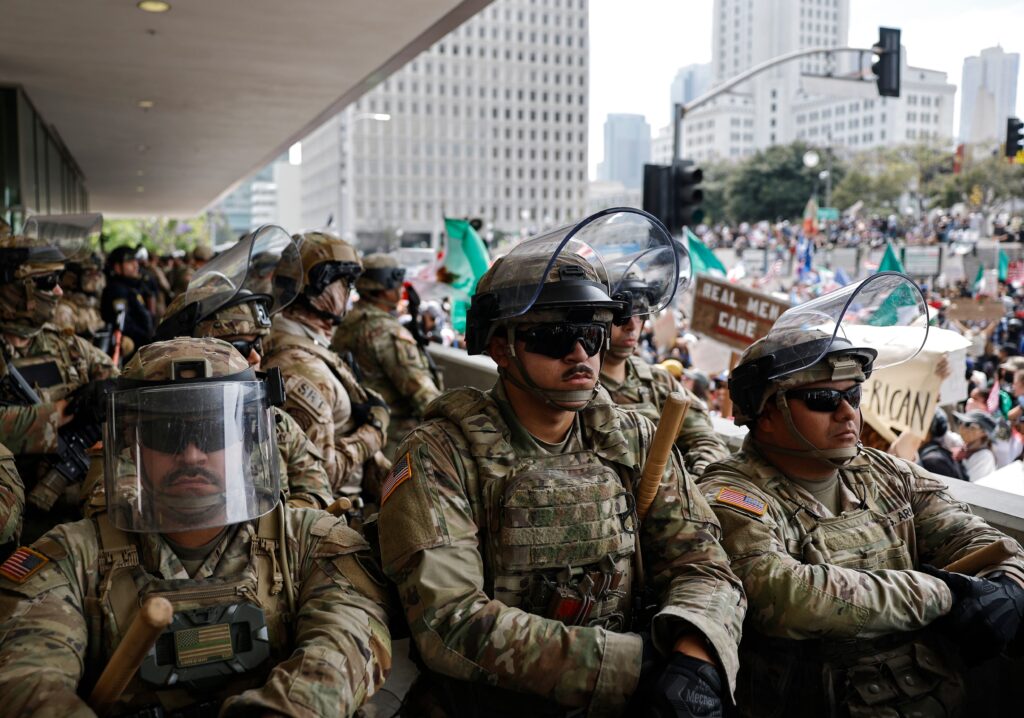
The politicization of coercive capacity is the most dangerous stage because it creates the potential for force to become a partisan instrument. Mature democracies usually have professional armed forces and established legal frameworks to keep them out of politics. A government that seeks partisan leverage therefore tends to expand or repurpose adjacent forces that have weaker oversight, while simultaneously testing the norms that restrain traditional security institutions. The aim is to cultivate a coercive tool that can be deployed domestically under broad pretexts, while normalizing rhetoric that frames political opponents as internal enemies. Even if the worst-case scenario does not materialize, the normalization of such rhetoric corrodes civil-military trust and raises the baseline level of fear in civic life.
At some point, legal and constitutional boundaries become obstacles rather than guardrails. The executive begins to treat legislative appropriations and statutory constraints as suggestions, invoking emergency frameworks or creative interpretations to bypass normal procedures. This is not merely a separation-of-powers dispute; it is a change in the hierarchy of authority, a move toward governance by unilateralism that erodes the principle that major state actions should be authorized, reviewable, and reversible through democratic mechanisms.
Each of these moves can be defended by the incumbent as a response to hostility, corruption, or national crisis. The deeper reality is that they restructure competition. They are not policy decisions in the conventional sense; they are regime decisions.
The Real Currency of Authoritarian Drift Is Anticipation?
Authoritarian systems do not rely only on repression. They rely on prediction. The most effective intimidation is the intimidation that never needs to be carried out, because institutions internalize the threat and adjust their behavior accordingly. This is why the most telling indicator of regime change is not the number of arrests or the number of violent incidents. It is the pattern of anticipatory obedience.
Once fear becomes credible, civic life shifts in subtle ways that are difficult to measure but easy to feel. Journalists avoid stories that will provoke lawsuits or regulatory retaliation. Editors soften language, not because they are convinced, but because they are managing risk. Donors reduce support for controversial causes, not because they changed beliefs, but because they fear audits, investigations, or public targeting. Law firms decline cases that might jeopardize lucrative contracts or security clearances. Universities limit protest rights and dismantle programs that attract political scrutiny. Corporate leaders keep their heads down and quietly advise employees to avoid public statements. Politicians who would normally speak plainly begin to hedge, because they anticipate retaliation that could affect their family, their donors, their committees, or their state’s federal funding.
This process is contagious. Each accommodation increases the isolation of those who resist, making resistance more expensive and accommodation more rational. The state does not need to coerce everyone; it needs only to coerce enough people to make everyone else cautious. Over time, the opposition remains formally legal, but its practical capacity declines, and the public sphere becomes more timid. That timidity then becomes evidence, in the eyes of the incumbent, that the crackdown is working and can be expanded.
The political field tilts not only because the state attacks opponents, but because private actors withdraw from supporting them. The withdrawal is framed as prudence, as neutrality, as a desire to avoid “politics.” In practice, it is a transfer of power to the incumbent, because neutrality under asymmetric pressure is not neutral. It is compliance.
This is the point at which societies often misjudge their situation. Citizens look around and see that elections still happen and courts still exist, so they assume the system remains intact. They overlook the fact that the purpose of competitive authoritarianism is precisely to preserve those forms while changing how they function. The regime does not need to abolish elections if it can shape the conditions under which elections are fought. It does not need to abolish courts if it can influence which cases are brought, which lawyers dare to represent plaintiffs, and which rulings are implemented.
In this model, the decisive battle is psychological and organizational. The incumbent aims to persuade opponents that resistance is futile or too costly, thereby converting dissent into private resentment rather than collective action. The opposition’s central task is to keep the channels of contestation alive by refusing demobilization.
The Competence Tax and the Geopolitical Cost
A state that governs through intimidation imposes a tax on its own competence. That tax is paid in several currencies: talent, information, time, trust, and institutional memory. Over time, it reduces the quality of decision-making and increases strategic error.
Talent drains first. Highly skilled professionals are less willing to enter public service when they suspect that career survival depends on political loyalty rather than performance. Experienced officials retire early or leave for the private sector. Remaining staff become risk-averse, avoiding decisions that could attract political attention. The result is a bureaucracy that is both less capable and less willing to confront reality.
Information degrades next. In any complex system, leaders need bad news early. They need dissenting analysis. They need competing views inside agencies. When officials fear retaliation for delivering inconvenient facts, they filter their reports. They avoid contradicting the executive’s narrative. Intelligence becomes politicized, not necessarily through crude orders, but through the subtle selection of which assessments reach the top and which analysts are promoted. The leadership then begins to operate inside a self-created information bubble, making decisions that feel decisive but rest on distorted data.
Time is then wasted on factional warfare. Agencies spend resources on investigations that are politically motivated, on legal battles that are avoidable, and on public messaging designed to justify controversial moves. Legislative relations become permanently adversarial, leading to policy whiplash and administrative chaos. The state’s ability to execute complex projects declines, whether in infrastructure, public health, procurement, or military modernization.
Trust collapses in parallel. Citizens stop believing that the law is applied fairly. Businesses stop believing that regulations are predictable. Foreign partners stop believing that commitments will survive domestic political cycles. Within the security apparatus, even small signs of politicization can erode confidence in leadership and undermine cohesion. The long-term effect is a society that becomes harder to govern without coercion, which then encourages more coercion, reinforcing the cycle.
The geopolitical consequences are not abstract. Allies plan on timelines that exceed electoral cycles. They need continuity in military planning, intelligence sharing, sanctions coordination, and crisis response. When U.S. policy becomes volatile and institutions appear captured by factional interests, allies hedge. Hedging can take the form of independent procurement, diversification of supply chains, alternative diplomatic channels, or cautious engagement with rival powers. This is not betrayal; it is risk management. It is also strategically costly for the United States, because hedging reduces the leverage that comes from unified coalitions.
Rivals, for their part, exploit domestic dysfunction by encouraging it, amplifying polarizing narratives, and presenting themselves as stable alternatives. They do not need to defeat the United States militarily to weaken it; they can simply let it exhaust itself. A government consumed by internal retaliation politics loses bandwidth for grand strategy. It becomes reactive. It mistakes symbolic gestures for durable outcomes. It overuses economic coercion and underinvests in coalition building. It escalates rhetoric, then struggles to follow through. Over time, the gap between American power and American performance widens.
Soft power also declines, not because other societies are naive about American contradictions, but because credibility depends on the ability to claim that rules constrain power. When the world sees the state used as a weapon against domestic critics, American appeals to rule-based order abroad sound instrumental. The narrative of democracy versus authoritarianism becomes harder to sustain when the methods of governance at home resemble the methods Washington condemns elsewhere.
Why Reversal Remains Possible and Why It Is Not Automatic?
The existence of institutional arenas for contestation is precisely what distinguishes competitive authoritarianism from closed dictatorship. Courts can still rule against the government. Elections can still produce defeats. Federal systems can still protect alternative centers of power. Civil society can still mobilize. The question is not whether these arenas exist in theory, but whether the opposition has the organizational strength and collective courage to use them under pressure.
Reversal remains possible for several reasons that are structural, not sentimental. Decentralized governance limits the executive’s ability to monopolize power quickly. An independent-minded judiciary, even if imperfect, can delay or block certain abuses and force transparency. A large and diverse media environment makes full narrative control difficult. A wealthy and organizationally dense civil society can fund litigation, mobilize voters, and build networks of resistance. A major opposition party provides a vehicle for national contestation, reducing fragmentation that often weakens oppositions in hybrid regimes.
Yet none of these advantages enforce themselves. They can be neutralized by demobilization. Demobilization occurs when citizens withdraw out of fear, exhaustion, or resignation. It occurs when donors decide it is safer to stop funding democracy defense. It occurs when lawyers decide it is safer to avoid politically sensitive clients. It occurs when talented candidates decide it is safer not to run. It occurs when media outlets decide it is safer to self-censor. The regime does not need to close every channel of contestation; it needs only to make using those channels costly enough that participation declines.
This is why complacency and fatalism are equally dangerous. Complacency treats the warning signs as normal politics and delays a coordinated response until institutional damage becomes harder to repair. Fatalism treats the situation as irreversible and persuades people that participation is pointless. Both attitudes deliver the same outcome: reduced resistance and increased room for further state capture.
If democratic recovery occurs, it will not occur through one heroic institution saving the republic. Courts matter, but courts depend on plaintiffs, lawyers, and enforcement. Elections matter, but elections depend on turnout, organization, and protection against intimidation. Civic protest matters, but protest depends on discipline, scale, and a message that enlarges rather than narrows the coalition. Each arena supports the others. None substitutes for the others.
The strategic center of gravity is coalition maintenance. In periods of democratic stress, the opposition must treat the defense of rules as a prior condition for the defense of policy preferences. That requires an uncomfortable breadth. It requires alliances between groups that may disagree profoundly on economics, culture, or foreign policy but agree on the principle that the state should not be weaponized against political competition. Such alliances are rarely inspiring. They are often messy, and they demand compromise. They are nonetheless the only realistic path to restoring rule-bound governance, because authoritarian drift feeds on fragmentation.
The Repair Problem After Any Electoral Victory
Even if the opposition wins elections and forces a change in leadership, the deeper problem remains: what prevents recurrence. A society that survives a democratic scare often makes a predictable mistake. It celebrates the survival and then tries to return to normal without reforming the vulnerabilities that allowed the scare to develop. In systems where constitutional rules grant large discretionary power to the executive, where emergency authorities are broad and loosely defined, where civil service protections can be circumvented, and where regulatory agencies can be pressured through appointments and budgets, the same dynamics can return under a future leader with similar instincts.
The repair agenda therefore matters as much as the electoral agenda, and it needs to focus on incentives and guardrails rather than moral lectures. The question is how to reduce the capacity of any administration to weaponize state instruments for partisan retaliation.
That begins with clarifying emergency powers, tightening the definitions that allow routine policy to be framed as national emergency, and strengthening legislative oversight of extraordinary measures. It requires reinforcing the independence of investigative and enforcement agencies through appointment procedures that limit direct political control and removal standards that cannot be manipulated casually. It requires protecting inspectors general and ensuring they have the resources and authority to investigate misconduct without fear of budgetary retaliation. It requires transparency mechanisms that make selective enforcement easier to detect and challenge. It requires election administration protections that limit intimidation and preserve broad access to voting. It requires reforms that address the vulnerabilities created by polarized media ecosystems and concentrated ownership, not through censorship, but through competition policy, transparency, and support for independent journalism.
None of these reforms are glamorous, and that is precisely why they are essential. Competitive authoritarianism advances through administrative detail. Democratic recovery must therefore take administrative detail seriously.
A Final Note on Power and Self-Respect
A state that cannot restrain itself domestically will struggle to lead internationally. The United States has long benefited from a reserve of credibility rooted not in perfection, but in the claim that rules constrain power and that institutions can correct abuses. When a government uses the state as a weapon against domestic rivals, it spends that reserve quickly. It also spends something less quantifiable but equally valuable: the confidence of citizens that public institutions belong to them rather than to a faction.
The most effective authoritarian strategy is not to crush all opponents, which is costly and risky, but to persuade them to retreat. Retreat looks rational in the moment, especially for organizations that must protect employees, budgets, and long-term survival. Yet widespread retreat becomes a collective defeat, because it leaves the field to those who view state power as a private instrument.
A society does not need every citizen to be brave to resist authoritarian drift. It needs enough citizens and institutions to keep contestation alive, to refuse the conversion of fear into silence, and to treat elections, courts, and civic action as mutually reinforcing tools rather than as substitutes. The contest is not a dramatic showdown; it is a prolonged struggle over whether public life will be governed by rules or by retaliation.
The outcome remains open in any system where competition still exists. What closes the outcome is not inevitability but surrender.