China’s battery advantage rests on control of the industrial stages where raw materials acquire strategic value. Lithium ore, nickel-bearing rock and natural graphite cannot be placed directly inside a battery. They must be refined into chemicals of extreme purity, converted into active materials, coated onto metal foils, assembled under controlled conditions and tested through thousands of production cycles. China has built capacity across nearly every one of these stages.
That industrial concentration gives Beijing three kinds of influence.
First, Chinese producers can use scale and low prices to determine which foreign competitors survive. Second, control of processing technology and production machinery can restrict the ability of other countries to establish independent factories. Third, the expansion of Chinese battery companies into electricity storage, transport, shipping and data-centre power systems creates long-term dependence on Chinese equipment, maintenance and operational software.
The central strategic question is therefore the distribution of production knowledge across the battery chain. Access to mineral deposits matters, but deposits create limited leverage when another country controls the refining plants, active-material factories, production equipment and largest customers. The countries trying to reduce their exposure to China need viable industrial capacity at the main bottlenecks. Building identical battery factories in every allied country would waste public money and leave important material and machinery gaps untouched.
China produced more than 80 per cent of global battery cells in 2025. It also produced about 85 per cent of the material used in positive electrodes and more than 90 per cent of the material used in negative electrodes. Its share of the entire lithium-ion supply chain stood close to 80 per cent. The global market exceeded $150 billion in 2025, while stationary battery deployment grew faster than the electric-vehicle market.
These figures describe an integrated industrial position rather than dominance in a single commodity. China’s leading companies can source processed materials domestically, purchase machinery from nearby suppliers, test new cell designs with Chinese automakers and deploy storage systems through Chinese electricity companies. When a production problem appears, the material supplier, machine manufacturer and cell producer may all operate within the same industrial region. This reduces costs and shortens the time required to improve a factory.
The United States, Europe, Japan and South Korea retain important parts of the chain. Their capabilities remain separated by national borders, corporate rivalries and incompatible subsidy programmes. Europe has chemical companies, automobile manufacturers and a large market. Japan has advanced materials and precision machinery. South Korea has experienced cell manufacturers. The United States has research laboratories, software companies, defence demand and capital. None has yet connected these strengths into a supply system capable of matching China’s speed and cost.
Lithium is important, but it is not the hardest bottleneck
Lithium attracts political attention because it appears in the name of the battery. Its geological distribution is broader than the geography of battery manufacturing.
World lithium production reached approximately 290,000 tonnes of contained lithium in 2025, an increase of 31 per cent from the previous year. Batteries consumed about 88 per cent of total lithium use. Production came from Australian hard-rock mines, South American brines, Chinese mines and a growing group of projects in Africa and North America. The market has repeatedly moved between fears of shortage and periods of oversupply.
Lithium still requires several industrial transformations. Australian ore is commonly concentrated and shipped abroad. It must then be converted into lithium carbonate or lithium hydroxide, purified and matched to a particular positive-electrode chemistry. A mine can take years to qualify its product with chemical processors and battery companies. Minor impurities can damage battery performance.
China invested heavily in this chemical-conversion stage. It processes material from its own mines and from suppliers in Australia, Argentina, Chile, Zimbabwe and other producing states. This allows Chinese companies to influence lithium markets without owning every deposit.
Australia’s experience illustrates the problem. It is one of the world’s largest lithium miners, yet much of the higher-value processing and cell manufacturing takes place elsewhere. Australia receives mining income while Chinese and East Asian companies capture greater value from chemical conversion, active materials and finished batteries.
Chile and Argentina occupy a stronger resource position because of the scale and quality of their brines. They still face the same industrial difficulty. Producing lithium carbonate does not automatically create a domestic positive-electrode industry. That requires chemical suppliers, electricity, specialised equipment, skilled workers, customers and years of product qualification.
Lithium diversification is achievable because deposits and projects are spread across several continents. The strategic weakness lies in processing concentration and the dependence of new projects on Chinese customers, capital and technical services.
Graphite gives China greater leverage
Graphite receives less public attention even though conventional lithium-ion batteries use considerably more graphite than lithium by weight.
Graphite forms most of the negative electrode in today’s batteries. Natural graphite must be mined, purified, shaped into small spherical particles and coated. Synthetic graphite is made from carbon-rich industrial feedstocks at very high temperatures. Both routes require specialised knowledge and substantial energy.
China produced an estimated 82 per cent of the world’s natural graphite in 2025. It held an even larger position in purified spherical graphite, synthetic graphite and finished negative-electrode material. The International Energy Agency estimates that China controls around 97 per cent of global capacity for negative-electrode materials.
The United States produced no natural graphite in 2025 and depended entirely on imports. Its imports of natural and synthetic battery-grade negative-electrode material rose sharply during that year. China supplied 55 per cent during the first eight months, while Indonesia and South Korea supplied the remainder. Some of the material arriving from Indonesia and South Korea was itself linked to Chinese companies or Chinese processing technology.
New mines in Mozambique, Tanzania, Madagascar, Canada, Brazil and the United States can reduce dependence on Chinese extraction. The greater challenge is processing. Battery manufacturers require graphite with a controlled particle shape, purity, coating and surface behaviour. Qualification can take several years. A producer may possess an excellent deposit and still fail to satisfy the technical requirements of a large cell manufacturer.
Graphite has already entered economic statecraft. China introduced export controls covering selected graphite products and later extended controls into battery materials and production technology. The measures allow Chinese authorities to delay licences, restrict particular customers or preserve the most advanced processes for domestic use.
This makes graphite one of the clearest cases where allied battery policy has focused on the wrong part of the chain. Financing a cell factory while continuing to import nearly all of its negative-electrode material creates local assembly, not a secure industry.
Indonesia has become the centre of the nickel economy
Nickel remains important for batteries requiring high energy density. It is used in positive electrodes for long-range electric cars, aircraft applications and some military systems. Its supply structure has changed rapidly because of Indonesia.
World nickel mine production reached approximately 3.9 million tonnes in 2025. Indonesia produced around 2.6 million tonnes, close to two-thirds of the world total. China produced 120,000 tonnes. Australia produced only 45,000 tonnes after several mines were placed into care and maintenance because of low prices. Indonesian expansion contributed to a persistent market surplus and placed severe pressure on higher-cost producers.
Indonesia created this position by restricting exports of unprocessed ore and requiring companies to invest in domestic processing. Chinese firms supplied capital, construction, equipment and technical knowledge. Large industrial parks now combine mines, smelters, chemical plants, ports and power stations.
Producing battery-grade material from Indonesian laterite ore is technically demanding. The process commonly involves high-pressure acid leaching, which uses heat, pressure and sulphuric acid to extract nickel and cobalt. The resulting intermediate product must undergo further refining before it becomes suitable for a battery.
Indonesia has gained employment, infrastructure, tax revenue and greater influence over the nickel market. Chinese companies have gained secure access to ore and control over much of the processing. The arrangement has shifted industrial activity into Indonesia without substantially weakening China’s position in the battery chain.
A nearly $6 billion project led by China’s largest battery company began construction in Indonesia in 2025. It covers nickel mining, processing, battery materials, cell production and recycling. The project extends across more than 2,000 hectares and is designed as a complete industrial chain.
This model has geopolitical consequences. Indonesia can negotiate with China, the United States, Japan and South Korea, but its existing industrial base is deeply connected to Chinese companies. Western trade rules that exclude Chinese-linked materials can place Jakarta in a difficult position. Indonesia wants access to Western markets without dismantling the partnerships that created its processing industry.
The nickel surplus also shows how industrial concentration can remove competitors. Indonesian production pushed prices low enough to damage Australian mines and projects elsewhere. Once alternative mines close, supply becomes more concentrated. The process can occur through ordinary market competition without an explicit political decision by Beijing or Jakarta.
Congo controls cobalt ore, while China controls its route to market
The Democratic Republic of the Congo produced about 230,000 tonnes of cobalt in 2025, equal to 73 per cent of global mine output. Indonesia produced another 44,000 tonnes, or 14 per cent. Two countries therefore supplied almost seven-eighths of mined cobalt.
Congolese authorities temporarily banned exports in 2025 after oversupply pushed prices downward. The government later introduced quotas allowing up to 96,600 tonnes of exports annually in 2026 and 2027, including 9,600 tonnes reserved for national strategic stocks. This was an attempt to use the country’s market position to influence prices and retain greater control over production.
Congo’s leverage remains incomplete. Much of the mining sector depends on foreign companies. China is the leading producer of refined cobalt and the main consumer through its battery industry. Congolese ore therefore enters a chain in which Chinese refiners and manufacturers hold considerable purchasing power.
Battery chemistry is also reducing cobalt demand. Lithium iron phosphate batteries contain no cobalt. Producers of nickel-rich batteries have lowered cobalt content to reduce cost and supply risk. Cobalt will retain importance in aircraft alloys, jet engines, high-performance batteries and defence equipment, although its future may involve smaller and more specialised markets.
Congo faces a difficult strategic choice. Restricting supply may raise prices and government revenue. High prices also encourage battery manufacturers to use less cobalt. Expanding production may preserve market share while depressing national income. Building domestic refining and precursor production would capture greater value, but those industries require electricity, infrastructure, chemical inputs and guaranteed customers.
The country possesses geological power without equivalent industrial power. China’s position is stronger because its refiners can buy from Congo, Indonesia and recycling networks and then sell into a very large domestic manufacturing market.
Battery chemistry determines which countries gain leverage
The battery industry does not depend on one fixed mixture of minerals. Manufacturers choose among different chemistries according to cost, weight, safety, charging speed, operating temperature and lifespan. Each change redistributes geopolitical demand.
Lithium iron phosphate uses lithium, iron and phosphate in the positive electrode. It avoids nickel and cobalt. It is thermally stable, relatively inexpensive and capable of a long operating life. Its lower energy density makes it less attractive when weight and space are extremely important.
Around 90 per cent of new battery-storage capacity installed in 2025 used lithium iron phosphate chemistry. Global storage additions reached 108 gigawatts during that year, 40 per cent above 2024. This chemistry has become the standard choice for electricity grids because storage projects care more about price, safety and repeated cycling than about vehicle weight.
China dominates lithium iron phosphate production. Its position covers positive-electrode powder, cell production, storage containers and complete project integration. Chinese companies also spent years improving cell-to-pack engineering, which reduces the inactive material surrounding cells and compensates for part of the chemistry’s lower energy density.
The rise of lithium iron phosphate weakened the market position of South Korean and Japanese manufacturers. Their international businesses were built mainly around nickel-rich batteries for American and European carmakers. Those products retain value in premium vehicles, but they struggle to compete in lower-priced cars and stationary storage.
South Korean companies are now developing lithium iron phosphate plants. They remain exposed to Chinese supplies of graphite, purified phosphoric acid, manufacturing equipment and other materials. A cell labelled as Korean or European can therefore contain several strategically important Chinese inputs.
Lithium manganese iron phosphate adds manganese to the chemistry. It can raise voltage and energy density while preserving much of the cost and safety advantage. Its commercial success depends on controlling manganese dissolution and maintaining long battery life. China’s strength in battery-grade manganese chemicals gives its producers another head start.
Nickel-manganese-cobalt batteries store more energy for a given weight and volume. They remain important for long-range vehicles, aviation, premium products and defence systems. Their material cost is higher, and nickel-rich versions demand strict control of moisture, coatings, electrolytes and temperature.
Sodium-ion batteries replace lithium with sodium. They can also replace graphite with hard carbon. Sodium is widely available, and some designs reduce dependence on several critical minerals. The chemistry has lower energy density than the leading lithium-ion products, though it performs well in cold conditions and can suit stationary storage, short-range vehicles and lower-cost applications.
Sodium-ion manufacturing uses many of the same production stages as lithium-ion manufacturing. Existing mixing, coating, rolling and assembly equipment can be adapted. This makes commercial expansion easier than a move to a completely different battery architecture.
China controls more than 95 per cent of announced sodium-ion production capacity through 2030. A chemistry promoted as an answer to lithium dependence may therefore reinforce Chinese industrial influence.
Silicon-enhanced negative electrodes provide another route. Adding silicon can increase the amount of energy stored and reduce graphite consumption. Silicon expands considerably during charging, which can crack the electrode and shorten battery life. Manufacturers are developing silicon-carbon composites, specialised binders, porous structures and additional lithium treatments to manage the problem.
The United States and South Korea retain useful positions in silicon-based materials. The technology can enter existing factories with modifications, giving it better commercial prospects than some more radical battery designs.
Solid-state batteries replace most or all of the flammable liquid electrolyte with a solid material. They may permit the use of lithium metal and achieve higher energy density. Production remains difficult. Solid electrolytes can be brittle, sensitive to moisture or unable to maintain stable contact with the electrodes. Factories may need new equipment for material production, pressure control, stacking and sealing.
Japan has invested heavily in this field, as have South Korea, China, the United States and Europe. Patents and prototypes do not guarantee industrial leadership. The leading country will need to produce cells at high yield, prove long life, control cost and build enough capacity to qualify with major customers.
The manufacturing process contains the real industrial knowledge
A battery factory is frequently described through its annual production capacity. That number says little about whether the factory can produce reliable cells at a competitive cost.
The process begins with active materials. For a nickel-rich positive electrode, nickel, manganese and cobalt chemicals are combined into precursor particles. Their size, shape and internal structure must be tightly controlled. The precursor is mixed with a lithium compound and heated. Temperature variation, contamination or excess moisture can damage performance.
Lithium iron phosphate powder requires a different process. Lithium, iron and phosphate sources are combined, heated and coated with conductive carbon. The material conducts electricity poorly without careful particle design and coating. Possession of iron and phosphate resources does not provide the ability to make high-performance battery powder.
The active material is mixed with conductive additives and a binding substance to form a paste. This paste is coated onto aluminium foil for the positive electrode and copper foil for the negative electrode. The coated foil passes through long drying ovens and is compressed between rollers to control thickness and porosity.
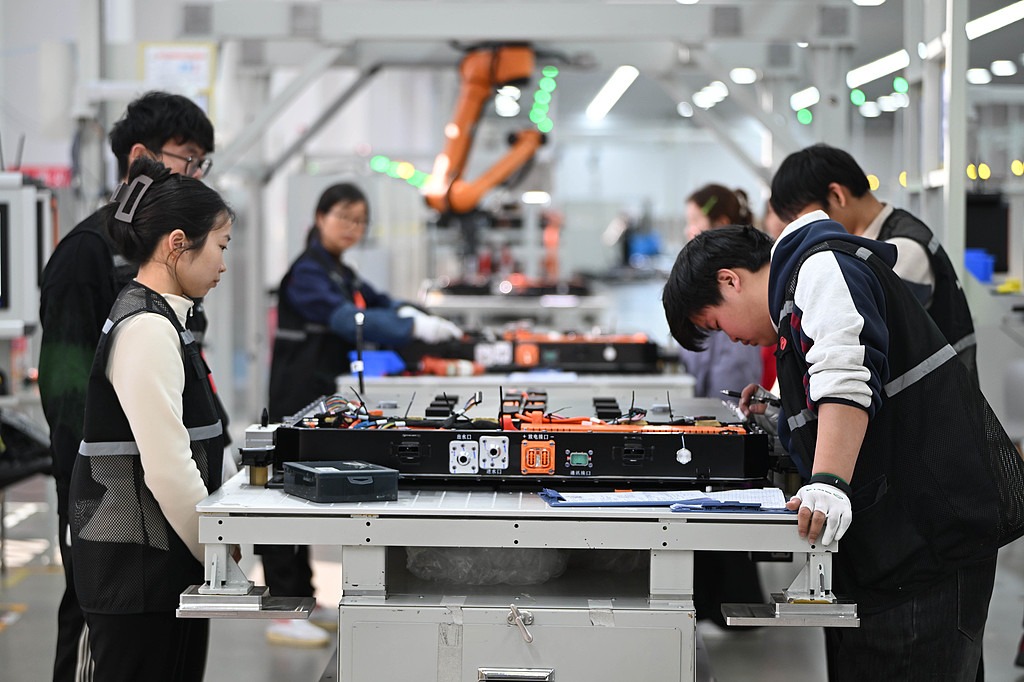
The electrodes are cut, stacked or wound together with a thin separator. Electrolyte is injected, and the cell is sealed. Assembly takes place in extremely dry rooms because very small amounts of water can react with battery chemicals and shorten cell life.
New cells then undergo controlled charging and discharging. This stage creates protective layers on the electrode surfaces and reveals defects. It occupies expensive equipment and ties up inventory for days or weeks. Poor control during this stage can reduce battery life even when the cell appears normal at the end of the production line.
A new factory can produce large quantities of defective material while engineers adjust coating speed, drying temperature, pressure, humidity and charging procedures. High scrap rates raise the cost of every good cell. This explains why factory announcements and theoretical capacity provide a misleading picture of industrial strength.
China’s advantage comes partly from accumulated production. Its companies have manufactured enormous volumes, collected operating data and trained large numbers of engineers. Machinery suppliers work closely with material and cell companies. A fault can be traced across several production stages more quickly than in a factory dependent on distant foreign suppliers.
Production machinery has become part of the geopolitical contest. Japanese companies have strong positions in coating, precision measurement and specialised equipment. South Korean suppliers expanded with Korean cell manufacturers. Chinese machinery companies increasingly provide complete and highly automated production lines at lower cost.
New methods may change factory economics. Dry-electrode manufacturing attempts to apply active powder to metal foil without creating a liquid paste. This can remove large drying ovens and solvent-recovery equipment. Successful dry processing could reduce factory energy use, floor space and capital costs. Achieving uniform coating at commercial speed remains difficult.
Water-based processing replaces toxic organic solvents with water during electrode preparation. It can lower energy use and remove expensive solvent recovery. The main challenge is preventing unwanted reactions and corrosion, particularly with nickel-rich materials. The United States Department of Energy has supported research into thick, water-processed electrodes and solvent-free manufacturing because these processes can reduce production costs and factory complexity.
Artificial intelligence and digital factory systems may improve quality control. Cameras can identify coating defects, while sensor data can connect changes in humidity or temperature with later cell failure. These tools work best in companies with large production datasets and experienced engineers. China’s manufacturing scale gives its leading producers more data with which to train process-control systems.
Overcapacity is part of China’s geopolitical advantage
China’s battery industry has built considerably more production capacity than its domestic market presently requires. This has created severe price competition inside China and pushed companies towards export markets.
Low prices help electric-vehicle buyers and make electricity storage more affordable. They also reduce the revenues available to new producers in Europe, North America and Asia. A new factory normally requires several years to improve yields and reach full output. It enters the market with higher costs just as established Chinese firms are cutting prices.
The result is an industrial attrition process. Weak Chinese companies may fail, but the strongest Chinese producers possess large domestic order books, established suppliers and access to financing. New foreign entrants can run out of money before achieving competitive production.
Europe’s recent policy shift reflects this problem. In June 2026, the European Commission created a €1.5 billion facility offering interest-free loans to help cell manufacturers survive the production ramp-up phase. The design recognises that the most dangerous period comes after a factory is built, when output remains low and scrap remains high.
The European Union has also proposed local-production and resilience conditions under its Industrial Accelerator Act. Foreign investments above €100 million in batteries and other strategic sectors would face requirements intended to generate European employment, skills and supply-chain value.
These measures may preserve some European production. Their success will depend on customer contracts, operating discipline and the selection of viable firms. Protecting every planned factory would leave Europe with expensive and underused plants. Allowing all of them to fail would destroy the engineers and production knowledge already developed.
Japan and South Korea face a struggle to preserve industrial depth
Japan created many of the technologies that made commercial lithium-ion batteries possible. It still has strong material companies, machinery producers and automobile manufacturers. Its cell companies lost market share as production moved towards South Korea and China.
Japan revised its strategy in June 2026 to cover batteries and complete power systems. The government recognised structural oversupply, supply-chain risks and growing demand from artificial-intelligence data centres, medical facilities and disaster-prevention systems. It aims to strengthen domestic production and triple battery-related sales by Japanese companies over ten years.
Japan’s most valuable contribution may come from materials, machinery and system reliability rather than an attempt to outproduce China in ordinary cells. Solid-state batteries, power electronics, control systems and high-precision production equipment offer areas where Japanese firms retain significant knowledge.
South Korea occupies a different position. Its three large battery manufacturers operate plants across Asia, Europe and North America. They have experience satisfying global automobile companies and producing at large scale.
Their weakness lies in chemistry and upstream dependence. Their international expansion concentrated on nickel-rich batteries during a period when lithium iron phosphate was taking a larger share of the market. They buy many processed materials from China and use Chinese equipment in parts of their factories.
South Korea remains the most credible large-scale manufacturing partner for the United States and Europe. Partnerships with Korean companies can bring operational knowledge that Western start-ups lack. Governments should use these partnerships to localise materials, train engineers and develop independent production processes rather than paying only for foreign-owned assembly capacity.
India and Indonesia could shape the next industrial geography
India has introduced an ₹181 billion programme to establish 50 gigawatt-hours of domestic advanced battery-cell capacity. Forty gigawatt-hours had been allocated to selected manufacturers by early 2026. The programme rewards production and domestic value creation rather than simple factory construction.
India offers a large vehicle market, growing electricity-storage demand, engineering companies and competitive manufacturing costs. It lacks mature supply chains for battery-grade materials and commercial cell production.
A strategy based mainly on imported Chinese production lines would create capacity quickly. It would also reproduce dependence in machinery, materials and technical support. Partnerships with Japanese and South Korean companies could create a more diversified structure. India’s scale gives it leverage to demand local supplier development and engineering activity.
Indonesia’s leverage comes from nickel. It is already moving into battery materials and cells. Its position will strengthen if it develops local engineering companies, chemical suppliers and managers capable of operating plants independently. Without this progression, Indonesia may remain an extraction and processing base inside a Chinese-led production system.
The two countries could become complementary. Indonesia can supply nickel-rich materials and develop processing. India can provide a large end market, engineering capacity and vehicle production. Japan and South Korea can contribute machinery, materials and cell-manufacturing knowledge. Such a chain would require political coordination and long-term purchasing contracts.
Electricity storage will carry battery competition beyond cars
Battery strategy was initially organised around electric vehicles. Electricity storage is now becoming a major source of demand.
The world installed 108 gigawatts of new battery-storage capacity in 2025. China added more than 60 gigawatts. The United States and Europe were the other major markets. Batteries are being used to shift solar electricity into evening hours, stabilise grids, provide backup power and reduce expensive periods of peak demand.
Storage systems involve more than cells. They require containers, cooling, fire suppression, inverters, transformers, communications equipment and software that decides when the system charges and discharges. Companies that supply the entire package can maintain a relationship with the customer for twenty years.
Chinese companies are moving rapidly into this complete-system market. Their equipment is attractive because it combines low-cost cells with established engineering and large production capacity. This extends Chinese influence from manufacturing into electricity infrastructure.
Data centres add another dimension. Artificial-intelligence computing requires concentrated and reliable electricity. Batteries can provide backup power, smooth demand and help large facilities connect in regions where grid construction is delayed. Japan’s new battery strategy explicitly links storage systems to artificial-intelligence data centres.
Control systems create security concerns. A battery-storage project may exchange operational data with the supplier, receive remote software updates and rely on proprietary maintenance tools. Critical facilities need the ability to inspect software, operate without a foreign cloud connection and replace control components without changing the entire battery system.
The country that dominates storage systems gains commercial information about electricity demand, battery degradation and grid operation. It also gains influence over technical standards and maintenance practices. These effects become more important as batteries handle a larger share of daily electricity balancing.
Defence demand will preserve specialised battery technologies
Modern military forces use batteries in drones, communications equipment, sensors, portable computing, unmanned ships, vehicles and base microgrids. Military demand places different requirements on the industry.
An inexpensive grid battery can be heavy because it remains in one location. A drone battery must provide as much energy as possible at low weight. Equipment used in northern climates must operate in extreme cold. Military cells may need to tolerate impact, remain in storage for long periods and use control electronics that can be inspected and secured.
Lithium iron phosphate can support bases, vehicles and stationary military power. Nickel-rich and silicon-enhanced cells are more useful when weight matters. Lithium-metal and lithium-sulphur batteries may find early markets in drones and aerospace because military buyers can pay more for lower weight and longer endurance.
Defence procurement can keep specialised production lines alive while commercial markets develop. Stockpiling finished batteries has limited value because cells degrade with age. A stronger strategy would maintain qualified factories, reserve production capacity and store selected materials that can be converted into new cells when demand rises.
This creates another reason to preserve a diverse battery industry. A market driven entirely by the lowest-cost stationary-storage cell will not necessarily produce the batteries required for aircraft, drones or military communications.
The strategic objective should be industrial survivability
Complete battery self-sufficiency would be prohibitively expensive for most countries. A durable strategy requires enough capacity at critical stages to continue production during a trade conflict, military crisis or major supply disruption.
Graphite processing deserves immediate attention because concentration is extreme and substitutes remain limited. Governments should support purification, spherical shaping, synthetic graphite and silicon-enhanced materials rather than financing mines alone.
Positive-electrode policy should follow expected demand. Lithium iron phosphate materials are essential for electricity storage and affordable vehicles. Nickel-rich materials remain important for high-performance applications. Supporting only one chemistry would expose the industry to shifts in technology and mineral prices.
Production machinery should receive the same security status as minerals. A country that cannot maintain coating machines, dry rooms, formation equipment and quality-control systems cannot operate an independent cell industry.
Public support should follow measurable production. Companies should receive assistance as they improve yield, reduce scrap and qualify products with customers. Large payments made when construction begins encourage exaggerated factory plans.
Foreign investment agreements should require training, local engineering, supplier development and access to operational data. A foreign-owned factory that imports materials, machinery, software and technical staff adds output but transfers little industrial power.
Allied cooperation needs a practical division of labour. Australia, Canada, Chile, Argentina and selected African producers can diversify mineral supply. Indonesia can provide nickel processing. Japan can contribute materials and equipment. South Korea can provide cell-manufacturing experience. Europe can supply chemical engineering, vehicles and a large regulated market. The United States can support advanced technology, software, defence procurement and commercial scale. India can provide manufacturing growth and a major future market.
The battery contest will be decided through the survival of these capabilities during the present period of low prices and excess capacity. China can accept thin margins because battery manufacturing supports its automobile industry, electricity system, export strategy and technological policy. Its competitors continue to treat batteries as separate mining, climate or automobile programmes.
That institutional separation leaves the main Chinese advantage intact. China manages the chain as an industrial system. Any serious alternative will have to do the same.