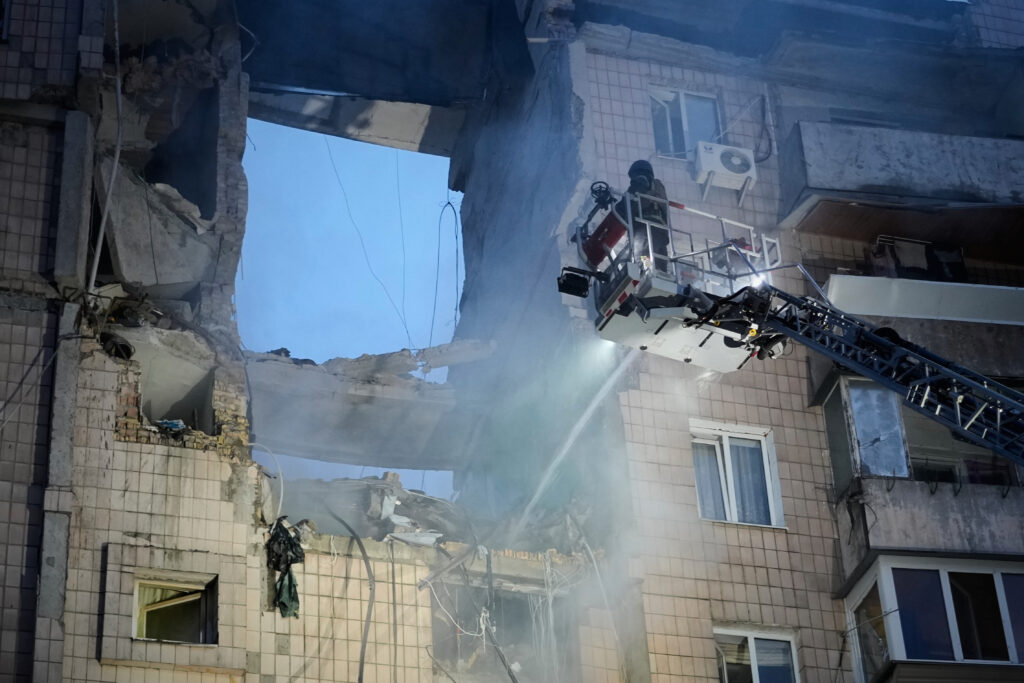
In the first week of July 2026, Russia carried out three major attacks on Kyiv. The largest involved 74 missiles and almost 500 drones. A second barrage included 23 ballistic missiles, none of which Ukrainian forces reported intercepting. These attacks were unusually deadly, but the size of the strike packages was no longer exceptional. By this stage of the war, launches involving several hundred unmanned aircraft had become a recurring feature of Russian operations.
The growth in launch numbers has changed the nature of the campaign. Russia is no longer relying mainly on limited stocks of cruise and ballistic missiles to strike a list of high-value facilities. It can now place much of Ukraine under recurring aerial pressure. Large numbers of Shahed-type aircraft and decoys keep air-defence crews active, expose gaps in coverage and create opportunities for faster missiles to reach selected targets.
Counting weapons, however, does not explain the full effect. A drone that damages one transformer may interrupt water pumping, railway signalling, industrial production and communications in the same district. A strike on a locomotive affects more than the train that was hit. It can remove scarce traction capacity from the network, delay freight and force the railway to reorganise crews and rolling stock. Damage at a port may remain physically limited while still increasing insurance costs, vessel delays and the price of moving grain to market.
Russia’s campaign is best understood through these connections. The relevant unit is not the individual building or vehicle. It is the service that depends on it, the alternatives available after it is damaged, and the time required to restore normal operation.
The strike package
Russian long-range attacks now combine several weapons with different purposes. Shahed-type drones provide mass. Decoys add uncertainty. Cruise missiles approach from more than one direction and can change course. Ballistic missiles give defenders only a short period to respond and require specialised systems such as Patriot for a realistic chance of interception.
In April 2026, Russia launched 6,583 Shahed-type aircraft according to data compiled from Ukrainian Air Force reporting. Of these, 4,335 were identified as strike variants. Three attacks during the month involved more than 600 Shahed-type aircraft. The total increased again in May, when 8,161 were reported. These figures included decoys and other unmanned aircraft, so they should not be read as 8,161 explosive warheads. They still describe the scale of the detection and allocation problem faced by Ukrainian air defence.
The familiar comparison between a cheap drone and an expensive surface-to-air missile only captures part of the burden. Ukraine does not use a Patriot interceptor against every Shahed. Mobile firing groups, electronic warfare, anti-aircraft guns, aircraft and interceptor drones are also used. The expense lies in maintaining the entire defensive network.
Radars must operate across a large area. Crews must remain dispersed and ready. Mobile units need vehicles, ammunition, communications and fuel. Electronic-warfare systems have to be positioned without leaving important corridors uncovered. Every incoming track must be assessed, even when it later proves to be a decoy. Russia can also alter routes and altitudes once a defensive pattern becomes predictable.
The problem becomes more severe when drones and missiles arrive together. A Shahed wave can occupy local defences while cruise missiles approach from another direction. Ballistic missiles may then be directed at targets for which there are few suitable interceptors. The July attacks on Kyiv showed the difference clearly: Ukraine reported destroying most of the incoming drones in one barrage while failing to intercept the ballistic missiles.
This means that Russia does not have to destroy the whole air-defence system. It can obtain an operational advantage by creating more simultaneous demands than the available systems can meet. Ukrainian commanders must decide which cities, power facilities, military sites and transport routes receive the strongest coverage. Defending one area can therefore increase exposure somewhere else.
Ukraine is trying to move the cheaper threats into a cheaper defensive layer. Its Unmanned Systems Forces report that interceptor drones are now being used systematically against incoming Shaheds, reducing reliance on conventional surface-to-air missiles. This may improve the cost ratio, although it does not solve the ballistic-missile problem or guarantee protection against very large mixed attacks.
What happens when the grid is hit repeatedly
Ukraine’s electricity system is a national network of generating stations, high-voltage lines, substations and regional distribution equipment. Damage to any one category produces a different result.
A strike on a power plant reduces generation. Damage to a large transmission substation may prevent electricity from moving from an operating plant to the regions that need it. Distribution damage produces more localised outages. When several parts of the system are hit within a short period, operators have fewer routes for balancing supply and demand.
The attack of December 13, 2025, showed how these effects can spread. Russia launched more than 450 drones and 30 missiles, concentrating much of the attack on southern energy infrastructure. More than one million households across Ukraine lost power. Odesa also suffered serious interruptions to water supply, while electricity was lost in parts of Mykolaiv and government-controlled Kherson.
The timing mattered. Electricity demand rises during cold weather, while heating, water pumping and communications become more dependent on a stable supply. A system operating with damaged transformers and reduced generation also has less reserve capacity to absorb another attack.
The winter campaign continued after December. The UN Human Rights Monitoring Mission reported that Russian forces carried out near-daily attacks on energy infrastructure during January 2026, including five large attacks covering several regions at once. Damage was recorded in at least 17 regions and Kyiv. By January, strikes since the previous October had affected at least 20 regions, and rolling outages in some places were reported to last as long as 18 hours per day.
These outages had effects outside the electricity sector. Heating systems stopped or operated intermittently. Water and sewage services were interrupted. Hospitals, schools and businesses depended on backup power. Generators reduced the immediate consequences, although they introduced a new requirement for fuel, maintenance and replacement parts.
Transmission damage also affected nuclear generation. Ukraine’s operating nuclear plants depend on external grid connections to transmit electricity and maintain safe operating conditions. The International Atomic Energy Agency reported repeated attacks affecting substations and power lines connected to nuclear facilities. Between October 2025 and February 2026, the agency recorded 21 waves of air attacks at substations it was monitoring. Damage to the 750-kilovolt Dniprovska line in March 2026 left the Zaporizhzhia nuclear plant dependent on a single 330-kilovolt backup connection for several months.
The military effect of these attacks is difficult to separate from the civilian damage. Electricity supplies arms production, railway operations and military communications. The same grid also supplies homes, hospitals and municipal services. A facility’s connection to military activity does not automatically make every attack against it lawful. International humanitarian law still requires an assessment of whether the particular facility is a military objective, whether expected civilian harm is excessive in relation to the anticipated military advantage, and whether feasible precautions have been taken.
The physical damage is only one part of the pressure on the grid. Repair teams have to work during air alerts and may return several times to the same site. Large transformers cannot always be replaced quickly. Spare equipment has to be stored, moved and protected. Imported electricity can cover part of a deficit, but cross-border capacity is limited. Small generators can support individual buildings without replacing the high-voltage network needed by industry and railway traction.
For these reasons, the campaign has produced a contest over restoration time. Russia benefits when new damage occurs before previous repairs are complete. Ukraine benefits when operators can isolate the damaged area, redirect power and restore basic service before the next large attack.
Railways, ports and the movement of the economy
Ukraine’s railway carries military supplies, civilian passengers, fuel, industrial materials and export cargo. The network has remained functional throughout the war, but Russian targeting became more systematic from the second half of 2025.
The attacks have increasingly focused on assets that are difficult to replace quickly, including locomotives, electrical equipment, depots and signalling infrastructure. By July 4, 2026, Ukrainian officials said that more than 200 locomotives had been damaged or destroyed since the beginning of the year. In one attack on June 25, three locomotives were hit and a driver was killed.
Locomotives are attractive targets because destroying track is often temporary. Railway crews can replace rails, clear debris or route traffic around a damaged section. Traction capacity is harder to restore when repeated strikes remove locomotives and trained crews.
The economic effects appear before the network stops operating. Fewer locomotives reduce scheduling flexibility. Trains may wait longer, travel by indirect routes or operate with less capacity. Repair costs add to the railway’s financial problems, while higher freight charges are passed to agricultural and industrial exporters. Ukrzaliznytsia sought a large tariff increase in 2026 after intensified attacks contributed to its funding difficulties. Steel and agricultural producers warned that higher transport costs would weaken their ability to compete in foreign markets.
The rail campaign is closely connected to attacks on the Black Sea ports. The ports of Odesa, Chornomorsk and Pivdennyi require functioning rail access, electricity, cranes, storage facilities and navigation services. An attack does not have to block a harbour entrance to reduce throughput. Damage to a substation, warehouse or railway approach may be enough to slow operations.
The wording used for Ukraine’s maritime exports also matters. The UN-brokered Black Sea Grain Initiative ended in July 2023. Ukraine then established its own temporary shipping corridor from the ports of the Odesa region. This corridor, together with the Danube ports and the European Union’s land routes, replaced much of the lost export capacity.
By June 2026, Ukrainian authorities reported that more than 205 million tonnes of cargo had passed through the wartime maritime corridor, including over 120 million tonnes of grain. Ukrainian seaports had handled 82.2 million tonnes during 2025, more than 95 percent of the annual target, despite repeated attacks and air-raid interruptions.
These figures show both the value and the limitation of the Russian campaign. Port strikes have killed workers, damaged equipment and increased transport costs. They have also caused fluctuations in grain and iron-ore exports. They have not closed Ukraine’s main maritime route on a lasting basis. In April 2026, Russian drones again hit infrastructure at Odesa port, but the corridor continued to operate.
The southern transport system therefore remains vulnerable without being paralysed. Russia can make each tonne of cargo more expensive to move and can interrupt operations for limited periods. Permanent closure would require sustained control of the sea approaches or a level of destruction that Ukraine has so far been able to repair or work around.
The air campaign extends beyond Ukraine
Belarus has been part of Russia’s military geography since the beginning of the full-scale invasion. Russian forces used Belarusian territory during the initial ground offensive, and Russian aircraft and missiles have operated from or through Belarusian airspace.
Drone movements through the area require more cautious interpretation. Some incidents may result from navigation failures, Ukrainian jamming or aircraft losing contact with their controllers. Other flights appear too numerous or geographically extensive to dismiss as isolated errors.
During the night of September 9 to 10, 2025, Poland reported that 19 Russian drones entered its airspace during a large attack on Ukraine. Poland shot down several that it considered dangerous and requested consultations under Article 4 of the North Atlantic Treaty. Reuters reported that at least two of the drones entered Poland through Belarusian airspace. NATO later established the Eastern Sentry activity to reinforce defence along its eastern flank.
The incident does not establish the intended route or assigned target of every aircraft. It does show how a Russian attack against Ukraine can impose military costs on neighbouring states. Poland had to scramble aircraft, close airspace and deploy allied resources. NATO then had to adjust its regional posture.
For Ukraine, possible northern and north-western approach routes widen the area that must be watched. Air-defence units concentrated around the eastern front and southern ports cannot automatically cover Volyn, Rivne, Zhytomyr and the routes towards western Ukraine. The defensive burden grows when the attacker can approach from several directions, even if only a small number of drones use each route.
For NATO, the problem is different. Expensive combat aircraft and missiles are poorly matched to repeated incursions by low-cost drones. Rules for identifying, tracking and engaging an unmanned aircraft may also differ between national airspace and an active war zone. Russia can exploit this difference without openly beginning a separate conflict with the alliance.
Civilian pressure and political coercion
The damage to electricity, transport and housing has an obvious human cost. It is harder to show that this cost has produced the political concessions Russia seeks.
There is a plausible coercive mechanism. Long outages reduce industrial output and household income. Repeated alerts interrupt sleep, education and work. Heating failures during winter can force temporary displacement. Municipal governments spend money on repairs that would otherwise support public services. The central government must request more air-defence equipment, financial support and replacement infrastructure from foreign partners.
These pressures can accumulate without causing a visible political break. A population may blame its own government for failing to provide basic services, but it may instead direct greater anger towards the state carrying out the attacks. The same strike can produce exhaustion in one group and stronger resistance in another. Statements about a general collapse in morale therefore require evidence from polling, migration patterns, workplace attendance or political behaviour.
The record through mid-2026 does not show that infrastructure attacks have forced Ukraine to accept Russian territorial demands. The government continues to reject a settlement imposed on Russian terms. The railway still operates. The grid remains connected. Maritime exports continue.
This does not mean the attacks have failed. The World Bank’s fifth damage and needs assessment estimated direct damage to Ukraine at $195.1 billion by the end of 2025, with housing, transport and energy among the most affected sectors. Fourteen percent of Ukraine’s housing stock had been damaged or destroyed, affecting more than three million households. These costs absorb labour, equipment and public money that could have been used elsewhere.
The clearest Russian achievement has been resource diversion. Ukraine must protect and repair hundreds of sites far from the front. Foreign governments must provide transformers, generators, air-defence missiles and budget support. Railway and port operators work under conditions that raise costs and reduce investment. Russia has also made living conditions more dangerous, particularly in regions close to the front and during periods of severe cold.
The less certain claim is that these costs are moving Ukrainian political decisions in Moscow’s preferred direction. Damage is measurable. Compellence is not.
Adaptation has become part of the target
Ukraine’s response has changed the systems Russia is trying to attack. Power operators have created additional switching arrangements, imported equipment and used scheduled cuts to prevent uncontrolled collapse. Railway teams have developed rapid repair procedures and dispersed equipment. Port operations are adjusted around alerts. Mobile firing groups and interceptor drones have expanded the lower-cost part of air defence.
These measures do not restore the pre-war system. They create a wartime version that can continue operating at lower capacity and with more frequent interruptions.
This adaptation changes Russian targeting. When a damaged railway line is repaired quickly, locomotives become more attractive targets. When local distribution networks are restored, attacks move towards generation and large transmission substations. When Ukraine becomes more effective at destroying Shaheds with mobile teams, Russia changes flight profiles, increases decoys or adds ballistic missiles.
The process works in both directions. Ukraine learns which equipment should be dispersed and which facilities need physical protection. Russia learns which nodes take longest to replace and which defensive corridors are thin. A successful repair may therefore reveal where a later attack would be most costly.
The result is a campaign with no stable endpoint. Russia does not need every attack to produce a national blackout. It needs the repair requirement to remain large enough to consume Ukrainian and foreign resources. Ukraine does not need to prevent every impact. It needs to keep essential services operating and prevent local damage from becoming national failure.
What the campaign has achieved
Russia’s long-range campaign has become more capable since the first attacks on Ukraine’s electricity system in 2022. Drone production supports larger and more frequent operations. Mixed attacks complicate interception. Ballistic missiles continue to exploit one of the weakest parts of Ukrainian air defence. Targeting of locomotives, ports and substations has become more systematic.
The campaign has caused serious civilian casualties, prolonged outages and extensive economic damage. It has forced Ukraine to devote people and equipment to protecting the rear while fighting along a front that extends for hundreds of kilometres.
It has not produced a general collapse of the electricity system, stopped national railway operations or ended maritime exports. Ukraine’s ability to adapt has prevented local destruction from producing the rapid political result that strategic bombardment is often expected to deliver.
The balance may still change. Ukraine depends on a steady flow of interceptors, spare parts and financial assistance. Russia’s drone output has continued to rise. Large attacks can expose shortages that are less visible during normal operations. The July 2026 barrages showed that high drone interception rates offer little reassurance when ballistic missiles penetrate and strike densely populated areas.
The central contest is therefore over replacement and reorganisation. Russia is trying to damage systems faster than Ukraine can restore them. Ukraine is trying to make those systems less dependent on individual facilities while reducing the cost of interception. Foreign support affects both sides of that equation because it determines how quickly equipment, ammunition and money can replace what has been lost.
Russia has succeeded in making ordinary national functions part of the daily war effort. Electricity dispatchers, railway engineers, port workers and municipal repair crews now influence the country’s military endurance. Whether that produces strategic coercion depends on something that weapon counts alone cannot answer: which side can continue replacing damaged capacity without losing the ability or willingness to pursue its political aims.