The Pentagon’s programme to acquire approximately 300,000 small drones initially appeared to represent a distinct response to the operational lessons of Ukraine. Examined within the wider American defence programme, however, Drone Dominance forms one component of a far more extensive force-design project. The department is financing tactical expendable aircraft, collaborative combat aviation, unmanned maritime vessels, counter-drone defences, long-range missiles, space-based sensing, homeland missile defence, industrial expansion and software-enabled command at the same time. The common strategic problem underlying these investments concerns the capacity of the United States to generate, distribute and replenish combat power during a technologically intensive war against a peer competitor.
The fiscal year 2027 request provides the clearest expression of this emerging structure. It proposes $1.45 trillion for the department, consisting of $1.1 trillion in discretionary authority and $350 billion in requested mandatory funding. The scale of the increase is politically exceptional, yet its internal distribution is more important than the headline figure. The budget allocates large sums to industrial capacity, munitions, missile defence, space systems, autonomy and procurement accounts while continuing the recapitalization of nuclear forces and the modernization of crewed aircraft and warships. The department describes more than half of the request as investment in procurement and research rather than the maintenance of existing forces.
The result is an attempt to modify the material foundation of American military strategy. For several decades, the United States relied on relatively small inventories of highly sophisticated platforms, extensive overseas infrastructure, assured access to communications and navigation, and a defence industry optimized for efficient peacetime production. The emerging programme assumes that future operations may involve rapid expenditure of missiles, persistent attacks against bases and logistics, disruption of satellite and communications networks, high losses among inexpensive systems, and sustained pressure on industrial supply chains. The Pentagon is therefore beginning to treat production capacity, software integration, magazine depth and logistics resilience as constituent elements of combat power.
The budget as a statement of force design
The distribution of the FY2027 request among the military departments provides an initial indication of the intended force balance. Approximately $252.4 billion is assigned to the Department of the Army, $377.5 billion to the Department of the Navy, $391.1 billion to the Department of the Air Force and $429.1 billion to defence-wide organizations and programmes. These amounts correspond to roughly 17.4 percent, 26 percent, 27 percent and 29.6 percent of the total request respectively. The unusually large defence-wide share arises principally from the concentration of mandatory investments in missile defence, industrial expansion, autonomy and other cross-service initiatives.
The FY2027 defence budget request totals approximately $1.45 trillion. Of this amount, the Department of the Army is allocated $252.4 billion, equivalent to roughly 17.4 percent of the total. The Department of the Navy receives $377.5 billion, representing about 26.0 percent, while the Department of the Air Force accounts for $391.1 billion, or approximately 27.0 percent. Defence-wide programmes constitute the largest single grouping, with $429.1 billion, equal to around 29.6 percent of the overall request.
Capability portfolios provide another view of the same budget. The request identifies $102.2 billion for air power, $87.2 billion for sea power, $71.4 billion for the nuclear enterprise, $59.7 billion in procurement and research funding for space capabilities, $53.6 billion for the Drone Dominance portfolio, $52.9 billion for designated critical munitions, $20.5 billion for cyberspace activities and $16.8 billion for land-power modernization. Missile, munition and hypersonic accounts considered more broadly reach approximately $114 billion, while Golden Dome and additional missile-defeat programmes together approach $85.8 billion. These categories overlap and should not be added together as independent portions of the budget, since a system such as a space-based missile-warning constellation may appear in space, missile-defence and service accounts. They nevertheless show the operational functions receiving concentrated investment.
This allocation indicates that the Pentagon has not adopted a simple transition from crewed platforms toward inexpensive autonomous mass. The department continues to fund aircraft carriers, submarines, advanced fighters, strategic bombers, nuclear weapons and global infrastructure. Autonomous systems, software and large munitions inventories are being inserted into this capital-intensive force. They are expected to increase the geographical reach, density of effects, survivability and operational endurance of existing formations.
Such an approach carries considerable financial pressure. A force containing new generations of exquisite platforms and much larger inventories of consumable systems may prove more expensive than either model separately. The strategic coherence of the programme will therefore depend on whether autonomy, distributed sensing and mass-produced weapons reduce requirements for selected legacy platforms, personnel structures and support systems. Without such substitution, the department may accumulate additional layers of capability while preserving most of the cost structure inherited from the previous force.
The strategic framework: homeland defence, China and industrial mobilization
The 2026 National Defense Strategy organizes departmental priorities around the defence of the American homeland, deterrence in the Indo-Pacific, increased allied burden-sharing and the expansion of the United States defence-industrial base. Its industrial line of effort calls for increased production capacity, the adoption of artificial intelligence and commercial technology, the removal of regulatory barriers and greater use of allied manufacturing. The strategy therefore treats industrial production as part of deterrence policy rather than as a supporting administrative activity.
This orientation has altered the structure of investment. Earlier great-power competition programmes concentrated heavily on the qualitative superiority of individual weapons: stealthier aircraft, longer-range missiles, better sensors and more capable submarines. The newer approach retains those programmes while assigning greater importance to production rates, replacement capacity and the survivability of the wider operational system. The central issue is whether the United States can continue generating combat power after initial stocks have been expended and fixed infrastructure has been attacked.
The concept of industrialized attrition provides a useful description of this emerging model, although it should not be reduced to the mass production of cheap equipment. Modern attritional warfare consumes interceptors, precision missiles, drones, satellite capacity, electronic-warfare equipment, spare parts, batteries, trained operators and software revisions. The production system must supply a heterogeneous force whose components age at radically different rates. A submarine may remain in service for several decades, while a drone communications link or computer-vision model can become operationally obsolete within months.
The Pentagon is consequently attempting to sustain multiple temporal cycles inside the same force. Nuclear submarines, bombers and shipyards require long-term planning and stable multiyear investment. Missiles and interceptors require predictable orders sufficient to justify expanded production lines. Commercially derived drones and software require continuous competition, frequent redesign and the rapid replacement of unsuccessful products. The department’s strategic problem involves constructing acquisition institutions capable of handling all three cycles without forcing them into a uniform programme-management model.
Drone Dominance as one layer of the autonomous portfolio
Within this larger structure, the $53.6 billion Drone Dominance portfolio is much wider than the competition to purchase several hundred thousand small attack aircraft. The FY2027 request divides the portfolio into $16.9 billion for the procurement of unmanned systems across the air, surface, subsurface and ground domains; $14.4 billion for counter-unmanned defences at more than 250 locations; $13.5 billion for a commercially integrated logistics network capable of supporting autonomous operations under contested conditions; $4.5 billion for collaborative autonomy; and $4.3 billion for the institutional systems, personnel and training required to employ autonomous forces at scale.
The small-drone competition is therefore a market-creation mechanism within a broader organizational programme. Its recurring Gauntlet competitions are intended to determine which companies can produce operationally useful systems in large quantities, maintain supply-chain compliance and support military users. The programme seeks to establish domestic production capacity for aircraft whose designs may change frequently rather than to select one definitive platform for several decades.
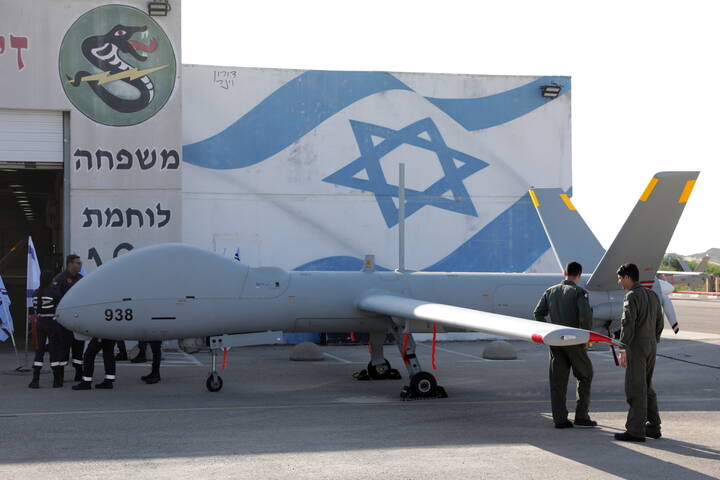
Other autonomous programmes occupy different operational levels. The Army is introducing launched effects, reconnaissance aircraft and loitering munitions into conventional formations. The Air Force and Navy are developing Collaborative Combat Aircraft intended to accompany crewed fighters or conduct independent sensing, electronic-warfare and strike missions. The Navy’s MQ-25 extends carrier aviation through aerial refuelling and intelligence functions. Unmanned surface and undersea vessels are intended to distribute maritime sensing, mine warfare, logistics and potentially strike capacity.
The distinctions among these programmes are operationally significant. A quadcopter carrying a small explosive charge, an autonomous underwater vehicle, an uncrewed tanker and a semi-autonomous combat aircraft share certain enabling technologies, yet they have different survivability requirements, communications architectures and cost tolerances. The Pentagon’s use of a single political language of “drone dominance” risks obscuring these differences. Some systems are designed to be expended by the thousand. Others will cost tens of millions of dollars and require maintenance infrastructures comparable to crewed platforms.
The $100 million Autonomous Vehicle Orchestrator challenge launched by the Defense Innovation Unit, the Defense Autonomous Warfare Group and the Navy addresses one of the principal integration problems. It seeks a vehicle-independent command layer capable of translating a commander’s voice, text or haptic instructions into tasks for multiple autonomous systems. The programme reflects an understanding that numerical mass remains operationally limited when every aircraft or vessel requires its own operator, control station and proprietary interface.
Human-machine command will determine the usable scale of the autonomous force. The department needs systems that can allocate routes, sensors, communications and targets among large numbers of platforms while preserving human understanding and authority over consequential decisions. This requires much more than autonomous navigation. It requires common data models, interpretable machine behaviour, communications under jamming, software certification, cyber protection and procedures for resolving conflicting orders across joint formations.
The central organizational question concerns where autonomy should reside. A tactical unit may need local authority to reconfigure aircraft and software in response to enemy electronic warfare. Theatre commands require the ability to coordinate hundreds or thousands of systems across a campaign. Centralized software governance may improve cybersecurity and interoperability, while excessive centralization can slow adaptation. The Pentagon has not yet resolved this distribution of authority, and the eventual answer will shape whether autonomous systems become routinely integrated military instruments or remain specialized capabilities attached to selected formations.
Air power: a family of systems rather than a single aircraft
The Air Force’s programme demonstrates how autonomy is being incorporated into a wider high-end aviation architecture. The FY2027 request includes $9 billion for the F-47 family of systems, $2.7 billion for Collaborative Combat Aircraft, $3 billion for 24 F-15EX aircraft, $4.4 billion for 15 KC-46 tankers and $6.1 billion for the B-21 bomber. It also sustains F-35 modernization, F-16 electronic-warfare upgrades, legacy bomber improvements and extensive base infrastructure.
The phrase “family of systems” describes a force in which the fighter is connected to autonomous aircraft, off-board sensors, electronic-warfare platforms, aerial refuelling, long-range weapons and distributed communications. The operational value of the F-47 will depend in part on whether Collaborative Combat Aircraft can extend its sensing radius, carry additional weapons, expose enemy air defences and absorb risks that would be unacceptable for a crewed platform.
This model addresses several structural limitations of conventional tactical aviation. Advanced fighters are expensive, fleet sizes are limited, pilot production is slow, and forward air bases are vulnerable to missiles. Collaborative aircraft could provide additional mass without requiring a proportional expansion in pilots. They may carry sensors or weapons optimized for particular missions and allow the crewed aircraft to remain farther from the most dangerous threat envelopes.
The economics of this architecture remain unsettled. If collaborative aircraft acquire extensive stealth, long range, high-end sensors and complex propulsion, their prices may rise toward those of traditional aircraft. The force would then gain additional platforms without achieving the intended cost exchange. The Air Force must therefore determine the acceptable loss rate and mission life for each class of aircraft. An attritable aircraft designed for several dozen missions has different engineering requirements from a reusable platform expected to serve for years.
Long-range strike remains central to the air programme. The B-21, upgraded B-52, Long-Range Stand-Off weapon and penetrating munitions support operations against defended targets at strategic distances. Autonomous systems can contribute reconnaissance, decoy, electronic-attack and weapons-carriage functions, but the bomber force continues to provide payload, range and nuclear capability that small systems cannot reproduce. The future air force is consequently likely to combine a limited number of highly survivable command and strike platforms with a larger outer force of collaborative aircraft and expendable effects.
The Air Force’s $14.9 billion munitions portfolio reinforces this architecture. It includes expanded production of the Joint Air-to-Surface Standoff Missile and Advanced Medium-Range Air-to-Air Missile, as well as investment in the Long-Range Anti-Ship Missile and future weapons. The service’s combat capacity will be determined by the number of weapons available for each aircraft rather than the aircraft inventory alone.
Sea power and the reconstruction of maritime capacity
The naval programme represents the largest service-specific industrial undertaking. The FY2027 request allocates $87.2 billion to sea power and $65.8 billion specifically to shipbuilding, including 18 battle-force ships, 16 other construction vessels and cost-to-complete funding for previous programmes. The planned ships include a Columbia-class ballistic-missile submarine, two Virginia-class attack submarines, a DDG-51 destroyer, a frigate, amphibious ships, medium landing ships, submarine tenders, replenishment oilers and an ocean-surveillance vessel.
The budget labels this expansion the Golden Fleet initiative. Its significance lies in the attempt to connect fleet composition with industrial capacity. Shipbuilding cannot be expanded through procurement orders alone. It requires dry docks, machine tools, nuclear-qualified suppliers, skilled labour, design stability and predictable production schedules. The request includes $8.7 billion for the submarine and maritime industrial base, including $1.8 billion for the Shipyard Infrastructure Optimization Program.
The Navy faces a different temporal problem from the small-drone sector. Warships take years to design and construct, and the United States has limited numbers of yards capable of building complex naval vessels. Production delays therefore affect force structure for decades. Injecting large amounts of funding into an industrial system with fixed physical and labour constraints may initially increase prices without generating proportional output.
Unmanned maritime systems are intended partly to alter this equation. Smaller autonomous surface and undersea vessels can distribute sensors, conduct mine warfare, perform reconnaissance, carry communications relays and complicate an adversary’s targeting problem. Their construction may be opened to shipbuilders outside the established naval primes. The potential strategic advantage lies in extending the fleet’s geographical presence without requiring every sensor or payload to be installed on a large crewed warship.
Maritime autonomy nevertheless confronts demanding technical conditions. Long-duration operations require reliable propulsion, navigation, collision avoidance, secure communications and maintenance. Undersea systems may operate with very limited connectivity, making independent mission execution essential. Surface vessels must comply with navigation rules while remaining useful in wartime environments where commercial communications and satellite positioning are disrupted. The Navy must also determine which autonomous vessels are expendable, which are recoverable and which require protection comparable to conventional ships.
The MQ-25 programme provides a more conservative form of naval autonomy. Its refuelling mission expands the effective range of carrier aviation and reduces the use of fighters as improvised tankers. This function supports the continued relevance of the aircraft carrier in a region dominated by long-range anti-ship weapons. The system illustrates how autonomy can increase the utility of an existing capital platform without displacing that platform.
The Navy’s strategic challenge concerns the relationship between fleet expansion and fleet distribution. Additional large ships strengthen global presence and payload capacity, while smaller autonomous systems can disperse risk and extend sensing. A coherent maritime architecture must connect these layers through common communications, targeting and logistics. Without such integration, the Navy could acquire a parallel unmanned fleet that adds operational complexity while remaining dependent on the same vulnerable command nodes and support ships.
The Army’s transition from platform formations to effects-based formations
The Army’s $252.4 billion request combines traditional land-force requirements with an accelerated transition toward long-range fires, air and missile defence, mobile formations, unmanned systems and theatre logistics. The Army remains essential to a Pacific-oriented strategy because it supplies ground-based missiles, air defence, communications, engineering, distribution and base protection for the joint force.
The budget allocates $4 billion to modernize 23 organic industrial-base facilities and an additional $7.3 billion in discretionary funding to expand production of the Precision Strike Missile, Long-Range Hypersonic Weapon, Guided Multiple Launch Rocket System, Next Generation Squad Weapon ammunition and 155 mm artillery rounds. A further $24.5 billion in mandatory munitions funding covers systems including PAC-3 MSE, THAAD, Tomahawk, SM-6 and PrSM.
These investments indicate that the Army’s strategic role extends far beyond manoeuvre combat on land. Patriot and THAAD units defend ports, airfields and command centres. Long-range missiles contribute to maritime and theatre strike. Logistics formations distribute fuel, ammunition and equipment across contested regions. Ground-based electronic warfare and counter-drone systems protect the infrastructure on which air and naval operations depend.
The Army’s Transformation in Contact initiative and the conversion of formations toward Mobile Brigade Combat Teams reflect an effort to adapt force organization through operational experimentation. The budget supports additional personnel for mobile brigades, multidomain commands, HIMARS units and Indirect Fire Protection Capability batteries. It also funds MV-75 Future Long-Range Assault Aircraft, counter-small-UAS systems, the Armored Multi-Purpose Vehicle, XM30 infantry vehicle and M1E3 Abrams development.
The underlying organizational shift concerns the movement from formations defined primarily by their principal vehicles toward formations defined by the effects they can generate. A brigade’s combat value increasingly depends on its reconnaissance drones, electronic warfare, air defence, precision fires, communications and access to joint sensors. Armour and infantry remain necessary for controlling terrain, but their survivability depends on an informational and protective envelope extending well beyond the vehicle.
This development requires changes in personnel and doctrine. Small units need operators capable of managing drones, electronic signatures and digital targeting tools. Commanders require procedures for coordinating artillery, loitering munitions, cyber effects and air defence. Maintenance organizations must support commercial electronics and batteries alongside armoured vehicles and helicopters. The Army must institutionalize these capabilities without creating specialist structures so isolated that ordinary manoeuvre units cannot use them.
The greater danger is that technical additions will increase the weight and complexity of formations. More sensors, batteries, antennas, control stations and air-defence systems generate additional transport and power requirements. A nominally lighter brigade may still depend on a substantial logistical tail. The Army’s transformation will be credible only when mobility, signature reduction and sustainment improve alongside the number of digital and autonomous systems.
Munitions and the restoration of magazine depth
The munitions programme is among the most consequential elements of the new force design. The Pentagon states that the FY2027 request contains approximately $114 billion for missiles, munitions and hypersonic weapons, with nearly $53 billion devoted to 14 systems prioritized through the Munitions Acceleration Council. The council is intended to expand production, replenish inventories and establish longer-term demand signals for suppliers.
Magazine depth has become a strategic concern because many American weapons were purchased in quantities suited to short campaigns rather than prolonged war. Precision missiles often require specialized rocket motors, energetic materials, seekers, microelectronics and cast components supplied by a small number of firms. Increasing final assembly cannot compensate when upstream suppliers lack capacity.
Multiyear procurement and framework agreements are intended to provide industry with sufficient certainty to build facilities and hire workers. This represents an important change from annual procurement patterns that frequently produced unstable demand. A company will not finance a new rocket-motor plant for a temporary one-year increase followed by an uncertain order book.
The Pentagon is also pursuing lower-cost weapons intended to complement premium missiles. This includes interest in affordable cruise missiles, simplified air-defence interceptors, loitering munitions and hypersonic prototypes designed with producibility in mind. The objective is to prevent the entire force from relying on weapons whose expense restricts inventory depth.
Cost exchange is particularly important in missile defence. Using a multimillion-dollar interceptor against a comparatively inexpensive drone or cruise missile may be necessary for the protection of a high-value target, but it is difficult to sustain across repeated attacks. The department therefore needs several defensive layers: electronic warfare, guns, inexpensive interceptors, directed energy and high-performance missiles reserved for the most demanding threats.
The munitions programme also exposes the limits of platform-centred budget analysis. Additional aircraft or launchers do not automatically increase combat output when magazines remain shallow. Conversely, larger inventories can improve the value of existing platforms by allowing them to operate at higher tempo. The strategic unit of measurement should therefore move from numbers of aircraft, ships or launchers toward the number of credible combat effects that the entire force can generate and regenerate over time.
Golden Dome and the return of homeland defence
The FY2027 request places homeland missile defence near the centre of the investment programme. It includes approximately $17.9 billion for Golden Dome and $67.9 billion for additional missile-defeat and defence capabilities. Golden Dome is expected to combine space-based sensors, potential space-based interceptors, terrestrial systems, kinetic and non-kinetic defeat mechanisms and supporting command infrastructure.
This investment signals a doctrinal shift. For much of the post-Cold War period, American missile defence concentrated on limited ballistic threats, deployed forces and regional allies. Golden Dome introduces a more ambitious architecture intended to address ballistic, cruise, hypersonic and potentially other threats against the continental United States.
The strategic rationale is connected to the vulnerability of mobilization and reinforcement. A peer adversary could seek to disrupt American power projection by attacking ports, airfields, command centres, satellite stations, energy infrastructure and defence production facilities. Homeland defence therefore affects the capacity to sustain overseas operations, not solely the protection of civilian territory.
The architecture faces difficult technical and economic questions. Persistent tracking of manoeuvring hypersonic vehicles requires extensive sensor coverage and rapid data fusion. Space-based interceptors would require large constellations, secure command links and continuous replenishment. Defensive systems must distinguish genuine threats from decoys and operate under cyber and counterspace attack. An attacker may also increase the number or diversity of offensive systems in response to American defences.
The budgetary opportunity cost will be substantial. Missile defence competes for sensors, launch capacity, microelectronics, engineering personnel and fiscal resources required by offensive strike and theatre defence. The strategic value of Golden Dome will depend on whether it produces a layered architecture protecting selected critical functions or develops into an open-ended attempt to provide comprehensive territorial protection against large peer arsenals.
A selective architecture centred on command continuity, nuclear forces, essential infrastructure and mobilization nodes may strengthen deterrence by reducing an adversary’s confidence in a disarming or disruptive attack. An excessively ambitious architecture could absorb resources while remaining vulnerable to saturation and countermeasures. Programme discipline will require clearly defined defended assets, threat assumptions and measures of effectiveness.
Space power, cyber operations and the informational structure of the force
The expansion of autonomous and distributed forces depends on an equally significant expansion of space and digital infrastructure. The FY2027 request includes $59.7 billion in procurement and research funding for space capabilities, while the total Space Force budget reaches approximately $71.2 billion. Within this programme, $21.6 billion is assigned to space-control capabilities, including proliferated constellations and defensive and offensive counterspace systems. Another $30.7 billion supports global mission operations, including missile warning and tracking, satellite communications, navigation warfare and space-based sensing and targeting.
Proliferated constellations are intended to reduce dependence on small numbers of expensive satellites. A larger number of distributed satellites can provide more frequent coverage and complicate adversary targeting. Commercial launch and smaller spacecraft also make replacement more feasible. The concept parallels the logic of autonomous mass in other domains, although satellites remain dependent on ground stations, data links and launch infrastructure.
Space systems perform several functions simultaneously. They detect missile launches, provide communications, support navigation, collect intelligence and transmit targeting data. Their importance makes them attractive targets for jamming, cyber operations, dazzling, direct-ascent weapons and attacks against terrestrial infrastructure. Space resilience therefore requires architectural distribution, defensive operations, rapid launch, alternative navigation methods and the capacity to operate with degraded service.
The cyber budget is similarly layered. The overview identifies $20.5 billion for broad cyberspace activities, while a more specific cybersecurity account contains approximately $12.1 billion for weapon-system security, defence infrastructure, zero-trust implementation, supply-chain risk management and cryptographic modernization. The department also assigns designated resources to Cyber Command and cyber research.
Cybersecurity is an operational requirement for every autonomous and networked system. A compromised logistics algorithm, flight-control update or targeting database can disrupt an entire formation without physically destroying its platforms. The expansion of software-defined weapons increases the number of potential vulnerabilities and the frequency with which software must be updated.
The Pentagon’s Combined Joint All-Domain Command and Control approach is intended to connect sensors, commanders and weapons across the services. The Chief Digital and Artificial Intelligence Office provides standards, governance and data infrastructure for this effort. Its emerging projects include Swarm Forge and an Agent Network for AI-enabled battle management, campaign planning and kill-chain support.
The strategic objective is decision advantage: identifying relevant information, allocating assets and generating an effect faster than an opponent. The practical challenge is that more data can increase confusion when it is not filtered, validated and presented according to operational need. Artificial intelligence may assist classification, planning and resource allocation, but commanders must understand the provenance and confidence of machine-generated recommendations.
The command architecture must also remain useful under degraded connectivity. A highly centralized system offering excellent peacetime awareness may fail when satellites, data centres or long-distance links are disrupted. Local formations need sufficient data, computing and delegated authority to continue operating. The design of CJADC2 must therefore balance global integration with tactical independence.
Contested logistics and operational endurance
The Pentagon’s new force design gives logistics a more explicit technological role. The Drone Dominance portfolio alone proposes $13.5 billion for a commercially integrated logistics network supporting autonomous operations. The department is also developing the Resilient Logistics Operations and Analytics Demonstrator, or RELOAD, to assess the logistical feasibility of operational plans and identify supply constraints. Operational-energy programmes cover propulsion, power planning, advanced reactors, power beaming and energy support for crewed and autonomous platforms.
This emphasis reflects the geography of an Indo-Pacific conflict. Forces may operate across widely separated islands and bases exposed to missile attack. Ports, fuel depots, airfields and communications nodes may be unavailable or only intermittently usable. Large logistics ships and transport aircraft will themselves require protection.
Autonomous logistics vehicles, distributed stockpiles and predictive planning can reduce some vulnerabilities. Small vessels may move supplies among islands. Uncrewed aircraft may deliver critical components. Additive manufacturing can produce selected parts near the point of use. Better data can reveal impending shortages before they immobilize a force.
These measures do not remove the physical requirements of warfare. Fuel, missiles, food, spare parts and batteries still possess weight and volume. Autonomous systems can even increase logistical demand by adding power requirements and large numbers of consumable components. The useful contribution of technology lies in prioritization, distribution and risk reduction rather than the disappearance of the logistical burden.
Contested logistics also affects force design at the platform level. Aircraft range, ship endurance, energy consumption and maintenance requirements determine the amount of support required. A weapon may possess excellent tactical performance while imposing an unsustainable theatre-level burden. Acquisition decisions should therefore incorporate logistics into operational evaluation rather than treating sustainment costs as a later administrative calculation.
The defence-industrial base as a warfighting system
The industrial programme constitutes the connective tissue among these initiatives. The FY2027 request claims more than $100 billion in defence-industrial investments. It includes $72.3 billion through Industrial Base Analysis and Sustainment and Defense Production Act mechanisms, $48.8 billion addressing critical minerals and supply chains across several accounts, $20.2 billion for the Office of Strategic Capital and $8.7 billion for submarine and maritime capacity. Some of these figures overlap, but their scale demonstrates the centrality of industrial intervention to the department’s programme.
The Defense Production Act account alone proposes approximately $30.4 billion, including investments in critical chemicals, missile and munition production, hypersonic supply chains, strategic materials, manufacturing, batteries and microelectronics. The programme seeks to intervene upstream rather than limiting funding to final weapon assembly.
This is necessary because the industrial constraints facing the Pentagon frequently reside several tiers below the prime contractor. A missile producer may be unable to increase deliveries because of a shortage of rocket motors, explosive precursors, castings, specialized chips or qualified testing equipment. A drone manufacturer may assemble thousands of airframes while remaining dependent on foreign batteries, permanent magnets, sensors and flight controllers.
The department’s five-year mine-to-magnet strategy and investments in strategic materials recognize that industrial sovereignty cannot be achieved through final assembly alone. Rare-earth processing, battery production, chemical manufacturing and semiconductor packaging require large capital investments, environmental permits, skilled labour and commercial markets capable of sustaining facilities between defence orders.
The Office of Strategic Capital is intended to use loans and other financial mechanisms to attract private investment into technologies relevant to national security. This approach expands the Pentagon’s role from purchaser to market organizer. It can address sectors in which defence demand is strategically important but insufficient to support the entire required industrial capacity.
The 2024 National Defense Industrial Strategy identified resilient supply chains, workforce readiness, flexible acquisition and economic deterrence as its four main priorities. The FY2027 programme converts many of these principles into large-scale financial commitments.
Several risks accompany this industrial policy. Rapid funding increases can produce inflated valuations and facilities designed around optimistic demand forecasts. Established contractors may absorb funds without creating genuine competition. Domestic-sourcing rules can raise costs and delay fielding before alternative suppliers reach scale. Government intervention may also preserve inefficient production methods when contracts reward capacity without measuring output and quality.
Effective industrial policy therefore requires contracts tied to production rates, delivery schedules, supplier diversification and demonstrable reductions in bottlenecks. The department must also distinguish strategic reserve capacity from ordinary inefficiency. Some excess capacity is economically costly during peacetime but militarily valuable during mobilization. The state will have to pay explicitly for that resilience rather than expecting private firms to maintain it without compensation.
Acquisition reform and the problem of institutional speed
The Pentagon’s technological programme depends heavily on changes in acquisition. Drone Gauntlets, DIU competitions, other transaction agreements, prize challenges and portfolio-based funding seek to shorten the period between experimentation and production. The operational logic is particularly strong for software and autonomous systems whose relevance may decline during a conventional multiyear acquisition cycle.
The new model emphasizes repeated competition, production-representative testing and direct operator participation. Companies that perform successfully can receive rapid follow-on orders, while unsuccessful firms are removed without preserving a long development programme. The Autonomous Vehicle Orchestrator challenge explicitly uses successive technical sprints and multiple awards to maintain competition.
This method can improve speed, although field experimentation cannot replace engineering discipline. Systems must still meet safety, cybersecurity, electromagnetic compatibility, reliability and legal requirements. A product that performs during a controlled competition may fail when deployed across hundreds of units with different maintenance conditions and software configurations.
The budget architecture itself is becoming an acquisition instrument. The $350 billion mandatory request concentrates resources in cross-service initiatives and creates funding outside conventional annual discretionary patterns. Defence-wide mandatory funding reaches approximately $245.2 billion, explaining the exceptional size of the defence-wide account.
This structure provides the department with resources for industrial expansion and multiyear projects, but it also complicates oversight. Capability categories overlap, and headline programme totals may include procurement, research, infrastructure and industrial investments distributed across several organizations. Congress and analysts will need to distinguish new funding from repackaged accounts and identify which investments produce deployable capacity.
Portfolio management can improve flexibility by allowing resources to move among related technologies. It can also weaken programme-level accountability when outcomes are defined too broadly. A portfolio labelled autonomy, missile defence or industrial resilience may contain activities with very different technical maturity and operational value. Transparent performance measures remain necessary even when managers receive greater freedom to reallocate funding.
The institutional challenge lies in combining speed with integration. The department can purchase a new drone or software application quickly. Building a common command architecture, changing force structure, training personnel and establishing reliable sustainment take considerably longer. Acquisition reform will have limited strategic effect when rapid procurement is followed by slow organizational adoption.
The strategic contradictions inside the programme
The Pentagon’s emerging force design contains several unresolved tensions.
The first concerns mass and sophistication. The department wants large numbers of affordable systems while continuing to demand high performance, domestic components, cyber protection and interoperability. Each additional requirement increases cost and reduces the number that can be purchased. The services will need disciplined segmentation, reserving high-end features for systems whose missions require them and accepting limited performance in systems intended for rapid consumption.
The second concerns homeland defence and forward power projection. Golden Dome, continental infrastructure protection and counter-drone defences consume resources that might otherwise support forces in the Western Pacific. Yet forward operations cannot be sustained when homeland production and mobilization nodes remain vulnerable. Strategy must identify which homeland functions require protection rather than allowing the defensive mission to expand without a defined boundary.
The third concerns exquisite platforms and distributed forces. The F-47, B-21, Columbia submarine and advanced warships remain central to American military power. Their value will increasingly depend on networks of autonomous systems, sensors and munitions. The Pentagon must avoid allowing the new outer force to become merely an expensive accessory to a platform structure that remains unchanged.
The fourth concerns central integration and tactical adaptation. Common software, data standards and cybersecurity are essential for joint operations. Operational adaptation often occurs locally, particularly in electronic warfare and drone employment. Excessive standardization may suppress innovation, while uncontrolled local modification can produce insecure and incompatible systems.
The fifth concerns industrial independence and alliance integration. The United States seeks domestic capacity in critical sectors while relying on allied production to expand scale. A completely national supply chain may be prohibitively expensive and technically unrealistic. A resilient architecture will probably require a protected industrial network linking the United States with selected allies, accompanied by shared standards, reciprocal sourcing rules and coordinated stockpiles.
The sixth concerns investment and readiness. Procurement and research receive exceptional increases, but new equipment does not generate immediate readiness. Personnel must be trained, infrastructure completed, software maintained and spare parts purchased. The department’s additional $31.7 billion for readiness and readiness enablers acknowledges this requirement, although the scale of modernization will place persistent pressure on operating accounts.
Strategic assessment
The Pentagon is constructing a force intended to combine several forms of military power that were previously managed as largely separate sectors. Strategic nuclear forces preserve deterrence against existential attack. Advanced crewed platforms provide range, payload and command capacity. Autonomous systems distribute sensors and weapons. Large missile inventories generate sustained precision effects. Space and cyber systems connect the force. Layered defences protect bases and infrastructure. Industrial investments provide the possibility of replacement and expansion.
This architecture is more appropriate to prolonged great-power conflict than a force designed principally for short expeditionary campaigns. It recognizes that technological superiority has limited operational meaning when weapons cannot be produced in sufficient quantities, bases cannot be defended, communications cannot survive attack and logistics cannot sustain the resulting tempo.
Its success will depend less on the announcement of individual programmes than on the relationships among them. Collaborative aircraft need munitions, communications and tanker support. Small drones need trained units, batteries, warheads and electronic-warfare protection. Warships need functioning shipyards and replenishment vessels. Missile defence requires space sensors and secure command networks. Every element depends on microelectronics, energy, software and skilled labour.
The budget’s scale can obscure this interdependence. A $1.45 trillion request can finance many parallel initiatives for a limited period. It cannot eliminate physical production constraints or substitute money for coherent operational design. Shipyards cannot immediately absorb unlimited orders. Missile plants cannot expand without upstream chemicals and motors. Autonomous fleets cannot operate at scale without command software and personnel.
The most important measure of the programme will therefore be the conversion of financial authority into sustainable operational throughput. Relevant indicators include monthly missile production, time required to revise software, numbers of trained autonomous-system operators, repair capacity, satellite-replacement timelines, protected logistics nodes and the number of combat sorties or effects that formations can sustain after initial inventories have been consumed.
The 300,000-drone competition retains considerable importance within this programme because it tests a different relationship between the state, military users and industry. It uses recurring competition and immediate production orders to shape a market. Its strategic relevance extends beyond the aircraft purchased. The Pentagon is examining whether it can establish an acquisition system compatible with rapid technological change and high rates of material consumption.
The broader force-design project will be determined by whether these methods influence the rest of the department. The United States requires stable multiyear commitments for shipbuilding, nuclear modernization and missile production, rapid competitive cycles for software and inexpensive autonomous systems, and adaptable portfolio management for technologies positioned between those categories. A uniform acquisition system cannot efficiently manage all of them.
The Pentagon’s current programme represents an attempt to develop this differentiated institutional structure while rebuilding physical capacity on a scale unseen in recent decades. It combines traditional rearmament with digital and autonomous transformation. The outcome may produce a joint force able to absorb attacks, distribute operations, replenish losses and sustain precision warfare over an extended period. It may also produce a larger collection of expensive programmes connected by ambitious terminology but limited by incompatible systems, industrial bottlenecks and organizational inertia.
The distinction will emerge through force structure, doctrine and production rather than budget announcements. American military power in the coming decade will depend on the number of systems procured, the speed at which they can be replaced, the security of their components, the adaptability of their software, the endurance of their logistics and the ability of commanders to integrate them under degraded conditions. The Pentagon’s rearmament programme has begun to address each of these dimensions. Its strategic coherence remains an institutional and operational project rather than an accomplished fact.