Iran’s military reconstruction after the 2026 conflict will be shaped by a strategic environment that predates the destruction of particular naval vessels, missile-production buildings or unmanned-aerial-vehicle facilities. For more than four decades, the Iranian defence establishment has operated under conditions of restricted access to foreign armaments, repeated attacks on military infrastructure, technological embargoes, financial isolation and a regional balance of power heavily favourable to the United States and its partners. Reconstitution will therefore emerge from an institutional system already designed around scarcity, dispersal, substitution and the expectation of recurrent external pressure.
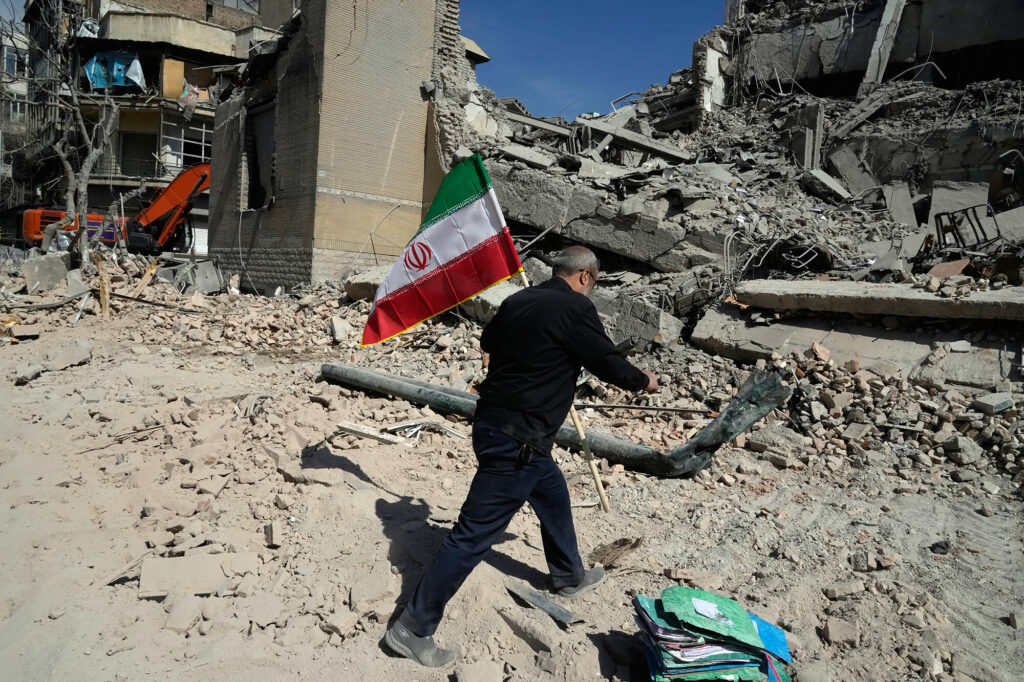
The physical damage documented through satellite imagery is substantial. Above-ground missile-production facilities, naval bases, shipyards, command installations and drone-related industrial sites have been struck, while the conventional surface fleet has suffered severe losses. Four major missile complexes and at least 29 launch sites were reportedly damaged during the first four weeks of the US-Israeli campaign. At Khojir alone, imagery reviewed by analysts indicated that at least 88 structures had been destroyed. The same assessments nevertheless concluded that Iran retained operational missiles, mobile launch capacity, underground storage and a demonstrated ability to repair blocked tunnel entrances and damaged production sites.
The strategic significance of these losses should therefore be assessed through the functions Iran seeks to restore rather than through a platform-by-platform inventory. Tehran’s immediate requirement is to recover a credible capacity to impose costs on adversaries, protect decision-making structures, preserve access to the Persian Gulf and the Caspian Sea, and prevent future attacks from becoming politically or militarily inexpensive. These requirements favour the reconstruction of missile, drone, air-defence, electronic-warfare and maritime-denial capabilities ahead of a costly attempt to reproduce the conventional force structure that existed before the war.
Reports that Iran restarted elements of drone production during the six-week ceasefire beginning in April, and that reconstruction was proceeding faster than early US intelligence estimates anticipated, support this interpretation. Such reporting remains difficult to verify independently, yet it is consistent with Iran’s historical preference for geographically distributed facilities, reserve production locations and industrial designs that can be reproduced without the full infrastructure associated with advanced Western weapons manufacturing.
Iran consequently faces a severe reconstruction challenge without confronting an unfamiliar strategic problem. Its defence establishment has spent decades converting limitations in capital, technology and conventional air power into incentives for industrial redundancy and asymmetric force design. The outcome will remain constrained by economic contraction, inflation, energy shortages, damaged transport infrastructure and dependence on selected imported technologies. It is nevertheless unlikely to resemble the linear disarmament scenario implied by assessments that treat the destruction of visible infrastructure as equivalent to the removal of military knowledge, organisational capacity or strategic motivation.
Reconstitution Within an Unequal Regional Military Order
Iran’s military posture cannot be evaluated coherently without reference to the distribution of military resources across the region. SIPRI estimated Iranian military expenditure at approximately $7.4 billion in 2025, compared with $48.3 billion for Israel, $83.2 billion for Saudi Arabia and $30 billion for Türkiye. SIPRI also cautioned that Iranian official figures understate total expenditure because off-budget oil revenue supports missile, drone and other military programmes. Even after accounting for this underreporting, the financial asymmetry remains considerable.
The contrast became still sharper during the 2026 war. The US administration requested approximately $67.15 billion in additional Pentagon funding for operations associated with Iran, including replenishment of munitions, operational expenditure and classified programmes. This supplemental request alone was several times larger than plausible estimates of Iran’s annual defence expenditure.
These figures help explain why Iranian military planning has concentrated resources in a limited number of fields. Iran has not developed a defence-industrial system capable of matching the United States or Israel across combat aviation, intelligence satellites, precision air attack, integrated reconnaissance or naval tonnage. It has instead constructed a specialised military economy centred on surface-to-surface missiles, relatively inexpensive unmanned systems, underground infrastructure, electronic warfare, dispersed naval units and the mobilisation of geography.
This force structure reflects an effort to create deterrence under conditions in which symmetrical competition would consume resources without overcoming the opposing coalition’s technological and financial advantages. Iranian missiles compensate partially for the absence of a modern long-range strike-aircraft fleet. One-way attack drones create persistent pressure at a cost below that of most systems used to intercept them. Fast boats, coastal missiles, mines and unmanned maritime platforms exploit the confined geography of the Persian Gulf. Hardened underground facilities complicate intelligence collection and increase the number of strikes required to achieve durable results.
The reconstruction programme will preserve this hierarchy of priorities. The objective will be the recovery of sufficient retaliatory depth to influence adversary calculations, rather than the rapid restoration of every destroyed asset. Iran may rebuild selected frigates, submarines and large auxiliary vessels for national prestige, training and limited presence missions, but the economic and operational case for recreating the former conventional surface fleet is weak. Its destruction has reinforced an established Iranian judgement that large, identifiable platforms are acutely vulnerable when the adversary possesses air superiority and persistent surveillance.
The Strategic Functions Tehran Will Seek to Restore
Command Continuity and Passive Defence
The first requirement concerns continuity of command. The destruction of senior command facilities, communications nodes and above-ground headquarters creates risks extending beyond the loss of individual leaders. A military system dependent on central authorisation can become vulnerable to decapitation, communications disruption and delays in coordinating dispersed forces.
Iranian reconstruction is therefore likely to devote significant resources to redundant communications, buried command sites, mobile headquarters, hardened fibre networks, independent regional command capacity and alternative procedures for authorising military operations under degraded conditions. These investments have little public visibility, but their strategic value may exceed that of many replacement platforms.
Passive defence will also assume greater importance. Future production facilities are likely to be smaller, more dispersed and less identifiable as single-purpose military complexes. Selected industrial functions may be integrated into civilian manufacturing environments, underground spaces or geographically separated production chains. This development would complicate battle-damage assessment and increase the possibility that attacks on dual-use industrial infrastructure affect civilian production, transportation and employment.
The distribution of industrial activity cannot fully protect Iran from advanced intelligence and precision-strike systems. It can reduce the probability that a limited number of attacks will eliminate an entire category of production. Iran’s experience during earlier attacks on nuclear, missile and drone-related facilities has already encouraged a model in which engineering knowledge, tooling, components and assembly capacity are separated across multiple locations.
Air Defence and Counter-Intelligence
The conflict exposed major weaknesses in Iran’s ability to detect, track and engage advanced aircraft and stand-off weapons. Reconstructing air defence will consequently become one of the most expensive and technologically difficult elements of the postwar programme.
Iran possesses domestic experience in producing radars, surface-to-air missiles and command systems, although their effectiveness against modern stealth aircraft, electronic attack and coordinated suppression campaigns remains uncertain. Reconstruction will involve the replacement of destroyed sensors, the creation of more mobile batteries, improved electronic decoys, passive detection systems and greater integration among military and civilian radar networks.
The Iranian leadership may also conclude that the central failure occurred within the intelligence and security system rather than exclusively in the performance of surface-to-air missiles. The accuracy of attacks on senior personnel, specialised facilities and concealed military assets suggests that foreign intelligence services possessed extensive knowledge of Iranian organisational routines and infrastructure.
Internal security investigations, changes in communications discipline, counter-intelligence restructuring and tighter compartmentalisation are therefore likely to accompany physical reconstruction. Excessive centralisation and political vetting could impair military initiative, while a failure to address security penetration would leave newly constructed facilities vulnerable. Managing this tension will become an important determinant of Iran’s recovery.
Missiles as the Core of Territorial Deterrence
Ballistic and cruise missiles will remain the principal means through which Iran can threaten distant military bases, airfields, ports, energy facilities and command infrastructure. The war appears to have damaged major propellant-production and assembly sites, yet it has also confirmed that Iran’s missile capability is distributed across underground stocks, mobile launchers, multiple missile families and several industrial organisations.
Reconstitution will probably emphasise production volume, launcher survivability, rapid dispersal and penetration aids rather than a general pursuit of maximum range. Iran already possesses systems capable of reaching its primary regional adversaries. Its technical challenge concerns the reliability and survivability of the entire strike complex, including targeting information, communications, launch preparation, transporter-erector-launcher availability and the ability to sustain operations after the opening phase of a war.
A larger proportion of missile-related investment may move towards mobile and solid-fuel systems because they require less visible preparation than liquid-fuel missiles. Iran will also have incentives to expand the use of decoys, hardened storage, concealed launch infrastructure and modular production. Precision will remain important because improvements in accuracy allow a smaller number of missiles to threaten military targets and reduce dependence on very large salvos.
Permanent elimination of this capability through air attack would require continuous surveillance and repeated strikes over an extended period. External assessments themselves acknowledge the difficulty of eradicating a missile system embedded in a large country with mountainous terrain, underground infrastructure and a long-established engineering base.
Unmanned Systems and the Economics of Attrition
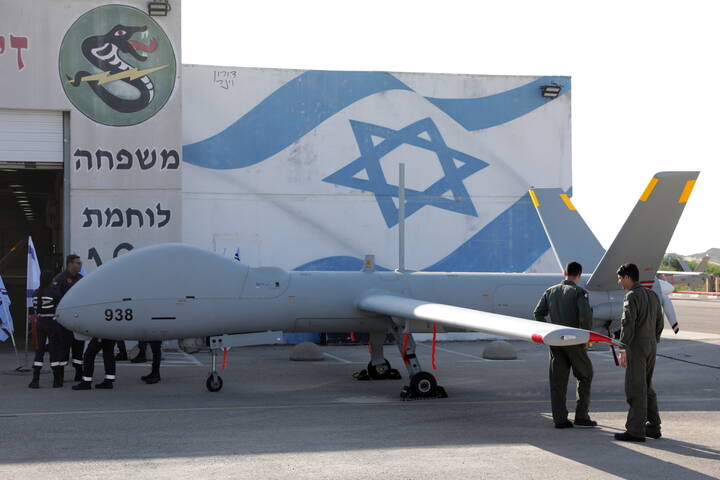
Drone production is likely to recover more rapidly than advanced missile or air-defence production. Many Iranian unmanned systems use commercial or dual-use electronics, relatively simple airframes and engines that can be manufactured, copied or substituted more easily than high-performance combat-aircraft components. This does not make the drone sector independent of foreign technology, but it reduces the capital and infrastructure needed to restore output.
Iran’s 2026 campaign also demonstrated the strategic function of mass unmanned systems. In the first week of the conflict, drones reportedly constituted about 71 percent of recorded Iranian strikes in the Gulf dataset assembled by CSIS. The campaign combined a large initial wave with a lower but sustained daily rhythm, using unmanned systems to maintain pressure while preserving more capable missiles for selected targets.
The importance of drones lies partly in the cost relationship they impose. Relatively inexpensive systems can oblige defenders to activate complex surveillance networks, disrupt commercial aviation and expend interceptors costing hundreds of thousands or millions of dollars. One assessment placed the cost of some Iranian attack drones around $30,000 while comparing them with interceptors costing approximately $2 million. Precise figures vary by system, but the underlying exchange remains favourable to the attacker when high-end missiles are used against mass-produced unmanned aircraft.
Iranian planners will seek to improve this exchange through greater variation in altitude, speed, navigation methods and attack profiles. They may also concentrate on the production ecosystem surrounding the airframe: engines, guidance units, communications, testing equipment, software, launch equipment and trained personnel. The decisive capability is the ability to generate repeated, coordinated waves under combat conditions, rather than the sophistication of an individual drone.
Maritime Denial After the Loss of the Surface Fleet
The destruction of much of Iran’s conventional naval surface force reduces its ability to conduct sustained operations in the Gulf of Oman and the northern Indian Ocean. It does not eliminate Iran’s capacity to influence maritime security near its coastline.
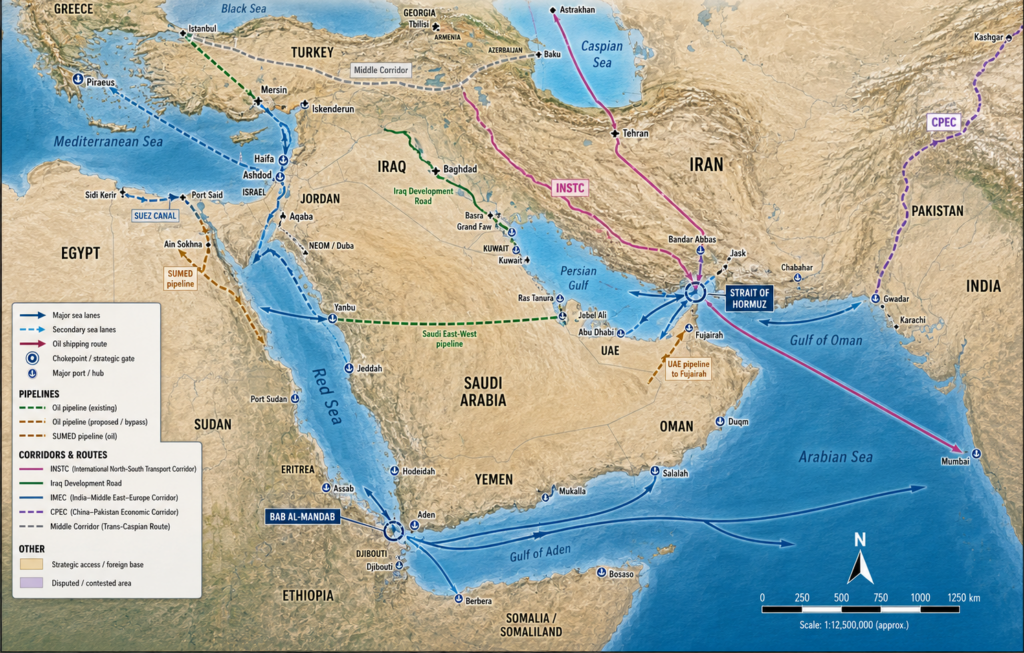
Iran’s geographical position gives it direct access to the Strait of Hormuz, a confined maritime space bordered by islands, commercial shipping routes and coastal terrain. In this environment, small vessels, coastal anti-ship missiles, sea mines, unmanned craft, shore-based surveillance and electronic warfare may generate greater strategic effects per unit of expenditure than large surface combatants.
Naval reconstruction is therefore likely to proceed along two tracks. The regular navy will seek enough conventional capacity to perform patrol, escort, training and diplomatic-presence missions. The Islamic Revolutionary Guard Corps Navy will continue to prioritise distributed systems capable of complicating maritime access and imposing risk on superior forces.
Port clearance and repair remain essential because Bandar Abbas, Bushehr, Chabahar and the Caspian ports support civilian commerce as well as military activity. Damage to quays, shipyards and harbour channels affects national economic recovery, energy exports, food imports and industrial logistics. Treating the restoration of these sites solely as military reconstitution obscures their broader role in an economy heavily dependent on maritime trade.
The Industrial Foundations of Recovery
Iran’s defence-industrial system combines large state-controlled organisations with universities, petrochemical producers, electronics companies, machine workshops and civilian contractors. The Ministry of Defence and Armed Forces Logistics oversees major holdings specialising in missiles, aviation, electronics, naval systems, ammunition and land equipment, while the regular armed forces and the IRGC generate separate operational requirements. Iran’s industrial strengths are concentrated in selected fields; its ability to manufacture advanced combat aircraft, large warships and modern armoured platforms remains limited.
This specialisation has produced a defence sector that is technically uneven but institutionally experienced in reverse engineering, redesign and component substitution. Imported machine tools, controllers, bearings, sensors, microelectronics and engine components remain important. Domestic firms have nevertheless accumulated the capacity to integrate these inputs into systems adapted to Iranian operational requirements.
The reconstruction problem extends beyond the acquisition of replacement components. Machine tools require trained operators, maintenance, software, calibration equipment and reliable electricity. Missile propellant production depends on chemical-processing infrastructure, safety systems and quality control. Drone manufacturing requires repeated flight testing and access to electronic components whose performance can vary considerably. Damage to electricity generation, telecommunications, transport links and industrial water supplies can therefore delay military production even when individual components remain available.
Human capital will be another limiting factor. Buildings and equipment can often be replaced more quickly than experienced engineers, production managers, radar specialists, metallurgists and test personnel. Iran’s universities and technical institutes provide a substantial domestic base, yet inflation, declining living standards and outward migration may weaken the state’s ability to retain highly trained workers.
The IMF projected a 6.1 percent contraction in Iranian real GDP during 2026 and consumer-price inflation approaching 68.9 percent. These projections illustrate the fiscal environment in which military rebuilding will occur. High inflation raises construction and labour costs, reduces the purchasing power of official budgets and intensifies competition between defence expenditure, infrastructure repair, household subsidies and social services.
Iran may partly protect priority military programmes through off-budget financing, controlled exchange rates, oil allocations and the economic resources of state-linked conglomerates. These mechanisms allow strategically important projects to continue during fiscal crisis, although they also reduce transparency, encourage inefficiency and transfer a larger share of economic adjustment to civilian households.
External Linkages Without Strategic Dependency
Foreign sourcing will remain necessary, but Iran’s external relationships should not be confused with formal alliance guarantees. China, Russia, Türkiye, Pakistan, India and the Central Asian states pursue their own commercial and geopolitical interests. None has demonstrated a willingness to assume unlimited economic or military risk on Iran’s behalf.
China will remain Iran’s most important commercial relationship. A March 2026 assessment by the US-China Economic and Security Review Commission estimated reported bilateral trade at $9.96 billion in 2025 and approximately $31.2 billion in additional Iranian oil exports to China. The same assessment observed that Chinese trade with Saudi Arabia and the UAE remained much larger, illustrating Beijing’s effort to preserve relationships across the Gulf rather than align exclusively with Tehran.
For Iran, China’s importance lies in the breadth of its industrial economy. Chinese manufacturers can provide machinery, electronics, vehicles, industrial chemicals and civilian technologies across a wide range of quality and price levels. This gives Iran alternatives where European, Japanese or American suppliers are unavailable. Chinese firms will remain attentive to sanctions exposure, however, and Beijing has avoided offering Iran a binding defence commitment.
Russia has a narrower commercial base but greater strategic incentives to cooperate in selected military, transport and energy sectors. The Ukraine war expanded technological exchanges in unmanned systems and created a shared interest in trade infrastructure less dependent on Western-controlled finance and shipping.
The International North-South Transport Corridor is particularly significant in this context. The proposed 7,200-kilometre network would connect Russia with Iran, the Persian Gulf and India through maritime, rail and road links. Its construction predates the present conflict, but Western sanctions on Russia and Iran have increased its geopolitical importance. Major financial, technical and political obstacles remain, including incomplete rail links and instability in the South Caucasus. Even partial implementation would provide Iran with greater logistical diversification and reinforce its position as a continental transit state.
The Caspian Sea will consequently acquire greater strategic value. It offers access to Russia and Central Asia beyond the Persian Gulf, while northern Iranian ports support trade routes less exposed to naval pressure around Hormuz. Pakistan and Türkiye may also gain importance as commercial gateways, although both governments will balance economic opportunities against relations with Washington, the Gulf monarchies and Europe.
Membership in BRICS and the Shanghai Cooperation Organisation provides diplomatic visibility and opportunities for transport, financial and technical cooperation. These institutions lack the cohesion and financial mechanisms required to insulate Iran fully from sanctions. Their importance lies in gradual diversification and the development of multiple political relationships rather than the creation of a unified anti-Western economic bloc.
Sanctions, Interdiction and the Limits of Economic Denial
Expanded export controls can delay Iranian access to specialised machine tools, high-end controllers, advanced microelectronics and selected aerospace materials. Enforcement directed at a narrow set of technologies may increase costs and slow production in sectors where substitutes are difficult to qualify.
The long-term effect becomes less certain when controls encompass broad categories of commercial goods. Machine tools, pumps, engines, bearings, communications equipment and industrial chemicals have extensive civilian applications and are produced across numerous jurisdictions. Comprehensive restrictions encourage substitution, domestic manufacturing, stockpiling and the development of alternative commercial networks. They also impose costs on civilian industry and can strengthen the political authority of organisations already experienced in operating under sanctions.
The attempt to reproduce Russia-related anti-circumvention measures for Iran would encounter further political obstacles. European and Asian governments do not share identical threat perceptions, while extraterritorial enforcement creates friction over sovereignty and commercial jurisdiction. China, India, Türkiye and several Central Asian states are unlikely to accept a permanent Western veto over their general industrial trade with Iran.
Sanctions have damaged Iranian economic development, restricted access to capital and contributed to inflation and technological isolation. Their effect on the defence sector has been more ambiguous. Scarcity has reduced the quality and quantity of some Iranian systems, while also encouraging industrial self-reliance in precisely the areas considered most important for national deterrence.
A strategy centred exclusively on denying Iran the ability to rebuild would therefore require an indefinitely expanding system of trade controls combined with recurrent military strikes. Such an approach could slow reconstruction, but it would also provide Tehran with a continuing incentive to disperse facilities, increase missile stocks, deepen relations with non-Western powers and reduce the transparency of its industrial activity.
Internal Constraints on Iranian Recovery
Iranian resilience should not be mistaken for unlimited capacity. The country enters reconstruction with damaged infrastructure, a depreciated currency, severe inflation and growing pressure on household living standards. The defence establishment must compete with the need to repair power generation, housing, transport, refineries, communications and public services.
Energy shortages present a particularly serious problem. Iran possesses some of the world’s largest hydrocarbon reserves, yet sanctions, underinvestment, ageing infrastructure and high domestic consumption have produced recurring electricity and natural-gas constraints. Precision manufacturing, metallurgy, chemical processing and advanced electronics all require reliable power.
The political allocation of reconstruction resources may also create institutional conflict. The regular military, the IRGC, the Ministry of Defence, the energy sector and provincial authorities will compete for capital, foreign currency, construction capacity and technical personnel. Central direction may establish priorities, but it cannot eliminate bureaucratic rivalry or corruption.
The most sustainable Iranian reconstruction strategy would therefore connect defence requirements with broader industrial renewal. Investments in machine tools, electronics, energy infrastructure, ship repair and communications can serve both civilian and military production. Such integration offers economic advantages, although it also increases the likelihood that future sanctions or attacks directed at military supply chains will affect civilian industry.
Strategic Implications
Iran’s postwar recovery will probably produce a smaller conventional force with a denser missile, drone, electronic-warfare and maritime-denial architecture. The defence establishment will seek greater geographical dispersion, improved command survivability and a production system capable of operating under periodic attack.
This force may be less visible than the one destroyed during the war. Large naval vessels and concentrated industrial complexes provide observable indicators of capability. Distributed launchers, small workshops, underground storage, software development and dual-use production are more difficult to measure. External intelligence agencies may therefore face growing uncertainty about Iranian inventories and regeneration rates.
The strategic consequences extend beyond Iran. The demonstrated ability of inexpensive unmanned systems to consume costly defensive resources has already accelerated counter-drone investment in the United States and allied countries. Washington is seeking major increases in Patriot, THAAD, Tomahawk and air-to-air missile output after operations associated with Iran strained munitions stocks.
This interaction creates a competitive cycle in which Iranian efforts to restore low-cost strike mass generate much larger defensive expenditures among its adversaries, while improvements in air defence encourage Iran to expand salvo size, diversify flight profiles and invest in penetration technologies. The result is unlikely to produce stable disarmament through unilateral military pressure.
A more durable regional order would require arrangements addressing the wider security environment in which Iranian rearmament occurs. These would include restrictions on attacks against civilian and energy infrastructure, mechanisms for managing incidents in the Persian Gulf, transparency regarding missile deployments, limitations on destabilising forward basing and a credible diplomatic framework for the nuclear issue. Measures applied exclusively to Iran while leaving the region’s broader military imbalance untouched are unlikely to gain sustained Iranian acceptance.
Conclusion
Iran’s military reconstitution should be understood as a national-security project conducted under conditions of deep economic strain and profound regional asymmetry. The destruction inflicted during the 2026 conflict has reduced operational capacity, disrupted production and exposed serious weaknesses in air defence, intelligence security and command protection. It has not removed the industrial knowledge, geography, institutions or threat perceptions that produced Iran’s existing force structure.
Tehran’s reconstruction priorities will favour capabilities that can be dispersed, concealed, reproduced and employed at tolerable cost. Missiles, drones, electronic warfare, underground infrastructure, mobile air defence and maritime-denial systems satisfy these requirements more effectively than large conventional platforms. China and Russia will provide important economic and technological linkages without becoming unconditional patrons, while the Caspian and north-south transport networks will gradually reduce Iran’s dependence on a limited number of Gulf commercial routes.
Economic sanctions and export controls can complicate this process, especially where Iran depends on highly specialised foreign technology. Their capacity to prevent reconstitution altogether remains doubtful. Forty years of pressure have produced economic damage and technological constraints alongside an institutional culture organised around adaptation.
The central strategic question is therefore broader than the speed with which Iran replaces damaged machinery or replenishes particular inventories. It concerns whether the regional system continues to reward military dispersal, opacity and asymmetric escalation. As long as Iran’s leadership assesses that the country faces recurring attack by states possessing overwhelming superiority in air power, intelligence and expenditure, the reconstruction of retaliatory capability will remain a core state priority. Military strikes can alter the timetable and composition of that effort. They have yet to eliminate its strategic foundation.