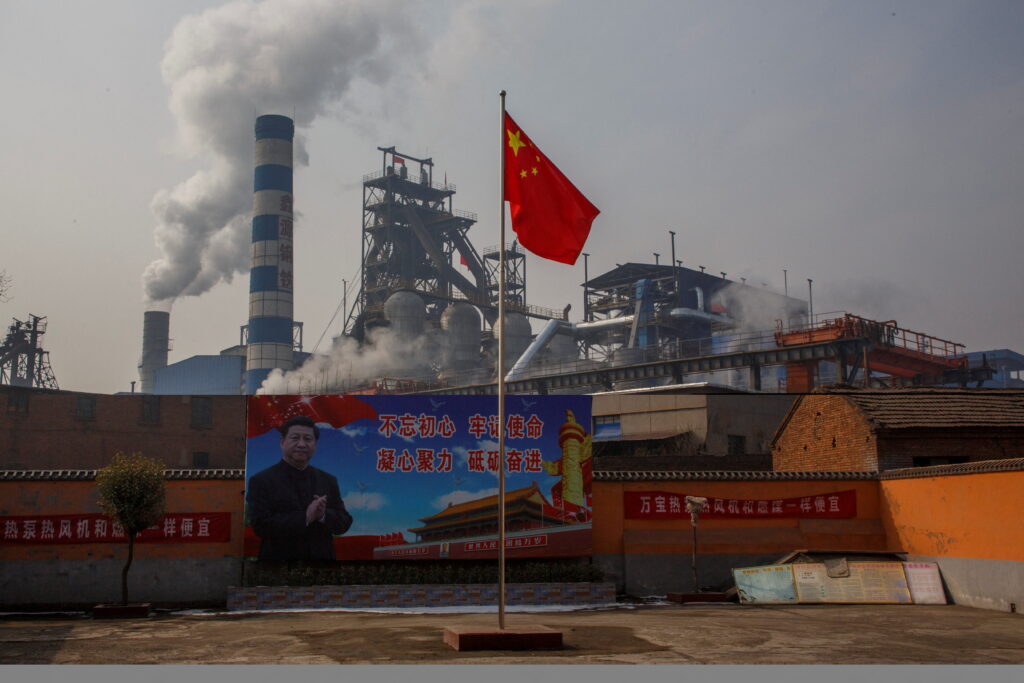
China’s response to the emerging international carbon regime forms part of a larger strategy for industrial modernization, energy security, technological autonomy and institutional influence. Beijing increasingly treats carbon accounting, emissions trading, renewable-energy deployment and low-carbon manufacturing as components of national economic power. European climate regulation, especially the Carbon Border Adjustment Mechanism, has accelerated this process by attaching a measurable commercial cost to the carbon intensity of Chinese production.
The immediate financial exposure created by CBAM remains manageable. In 2025, goods covered by the mechanism accounted for approximately 0.8 percent of China’s exports to the European Union, with iron and steel representing 92 percent of the affected trade and aluminium another 7 percent. The strategic importance of the mechanism lies in its anticipated expansion into downstream products, including machinery, appliances and steel- or aluminium-intensive manufactured goods. These sectors occupy a much larger position in China’s export structure and industrial employment. European authorities have already proposed extending CBAM to selected downstream products from 2028.
Beijing’s central objective is therefore to preserve the international competitiveness of Chinese industry as market access becomes increasingly dependent on verified carbon performance. This requires China to lower the carbon intensity of electricity and industrial materials, construct internationally credible systems of measurement and certification, strengthen domestic carbon pricing and secure a greater role in writing the standards through which low-carbon production is evaluated.
This strategy carries wider geopolitical consequences. Carbon governance is becoming an organizing principle of international trade, industrial policy and technological competition. China is positioning itself to remain the principal manufacturing power within that order while reducing its vulnerability to rules designed in Europe or North America.
Carbon regulation as an industrial-security challenge
The Chinese leadership approaches decarbonization through the institutional framework of national development planning. Climate policy is incorporated into industrial restructuring, infrastructure investment, technological innovation, resource security, urban development and the governance of state-owned enterprises. The resulting system differs considerably from the regulatory model developed in Europe, where carbon prices and legally binding emissions ceilings exercise a stronger direct influence over corporate decisions.
China’s approach relies on coordinated targets, administrative guidance, subsidized investment, industrial planning, public procurement, state-controlled finance and progressively expanding market instruments. Carbon markets operate within this wider structure. Their role includes improving emissions data, encouraging cost-effective reductions, creating financial signals and preparing Chinese firms for carbon-constrained international markets.
The Fifteenth Five-Year Plan for 2026–2030 gives this agenda greater strategic weight. It sets a target of reducing carbon dioxide emissions per unit of GDP by 17 percent during the plan period and raising the non-fossil share of total energy consumption from 21.7 percent in 2025 to 25 percent by 2030. China’s new energy plan also anticipates that non-fossil sources will provide 50 percent of national electricity generation by 2030, while wind and solar will account for more than half of installed generating capacity. The plan explicitly connects energy transition with technological self-reliance, resilient infrastructure and control over strategic industrial chains.
China’s 2035 climate commitment extends this trajectory. Beijing has pledged to reduce economy-wide net greenhouse-gas emissions by 7–10 percent from their peak level, increase non-fossil energy to more than 30 percent of total consumption and expand wind and solar capacity to approximately 3,600 gigawatts. The emissions target remains conservative relative to several external assessments, although it represents China’s first formal commitment to an absolute reduction in greenhouse-gas emissions. The design of these targets reflects a preference for policy flexibility. Chinese planners retain space to respond to economic slowdowns, electricity shortages, geopolitical disruptions and fluctuations in energy demand. This flexibility supports political and industrial stability, although it also delays the emergence of a clearly defined national emissions ceiling.
The first strategic objective is protecting manufacturing competitiveness
The expansion of carbon-conditioned trade presents China with a direct challenge to its manufacturing model. Chinese industry benefits from large production clusters, extensive infrastructure, economies of scale, mature supply chains and substantial access to policy finance. A significant share of this industrial system still depends on coal-intensive electricity and high-emission primary materials.
In 2024, China emitted approximately 0.39 kilograms of carbon dioxide equivalent for every dollar of GDP measured at purchasing-power parity, roughly four times the European Union average and about twice the global average. Coal supplied 53 percent of Chinese primary energy consumption and approximately 58 percent of electricity generation. The carbon content of Chinese steel, aluminium, chemicals, machinery and manufactured components therefore carries growing commercial implications when these products enter regulated foreign markets.
CBAM currently concentrates its effects on cement, fertilisers, electricity, hydrogen, iron and steel, and aluminium. Its expansion along industrial value chains will gradually affect the cost structure of Chinese machinery, electrical equipment, automotive components, consumer appliances and construction products. European legislation has already established the definitive CBAM regime from 2026, alongside the progressive removal of free allowances under the EU Emissions Trading System. A new 50-tonne exemption removes many small importers from the system while preserving coverage of more than 99 percent of emissions within its scope.
Chinese policy consequently focuses on reducing the carbon content of export production at the plant and product levels. Export-oriented companies will increasingly seek long-term access to renewable electricity, lower-emission metals, recycled inputs, efficient logistics and certified supply chains. Industrial relocation within China will follow energy availability more closely, especially in electricity-intensive sectors such as aluminium, polysilicon, chemicals, data processing and battery materials.
This process may generate a segmented industrial geography. Coastal manufacturing centres will retain their advantages in logistics, finance, advanced services and export infrastructure, while selected energy-intensive stages move toward western and southwestern provinces with abundant hydropower, solar, wind or nuclear resources. Green industrial parks will connect low-carbon electricity, energy storage, industrial heat, recycling, hydrogen and digital carbon-accounting systems within geographically concentrated production zones.
The resulting structure would allow China to preserve the scale advantages of its national manufacturing system while assigning lower-carbon production to firms and regions serving the most demanding foreign markets.
The second objective is converting carbon accounting into state capacity
China’s most consequential response to external carbon regulation may be the construction of a nationwide measurement, reporting, verification and certification architecture. Reliable carbon data has become a prerequisite for market access, green finance, government procurement, industrial planning and corporate supply-chain management.
The Ministry of Ecology and Environment has developed a general national standard for product carbon-footprint quantification. By the end of 2024, six national product-footprint standards had been issued, 67 additional standards were under development and more than 100 association standards had been published. The authorities have prioritised primary energy, industrial materials, electric vehicles, lithium-ion batteries, photovoltaic products and transport. Pilot certification rules introduced in 2025 cover 17 product categories and are intended to support product labelling, government procurement, financial products and carbon disclosure on major e-commerce platforms.
This infrastructure serves several strategic purposes. It enables Chinese exporters to document embedded emissions under European rules, gives central authorities greater visibility into industrial energy use, provides financial institutions with data for green lending and allows government agencies to differentiate between efficient producers and obsolete capacity. Carbon databases can also support industrial consolidation by increasing compliance costs for smaller and less efficient companies.
Digitalisation strengthens these capabilities. China’s national carbon-market infrastructure increasingly links emissions reporting, verification, trading and compliance data. The Ministry of Ecology and Environment reports the use of automated anomaly detection, data-correlation systems and artificial intelligence in the supervision of carbon-market information. Such systems can gradually integrate electricity consumption, production records, fuel quality, logistics information, corporate reporting and third-party verification.
Control over carbon data also carries international influence. Countries, companies and financial institutions that adopt Chinese accounting methods, databases, certification procedures or digital platforms will become more closely connected to Chinese technical standards. Beijing can support this process through South–South cooperation, Belt and Road projects, development finance, training programmes and technical assistance to emerging carbon markets.
China therefore has an incentive to achieve international recognition for its carbon-accounting system while retaining sufficient institutional autonomy to accommodate domestic industrial conditions. Mutual recognition with Europe would offer Chinese producers substantial commercial benefits. Wider acceptance across Asia, Africa, Latin America and the Middle East would provide China with a platform for shaping the carbon-governance practices of developing economies.
The national emissions market as an instrument of industrial coordination
China’s national Emissions Trading System began with the power sector in 2021 and expanded in 2025 to include steel, cement and aluminium smelting. The enlarged market covers roughly 3,000 firms and close to 60 percent of national emissions, giving it the largest sectoral emissions coverage of any carbon market in absolute terms.
The Chinese ETS remains intensity-based. Allowances are allocated primarily through benchmarks linked to output, and most permits remain free. Efficient production facilities can expand while improving their emissions performance per unit of output. This structure supports industrial growth, limits abrupt cost increases and encourages technological upgrading within operating sectors.
The carbon price has so far remained considerably below the EU ETS price. China’s composite allowance price crossed 100 yuan per tonne for the first time in April 2024, equivalent to a small fraction of recent European allowance prices. The modest price signal limits the ETS’s immediate ability to force major fuel switching or early retirement of coal-intensive assets. Its stronger near-term contribution lies in standardising emissions data, creating compliance routines, developing verification capacity and familiarising firms with carbon as a balance-sheet variable.
The Chinese government appears prepared to strengthen the system gradually. Official plans envisage wider sectoral coverage, more diverse trading instruments, improved data quality, greater participation by financial institutions and a movement toward absolute emissions controls during the period leading to 2030. The transition is likely to proceed selectively, with allowance scarcity and auctioning introduced at a pace consistent with industrial conditions.
Such sequencing allows authorities to use the ETS as a mechanism for industrial coordination. Benchmarks can reward advanced facilities, accelerate the removal of inefficient capacity, influence investment decisions and encourage firms to purchase renewable electricity or adopt lower-carbon processes. The market can also provide information for banks, regulators and provincial governments, making carbon performance part of a broader system of industrial discipline.
The third objective is integrating decarbonisation with energy security
China’s energy transition is shaped by the country’s dependence on imported oil and gas, the enormous scale of electricity demand and the political requirement to prevent supply disruptions. Electrification and domestic renewable generation reduce exposure to maritime energy routes, external sanctions, price volatility and instability in major hydrocarbon-producing regions.
Renewable expansion has already reached a scale without precedent in any other national system. China added more than 430 gigawatts of wind and solar capacity during 2025, bringing total renewable generating capacity above 1,800 gigawatts and raising renewables to more than 60 percent of installed power capacity. China also accounted for 70 percent of global electric-car production and more than 80 percent of battery-cell production in 2025, together with approximately 85 percent of cathode-material production and over 90 percent of anode-material production.
These investments serve economic, environmental and security objectives simultaneously. Electric vehicles reduce demand for imported petroleum. Solar and wind power reduce the marginal requirement for imported gas and coal. Battery storage, high-voltage transmission, nuclear power and demand-management systems reinforce electricity security. Domestic control over equipment manufacturing limits exposure to foreign technology restrictions.
Coal retains an important position within this strategy. Its domestic availability gives Chinese planners a dependable source of dispatchable power, industrial heat and chemical feedstock. Provincial governments also rely on coal-related industries for employment, fiscal revenue and local investment. China’s power system will consequently retain substantial coal capacity during the Fifteenth Five-Year Plan, even as the utilisation rate of some plants declines and renewable generation captures a larger share of electricity growth.
The central strategic question concerns the function assigned to the coal fleet. A system in which coal plants provide reserve capacity, seasonal balancing and emergency support would allow emissions to decline despite continued installed capacity. A system that protects guaranteed coal generation hours, expands coal-to-chemicals production and permits persistent duplication of power assets would weaken the emissions benefits of renewable expansion.
Grid reform will determine much of the outcome. China needs larger interprovincial electricity markets, more flexible pricing, stronger transmission, improved storage economics and dispatch rules that prioritise low-marginal-cost generation. Provincial protectionism and the institutional interests of coal-producing regions remain major obstacles. The effectiveness of national coordination during the 2026–2030 period will therefore carry greater significance than aggregate renewable-capacity figures alone.
The fourth objective is preserving leadership across the clean-technology system
China’s clean-technology strategy covers the entire industrial chain, including mineral processing, materials, components, production equipment, final assembly, infrastructure deployment, recycling and export finance. The depth of this ecosystem gives Chinese companies advantages that competitors struggle to reproduce through individual subsidies or tariffs.
Domestic deployment provides manufacturers with very large initial markets. Repeated production lowers costs, improves product quality, develops specialised suppliers and creates a skilled workforce. Excess capacity then supports international expansion through lower prices and aggressive competition. Foreign trade measures can slow access to particular markets while Chinese firms respond through local manufacturing, joint ventures, technology licensing, component exports and investment in third-country production.
Carbon regulation can reinforce this position when Chinese firms lower the embedded emissions of their products. A Chinese battery, solar module, electric vehicle, aluminium component or industrial machine that combines low manufacturing cost with verified low-carbon production will remain competitive under stricter environmental rules. China’s carbon-accounting programme therefore supports the commercial expansion of the “new trio” of electric vehicles, lithium batteries and photovoltaic products.
The aluminium sector illustrates this logic. China produces approximately 60 percent of global primary aluminium, and the sector accounts for around 5 percent of Chinese carbon emissions. Since 2017, producers have moved a significant share of capacity toward provinces with abundant hydropower and other lower-carbon electricity sources. National policies also promote recycled aluminium, which requires only a fraction of the energy consumed in primary production.
Over time, differentiated production categories may emerge within Chinese industry. Premium low-carbon aluminium, steel, batteries and chemicals would serve regulated export markets and advanced domestic supply chains. Conventional production would continue serving less regulated markets while gradually facing tighter domestic efficiency requirements. This structure would allow China to manage the pace of transition while protecting aggregate industrial capacity.
Local governments as laboratories of carbon governance
Chinese implementation depends heavily on provincial and municipal governments. Local authorities administer industrial parks, approve projects, supervise emissions reporting, coordinate electricity access and maintain relationships with major companies. Their incentives vary according to regional income, export exposure, resource endowments, fiscal conditions and industrial structure.
By April 2026, 30 provincial-level carbon-accounting platforms had been officially announced, with seven operating, 11 in pilot phases and 11 under planning. Wealthy and export-oriented regions such as Guangdong, Zhejiang, Jiangsu and Shanghai have moved quickly because their firms face stronger foreign regulatory pressure and their governments possess greater administrative capacity.
This decentralised experimentation allows China to test certification systems, carbon databases, green-finance products and industrial-park models before broader national adoption. Successful practices can be standardised and extended through ministerial regulations and Five-Year Plan targets.
Decentralisation also produces uneven enforcement. Local governments carrying heavy debt burdens or depending on carbon-intensive employers may resist costly adjustments. Emissions data can be influenced by weak technical capacity, fragmented bureaucratic authority or local protection of major firms. Competition among the Ministry of Ecology and Environment, the National Development and Reform Commission, the National Energy Administration and industrial ministries can further slow the consolidation of standards.
Beijing will therefore need to strengthen central data systems, third-party verification and cadre-performance criteria. Carbon governance will gain practical authority when it influences investment approval, credit access, government procurement, electricity allocation and the evaluation of local officials.
China’s international strategy
China’s external position combines legal resistance, institutional adaptation, commercial expansion and coalition building. Chinese officials continue to describe CBAM and several European industrial measures as protectionist instruments with potential implications for World Trade Organization principles and the development interests of emerging economies. Beijing also works pragmatically with European institutions on emissions trading, carbon accounting and technical standards.
This approach gives China negotiating flexibility. Legal and diplomatic criticism preserves solidarity with developing countries concerned about the distributional effects of carbon border measures. Technical engagement helps Chinese companies comply with European requirements and gives Chinese officials insight into the evolution of EU rules. Domestic reform strengthens China’s argument that its own carbon price and certification system should receive international recognition.
In the Global South, China can present itself as the provider of affordable decarbonisation technologies and industrial infrastructure. Renewable equipment, electric transport, batteries, transmission systems and digital energy platforms offer governments a path toward lower fuel-import dependence and expanded electricity access. Financing constraints, local industrial aspirations and concerns about trade dependence will shape the reception of this offer.
Chinese firms are likely to expand overseas manufacturing as trade barriers increase. Battery plants, electric-vehicle factories, solar-component facilities and mineral-processing investments in Southeast Asia, the Middle East, Africa, Latin America and parts of Europe can secure market access while embedding Chinese technology and production systems within foreign industrial strategies. The IEA has already identified a growing share of Chinese overseas energy investment and official financing moving toward clean-energy projects and clean-technology manufacturing.
The strategic value of this expansion extends beyond exports. Overseas production can diversify geopolitical risk, create constituencies that favour continued economic relations with China and increase international dependence on Chinese equipment, engineering expertise, software, components and maintenance networks.
Europe, the United States and the contest over standards
Europe currently exercises substantial regulatory influence because access to its market depends on increasingly detailed environmental conditions. CBAM extends the reach of the EU ETS into international supply chains and encourages foreign producers to develop compatible carbon-accounting systems.
China is responding through selective institutional convergence. Its carbon market, product-footprint standards and certification systems increasingly engage with concepts developed in European climate governance. Beijing seeks to participate in the evolution of these rules and secure recognition for Chinese methodologies.
This process could produce a partially integrated Eurasian carbon-commercial space in which European regulation establishes demanding market conditions while Chinese industry supplies a significant share of the technologies and manufactured goods required for compliance. Political tensions over subsidies, electric vehicles, procurement and industrial overcapacity will continue, although the technical systems governing carbon data may still converge.
The United States faces a different strategic position. American policy relies more heavily on subsidies, tax incentives, trade restrictions, domestic-content requirements and controls on Chinese technology. The absence of a comprehensive federal carbon price limits Washington’s influence over the development of internationally compatible carbon-accounting and border-adjustment systems.
China can exploit divergences between the European and American approaches. It can work with European institutions on technical carbon governance, challenge discriminatory industrial rules, expand manufacturing in third countries and present American policy as commercially restrictive and institutionally detached from multilateral climate governance.
For Washington, the central risk involves rule-setting. China’s combination of manufacturing scale, carbon data infrastructure and engagement with emerging economies could allow it to shape standards in markets where American firms have limited industrial presence. China does not need formal control over global climate institutions to acquire this influence. Widespread use of Chinese equipment, methodologies, digital platforms and financing arrangements can generate a durable form of structural power.
Constraints and vulnerabilities
China’s strategy faces several domestic limitations. The economy remains highly energy intensive, electricity demand continues to expand and local governments retain strong incentives to support investment in heavy industry. Coal-related assets are comparatively young, and their owners will seek continued utilisation over several decades.
Carbon-market credibility remains another concern. International acceptance will depend on plant-level data quality, independent verification, enforcement consistency and transparency regarding electricity-emission factors. European authorities may refuse to recognise Chinese carbon payments or certificates when methodological differences remain substantial.
Industrial overcapacity creates additional pressure. Aggressive expansion in solar modules, batteries, electric vehicles, steel and other sectors has lowered global prices and strengthened China’s commercial position. It has also intensified foreign trade action and weakened profitability among some Chinese producers. Environmental certification cannot resolve structural excess capacity, although it can facilitate consolidation around technologically advanced firms.
The electricity system presents a further challenge. Installed renewable capacity does not automatically produce equivalent renewable generation. Grid congestion, curtailment, inflexible coal contracts and provincial barriers can prevent full utilisation. The new 2030 target of obtaining half of electricity from non-fossil sources will require faster market reform and substantial investment in grids, storage and flexible demand.
International trust will remain difficult to establish in an environment of strategic rivalry. European and American policymakers may interpret Chinese carbon institutions through concerns about subsidies, market distortion, state control and data reliability. Chinese officials will view many foreign environmental conditions through the experience of sanctions, export controls and industrial containment.
Strategic outlook
China’s performance during the Fifteenth Five-Year Plan should be assessed through a group of interconnected indicators.
The first concerns whether national emissions reach a durable peak and begin declining despite continued economic growth. A temporary reduction caused by weak construction activity would carry less structural importance than sustained reductions driven by changes in electricity generation, industrial processes and transport.
The second concerns electricity-market reform. Progress in interprovincial trade, renewable dispatch, storage deployment and the declining utilisation of coal plants would indicate that installed clean capacity is transforming actual generation.
The third concerns the evolution of the national ETS. Greater allowance scarcity, partial auctioning, broader sectoral coverage and a transition toward absolute controls would make the carbon price a more influential economic signal.
The fourth concerns international recognition of Chinese carbon data. Acceptance of Chinese product-footprint calculations by European importers, certification bodies and regulators would represent a major strategic achievement.
The fifth concerns overseas industrialisation. Chinese investment in foreign clean-technology production will show whether firms can move from an export-centred model toward a geographically distributed manufacturing system that remains technologically and commercially connected to China.
The final indicator concerns the distribution of industrial adjustment inside China. Successful restructuring requires viable economic alternatives for coal-producing regions, heavily indebted local governments and workers in inefficient industrial facilities. Failure to manage these interests could slow the transition and generate repeated cycles of overinvestment.
Conclusion
China’s carbon strategy is developing into a comprehensive programme of economic statecraft. Its institutions are intended to lower the environmental intensity of Chinese development, defend access to foreign markets, strengthen control over strategic technologies and give Beijing a larger role in the governance of international trade.
European carbon regulation has accelerated this strategy by establishing clear commercial incentives for emissions accounting and low-carbon production. China has responded through national standards, provincial carbon platforms, emissions-market expansion, renewable deployment, industrial relocation and the integration of carbon performance into finance and procurement.
The wider contest will concern the relationship between industrial scale and regulatory authority. Europe possesses considerable capacity to define environmental market-access conditions. China possesses the world’s deepest clean-technology manufacturing system and an expanding ability to create parallel standards, databases and certification institutions. The United States retains major financial and technological resources while operating through a more fragmented climate-governance structure.
China’s likely objective is to combine manufacturing dominance with growing institutional influence, ensuring that the transition toward a carbon-constrained world strengthens Chinese industrial power and reduces exposure to foreign energy, technology and regulatory pressure. The success of this strategy will depend on the credibility of Chinese carbon data, the reform of the power system, the management of coal dependence and Beijing’s ability to persuade trading partners that Chinese low-carbon institutions can support reliable international commerce.