The Strait of Hormuz legal framework defines one of the most contested issues in modern maritime law. It sits between two principles: coastal state sovereignty and global navigation rights. Iran’s position emerges from this tension. It relies on established legal doctrines, treaty interpretation, and state practice. When examined closely, Iran’s argument is neither abstract nor purely political. It rests on a structured legal foundation that allows both regulation and economic benefit.

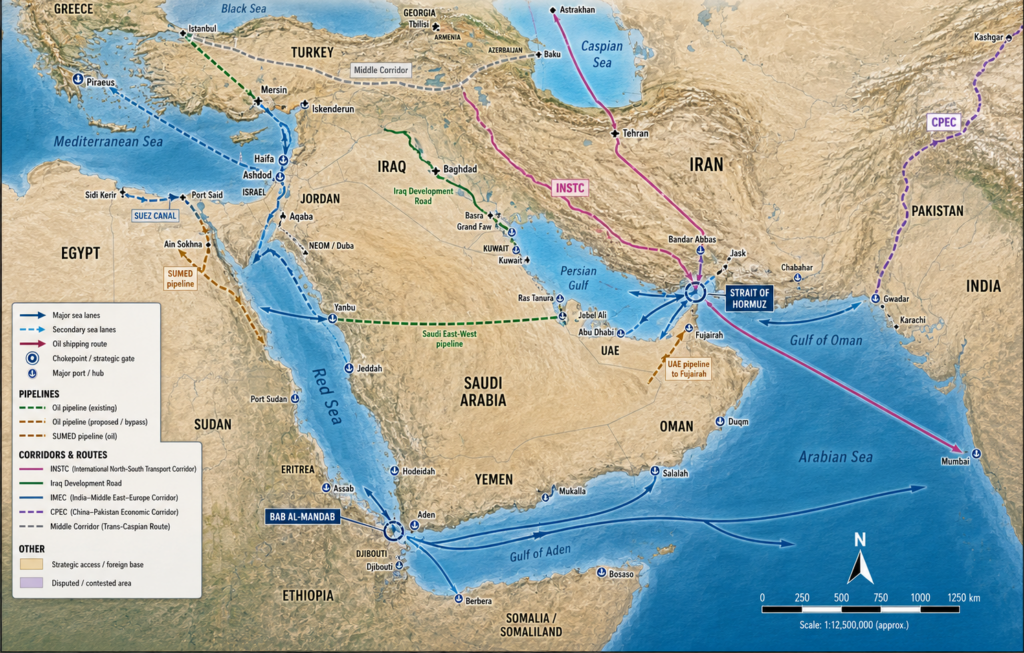
The Strait of Hormuz connects the Persian Gulf to the Gulf of Oman. It carries a large share of global energy exports. Its narrow width places key navigation routes within territorial seas. This geographic fact shapes the entire legal analysis. Because vessels pass through territorial waters, sovereignty becomes the starting point. Navigation rights must therefore be justified as exceptions.
Sovereignty in the Strait of Hormuz Legal Framework
International law begins with coastal state sovereignty. Article 2 of the United Nations Convention on the Law of the Sea confirms that sovereignty extends to territorial waters, seabed, and airspace. This rule carries a direct implication. Any foreign navigation right limits sovereignty. Law does not presume such limits. States must accept them explicitly or through clear customary practice. Iran relies heavily on this logic. It treats navigation rights as conditional, not absolute.
Innocent Passage as the Core Legal Regime
The Strait of Hormuz legal framework can be interpreted through innocent passage. This regime appears in Articles 17 to 32 of UNCLOS. It allows ships to pass, but only under strict conditions. A vessel must not threaten security. It must avoid military activity. It cannot collect intelligence or cause pollution. If it does, passage loses its protected status. The coastal state plays an active role. It evaluates conduct. It enforces compliance. It may intervene when passage becomes harmful. The International Court of Justice reinforced this approach in the Corfu Channel case. The Court recognized passage but tied it to conditions. It did not support unrestricted transit.
Transit Passage and Its Legal Limits
Transit passage expands navigational freedom. It appears in Articles 37 and 38 of UNCLOS. It allows continuous and rapid movement through straits. However, this regime does not bind every state equally. Iran signed UNCLOS but did not ratify it. Under the Vienna Convention on the Law of Treaties, signature alone does not create full obligations.
Iran can therefore argue that transit passage remains contractual. It can also invoke persistent objection. If a state consistently rejects a rule during its formation, that rule may not apply to it. Even within UNCLOS, coastal states retain authority. Article 42 allows regulation of safety, traffic, and environmental protection. Transit passage does not eliminate control. It only limits it.
Regulation Without Closure

Lawful Revenue in the Strait of Hormuz Legal Framework
The most sensitive issue concerns money. International law draws a strict line. A state cannot charge for passage alone. Article 26 of UNCLOS makes this clear. However, the same framework allows revenue tied to services. This distinction creates multiple lawful pathways.
Navigation and Traffic Services
Iran may operate vessel traffic systems. It may guide ships through narrow routes. These services require infrastructure and expertise. Fees for these services remain lawful. They compensate for real assistance, not mere transit.
Environmental Protection Charges
States must protect marine environments under Articles 192 to 194. This duty requires monitoring, inspections, and enforcement. Iran may charge for environmental compliance checks. It may require certification. These fees reflect legal obligations, not arbitrary taxation.
Security-Based Services
The strait carries geopolitical risk. Protecting shipping lanes demands surveillance and coordination. Iran may offer security-related services. It may provide escort arrangements or risk management systems. Charges remain lawful if tied to actual services.