The Iran war Strait of Hormuz situation is no longer just a geopolitical crisis or a question of whether maritime traffic can resume. It has already crossed into something structurally different. What is unfolding resembles a system shock, where a single geographic disruption is cascading across multiple layers of the global economy at once. The Strait has always been described as the most important energy chokepoint in the world, but that description understates how deeply embedded it is in systems that extend far beyond oil.
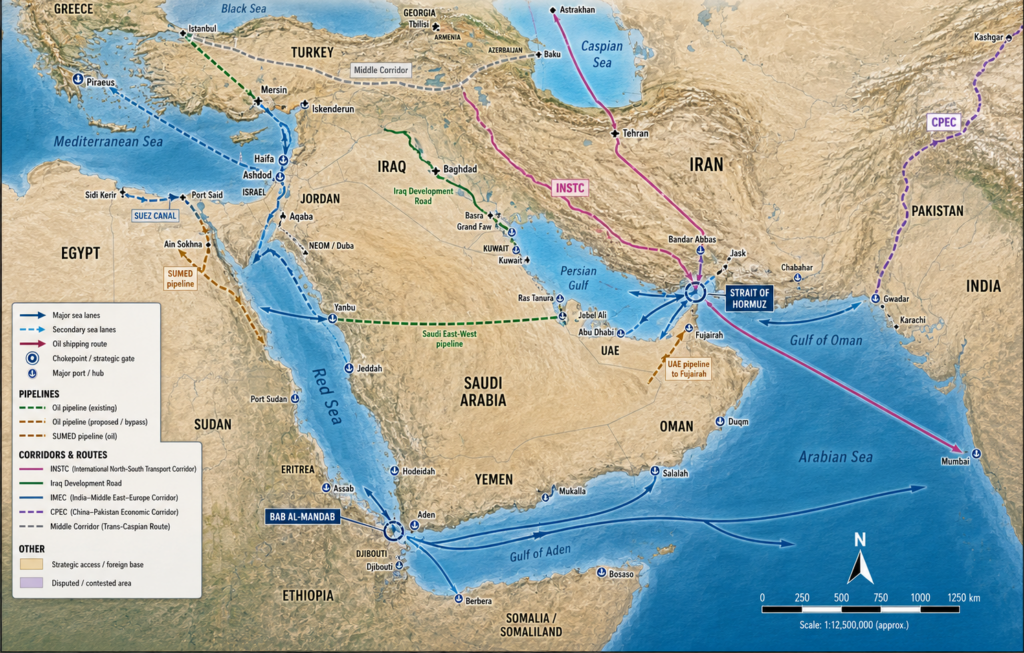
Before the conflict, roughly twenty million barrels of oil and petroleum products moved through the Strait each day. That figure is often repeated, but its real significance becomes clearer only when those flows stop or even partially slow. What matters is not just the volume but the absence of alternatives. Even under optimistic assumptions, rerouting capacity through pipelines and other corridors covers only a fraction of that flow. The rest does not disappear smoothly. It backs up into production systems. Wells are shut in. Storage fills. Supply chains that depend on continuous throughput begin to stall. What appears as a disruption in transit becomes a disruption in production itself.
What has made the current situation particularly destabilizing is not a full physical closure of the Strait, but the way risk has been redefined. A relatively small number of targeted attacks has been enough to alter the behavior of the entire shipping industry. Insurance costs rise sharply. Operators hesitate. Transit decisions are delayed or rerouted. The system does not require complete shutdown to experience effective paralysis. It only requires enough uncertainty to shift the risk calculus. This is a form of disruption that operates through perception as much as through physical constraint.
The price response reflects this dynamic. Oil markets react not only to actual shortages but to expectations of sustained disruption. A movement from around sixty to above one hundred dollars per barrel in a short period is not simply a market fluctuation. It signals a reassessment of structural risk. The more important question is not whether prices rise, but how long they remain elevated. If disruption persists, the effect compounds. Higher prices feed into transportation, production, and consumer costs across multiple sectors. The shock moves outward from energy into the broader economy.
The Iran war Strait of Hormuz dynamic also reveals the limits of mitigation tools that are often assumed to stabilize markets. Strategic reserve releases can offset part of the shortfall, but their scale remains limited relative to the disruption. Releasing several million barrels per day sounds substantial until it is measured against a potential loss of ten or more million barrels per day from constrained flows. These measures buy time, but they do not resolve the underlying imbalance. They are temporary buffers in a system that is experiencing sustained pressure.
What is less visible, but potentially more consequential, is how this disruption interacts with sectors that are not usually associated with the Strait. Fertilizer is one of the clearest examples. A significant share of global fertilizer production depends on inputs and exports that pass through or originate in the Gulf. When these flows tighten, the effects do not remain confined to the region. They propagate into agricultural systems worldwide. Fertilizer prices rise quickly because supply is concentrated and alternatives are limited. Farmers respond by reducing application or absorbing higher costs, both of which translate into lower yields or higher food prices in subsequent seasons. The time lag masks the connection, but the causality is direct.
At the same time, the Gulf has taken on a growing role in supply chains that extend beyond traditional commodities. The targeting of data infrastructure in the region introduces a different dimension of vulnerability. Data centers are not simply commercial facilities; they are critical nodes in digital and artificial intelligence systems. Their concentration in a region exposed to kinetic conflict creates a new type of risk. Unlike energy, where diversification has been an ongoing strategy, the rapid expansion of digital infrastructure has often prioritized efficiency over resilience. The result is a form of dependency that is only now becoming visible.
This layering of vulnerabilities changes how the crisis should be understood. It is not a sequence of isolated disruptions but a convergence of them. Energy, food production, and digital infrastructure are being affected simultaneously, each amplifying the others. Higher energy prices increase the cost of agricultural production. Fertilizer shortages reduce output. Food prices rise, adding pressure to already fragile economies. At the same time, disruptions to digital infrastructure affect financial systems and logistical coordination. The system becomes more tightly coupled under stress rather than less.
There is also a macroeconomic dimension that is beginning to take shape. Sustained increases in energy prices create inflationary pressure at a time when many economies are already balancing slowing growth and elevated debt levels. Central banks face a familiar but difficult trade-off. Tightening policy to control inflation risks further slowing growth, while easing policy risks allowing inflation to become embedded. This dynamic resembles earlier periods of supply-driven shocks, where the source of inflation lies outside the control of monetary policy.
The Iran war Strait of Hormuz crisis therefore sits at the intersection of multiple constraints. It exposes the limits of supply flexibility, the concentration of critical inputs, and the fragility of coordination mechanisms that are expected to respond in moments of disruption. It also reveals how much of the global system depends on continuous flow rather than stored resilience. When that flow is interrupted, even partially, the effects do not remain localized.
What becomes clear is that the Strait is not simply a passage that can be opened or closed. It is a structural node in a network that has grown more complex and more interconnected over time. Disruptions at this node do not produce linear effects. They produce cascading adjustments that move through energy markets, agricultural systems, financial structures, and technological infrastructure. Each layer responds differently, but all are connected.
This is why the focus on reopening the Strait, while necessary, is insufficient as a framing. Even if traffic resumes, the adjustments already set in motion will continue to unfold. Prices will remain elevated until confidence returns. Supply chains will reconfigure, often at higher cost. Strategic decisions about infrastructure, sourcing, and dependency will shift in ways that persist beyond the immediate crisis.
The deeper implication is that the system itself is being tested. Not in terms of whether it can withstand a single shock, but in terms of how it absorbs multiple, overlapping pressures. The Iran war Strait of Hormuz situation is showing that resilience is unevenly distributed and that the costs of disruption are not shared equally. Some actors can buffer the shock. Others cannot. The redistribution of those costs is likely to shape economic and political outcomes long after the immediate crisis fades.