The Strait of Hormuz disruption is usually described in terms of oil. Tankers stop moving, prices react, and energy markets enter a familiar cycle of volatility. That framing is incomplete. What is unfolding is not simply an energy shock but a systemic disruption affecting the material foundations of food production, water access, and agricultural stability. The consequences extend well beyond the Gulf and, if sustained, risk triggering a wider structural crisis in global supply systems.
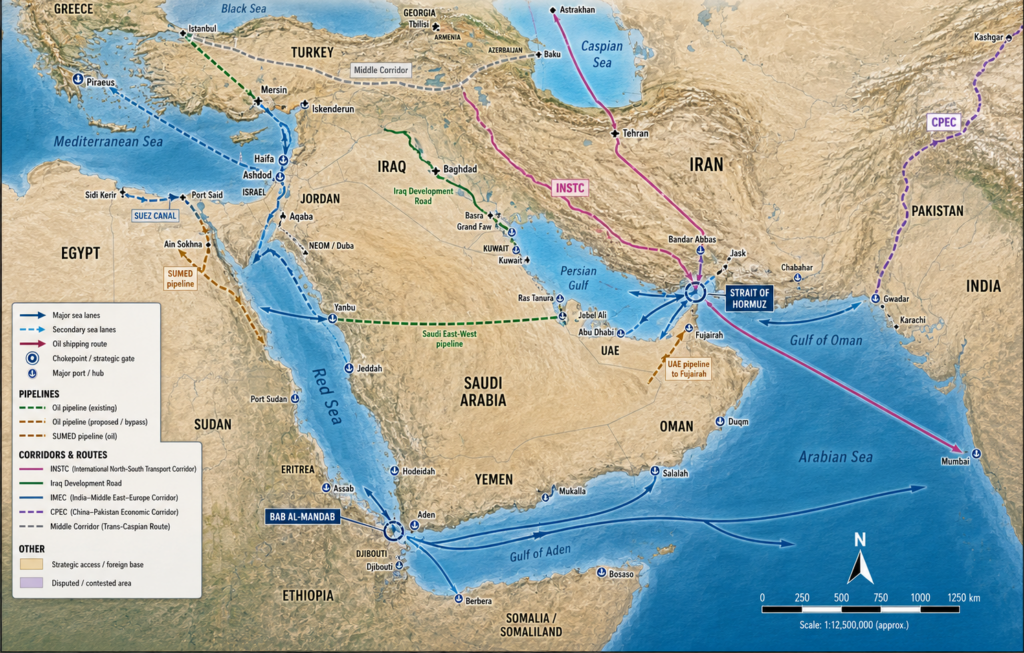
The Gulf has long functioned as a logistical corridor not only for hydrocarbons but also for essential commodities that sustain entire regions. Countries across the Middle East and North Africa depend heavily on imports of staple goods. In many cases, this dependence approaches total reliance. Grains, vegetable oils, and animal feed arrive through maritime routes that pass directly through the Strait of Hormuz. The disruption of this corridor therefore acts less like a temporary blockage and more like a systemic choke point. Supply chains do not simply slow down; they begin to fracture.
This fragility is amplified by the structure of regional consumption. Per capita wheat consumption in parts of the Middle East and North Africa remains among the highest globally. Bread is not just a commodity but a political constant. When prices move sharply, the effect is immediate and visible. The historical record shows how quickly food instability can translate into broader social pressure. The events of the early 2010s demonstrated that external shocks in agricultural markets can cascade into political consequences when combined with existing economic strain. The current situation carries similar ingredients, but with greater interdependence and less slack in global supply.
The Strait of Hormuz disruption interacts with an already strained global system. Food insecurity is not confined to one region. Hundreds of millions of people worldwide face varying degrees of hunger, and several regions operate on the edge of famine conditions. In such an environment, even a moderate disruption in supply can produce disproportionate effects. What might appear as a regional logistical issue can evolve into a multiplier of existing crises. The system does not absorb shocks evenly. It transfers them toward its weakest points.
Water adds another layer of structural vulnerability. Much of the Gulf depends on desalination for drinking water. This reliance creates a highly centralized and infrastructure-dependent system. Desalination plants require stable energy inputs and physical protection. Any disruption, whether through direct targeting or indirect operational constraints, has immediate consequences. In some states, the vast majority of potable water originates from these facilities. The margin for disruption is therefore extremely narrow. Water security, in this context, becomes inseparable from broader geopolitical stability.
The relationship between water and energy further complicates the situation. Desalination is energy-intensive. When energy systems are disrupted, water production becomes more fragile. When infrastructure is threatened, the risk multiplies. This interdependence creates a feedback loop in which disruptions in one sector amplify vulnerabilities in another. The Strait of Hormuz disruption thus operates across systems rather than within a single domain.
Fertilizer introduces a third, often overlooked, dimension. Agricultural production depends heavily on chemical inputs, and a significant share of global fertilizer exports originates from Gulf states. These exports rely on both natural gas feedstock and stable shipping routes. When maritime flows are interrupted, fertilizer markets tighten quickly. Prices respond almost immediately, reflecting both reduced supply and increased uncertainty.
The consequences of fertilizer disruption extend far beyond the region. Modern agriculture depends on consistent input levels. When fertilizer becomes more expensive or less available, yields decline. Farmers adjust planting decisions, reduce application rates, or absorb higher costs. Each of these responses feeds into higher food prices and reduced availability. The effects are not immediate but accumulate over time, often appearing months later in the form of reduced harvests.
Recent history provides a clear reference point. Disruptions linked to earlier conflicts reshaped global fertilizer markets and pushed prices well above historical norms. Those effects persisted long after the initial shock. The current situation carries similar dynamics but operates within a more fragile global environment. Supply chains have already adjusted to previous disruptions, leaving less capacity to absorb new ones.
The Strait of Hormuz disruption therefore creates a layered crisis. It restricts food imports into highly dependent regions, destabilizes water systems that rely on continuous operation, and constrains fertilizer flows that underpin global agriculture. Each of these effects would be significant on its own. Combined, they form a systemic risk that extends well beyond the immediate geography of the Gulf.
What makes this situation distinct is the way these elements interact. Food, water, and fertilizer do not operate independently. They form an interconnected system in which stress in one area propagates through others. Reduced fertilizer availability affects crop yields, which in turn influences food prices. Water constraints limit agricultural capacity and increase reliance on imports. Disruptions in shipping affect all three simultaneously. The result is not a series of isolated problems but a single, interconnected crisis.
This dynamic also reshapes the concept of security. Traditional approaches tend to focus on military and energy considerations. The current situation suggests that food systems, water infrastructure, and agricultural inputs must be understood as central components of strategic stability. When these systems are disrupted, the effects can rival or exceed those of more conventional threats.
The global implications are difficult to ignore. Countries far removed from the Gulf depend indirectly on its stability through interconnected supply chains. Fertilizer shortages affect agricultural output in distant regions. Food price increases influence global markets. Vulnerable states, particularly those with limited financial capacity, face the greatest risk. In these contexts, even small changes in price or availability can produce significant humanitarian consequences.
The Strait of Hormuz disruption thus represents more than a regional disturbance. It reveals how tightly coupled global systems have become and how quickly localized events can produce global effects. It also highlights the limits of current resilience. Supply chains optimized for efficiency often lack the redundancy needed to absorb shocks of this scale.
If the disruption persists, the most likely outcome is not a single dramatic collapse but a gradual tightening of constraints across multiple systems. Prices will adjust, trade routes will shift, and new intermediaries will emerge. Yet these adjustments come with costs. They redistribute risk rather than eliminate it. In many cases, they transfer the burden to regions least able to bear it.
What emerges from this analysis is a different understanding of the situation. The Strait of Hormuz is not only a strategic waterway but a structural node in global systems of food, water, and agricultural production. Disruptions at this point reverberate outward in ways that are both predictable and difficult to contain. The energy narrative captures only the surface. The deeper impact lies in the systems that sustain daily life across much of the world.