The most revealing feature of the present international moment is the poverty of the vocabulary with which it is being described. Public discourse has become crowded with phrases such as “new world order,” “multipolarity,” “post-American world,” “geopolitical transition,” and “the return of history,” yet these expressions often function less as concepts than as gestures toward confusion. They announce movement without explaining its direction, register anxiety without identifying its structure, and convert a crisis of theory into a fashion of language. The task, therefore, is to resist the premature naming of an order that has not yet acquired institutional form, ideological coherence, or normative authority, while taking seriously the deeper fact that the inherited architecture of global governance no longer possesses the persuasive force, managerial capacity, or symbolic legitimacy that once allowed it to organize the conduct of states.
The contemporary world should be approached as a condition of hegemonic depletion. This term is preferable because it captures the central paradox of the age: the institutions of the old order continue to operate, the United States retains immense military, financial, technological, and cultural power, the dollar remains central to global liquidity, NATO continues to expand its strategic vocabulary, and liberal international law still claims universality, yet the authority that once enabled these structures to appear as the natural language of world politics has been profoundly damaged. The machinery remains visible, active, and often coercive, while the aura of inevitability surrounding it has faded. In Gramscian terms, the crisis lies in the weakening of hegemony as consent-producing domination. In the language of Robert Cox, the historical bloc that joined material power, institutions, and ideas into a coherent world order has entered a phase in which its components no longer reinforce one another.
A durable international order requires more than preponderant force. It requires the successful conversion of hierarchy into legitimacy. The genius of the American-centered order after 1945, and especially after 1991, was its ability to present American preferences as global rationality. Bretton Woods appeared as economic stabilization. NATO appeared as collective security. The expansion of markets appeared as modernization. Liberal democracy appeared as the horizon of political development. Human rights appeared as a universal moral grammar. The dollar appeared as neutral liquidity rather than imperial infrastructure. Washington’s power was most effective when it could disappear into procedure, institution, expertise, and law.
That disappearance has become increasingly impossible. The Iraq War shattered the claim that legality constrained force when force served the strategic imagination of the hegemon. The 2008 financial crisis damaged the priesthood of market liberalism by revealing that the guardians of global financial rationality had built a system capable of exporting catastrophe. The annexation of Crimea in 2014 and the war in Ukraine after 2022 demonstrated the return of territorial revision, spheres of influence, and hard security dilemmas at the center of world politics. The American withdrawal from the Joint Comprehensive Plan of Action showed that even a multilateral agreement endorsed by major powers could be undone by electoral turnover inside the United States. Gaza after October 2023 transformed a regional catastrophe into a global crisis of normative credibility, because the gap between humanitarian language and strategic selectivity became politically visible across much of Asia, Africa, Latin America, and the Islamic world.
These events should be read as cumulative evidence of a broader process. The existing order has entered a condition of institutional overextension and normative underperformance. Its institutions produce resolutions, communiques, reports, legal interpretations, sanctions packages, emergency sessions, diplomatic formulas, and humanitarian vocabularies, yet their capacity to generate compliance, settle conflict, or command moral confidence has contracted. The result is a peculiar historical condition in which the institutional surface of order survives while the deeper grammar of obedience erodes.
This is the key to understanding the present. Order does not collapse only when institutions disappear. More often, order decays when institutions remain but cease to organize belief. The League of Nations did not vanish before its failure became evident. The Concert of Europe did not need formal abolition before the forces of nationalism, imperial rivalry, and militarized alliance politics overwhelmed it. The post-Cold War liberal order now confronts an analogous crisis of credibility. Its rules still matter, its punishments still hurt, its rewards still attract, yet its claim to universality has become contested by actors who increasingly experience that universality as the provincial morality of a powerful minority.
This does not vindicate crude realism, although realism has regained much of its explanatory force. Kenneth Waltz was right to insist that anarchy compels states to attend to survival. John Mearsheimer was right that great powers seek strategic depth and resist encirclement when they possess the capacity to do so. Robert Gilpin was right that orders become unstable when the distribution of prestige and authority no longer corresponds to the distribution of material power. Charles Kindleberger was right that global systems require leadership capable of providing public goods, and that systemic crisis deepens when the leading power lacks either capacity or will. Yet the present cannot be reduced to the mechanics of polarity, because the crisis is simultaneously material, institutional, ideological, and civilizational. Power has shifted, but so has the meaning of legitimacy.
For this reason, a more ambitious theory is required. The world has entered a period of atmospheric politics. In earlier phases of order, states acted within a relatively stable architecture of rules, alliances, financial circuits, and ideological expectations. In the present phase, those very structures behave like weather systems. Sanctions move like storms across banking networks. Supply chains become climates of vulnerability. Currencies become instruments of pressure. Technologies become borders. Energy corridors become strategic fronts. Platforms become arenas of perception management. Legal institutions become fields of symbolic struggle. Undersea cables, ports, data centers, rare earth minerals, insurance regimes, payment systems, grain routes, and drone supply networks now belong to the same grammar of power as armies and treaties.
Atmospheric politics means that sovereignty is increasingly measured by a state’s capacity to withstand interruption. The sovereign state of the coming era will be the one capable of absorbing shocks across finance, food, energy, technology, narrative, and security without losing strategic coherence. Territorial control remains essential, yet it no longer exhausts the meaning of sovereignty. A state may possess borders and still be penetrated by monetary dependency, technological exclusion, food insecurity, informational capture, elite compradorization, or logistical fragility. The classical Westphalian state claimed jurisdiction. The atmospheric state must develop resilience.
This transformation explains the political importance of the Global South. The Global South should be understood less as a unified bloc than as a historical field of accumulated suspicion toward the universal claims of Western power. Its unity is episodic, uneven, and frequently exaggerated, since India, Brazil, Iran, South Africa, Indonesia, Saudi Arabia, Egypt, Turkey, Nigeria, and Vietnam do not share a single ideology, threat perception, economic model, or strategic horizon. Yet these states and societies share an inherited memory of being governed through doctrines that arrived in universal language and operated through hierarchy. Civilization, mandate, development, modernization, structural adjustment, humanitarian intervention, counterterrorism, democracy promotion, and rules-based order belong to different historical vocabularies, yet each has been used at different moments to discipline non-Western political agency.
The Global South has therefore emerged as a politics of withheld consent. It does not yet offer a coherent alternative world order. It does not possess a single institutional center, ideological doctrine, or command structure. Its significance lies in its growing refusal to treat Atlantic priorities as identical with global priorities. The war in Ukraine, the rise of China, the weaponization of finance, the uneven memory of intervention, the politics of vaccine access, the climate finance dispute, and the war in Gaza have all intensified this refusal. Much of the non-Western world is no longer willing to accept that Western urgency automatically defines the moral calendar of humanity.
This refusal has deep theoretical meaning. In the tradition of Immanuel Wallerstein, one might say that the semi-periphery has become more politically articulate within a world-system whose core can no longer monopolize either production or legitimacy. In the language of Giovanni Arrighi, the long twentieth century of American systemic leadership has entered a turbulent phase in which financialization, military overstretch, and Asian industrial ascent point toward a rearrangement of global accumulation. In the spirit of Karl Polanyi, one can read the present as a countermovement against the social and strategic violence of market universalism. The liberal era globalized vulnerability, then taught states that vulnerability could be weaponized. The resulting countermovement is protectionist, developmental, civilizational, regional, and strategic all at once.
The sacred term of the 1990s was openness. The sacred term of the 2020s is resilience. This substitution marks a civilizational turn in political economy. States now seek industrial policy after decades of being told that industrial policy was backward. They seek payment alternatives after discovering that financial infrastructure could become a weapon. They seek food security after learning that grain corridors can become hostage to war. They seek technological sovereignty after seeing chips, platforms, satellites, cloud systems, and operating standards become instruments of strategic exclusion. They seek regional depth after globalization exposed the fragility of distant dependency. The dream of frictionless interdependence has yielded to the age of managed exposure.
Iran occupies a distinctive position within this transformation because it has long lived under conditions that many states are only beginning to theorize. Iran has experienced the disciplinary underside of the American-centered order through sanctions, financial isolation, nuclear securitization, military encirclement, covert pressure, narrative delegitimization, and conditional diplomacy. Its modern strategic consciousness has been formed inside a laboratory of coercive interdependence. For Iran, the weaponization of the global system is not a recent discovery. It is the basic environment within which statecraft has been practiced for more than four decades.
This gives Iran a certain epistemic advantage, provided that it is disciplined by intellectual seriousness. Iran knows that international order can punish without invading, isolate without occupying, and restructure incentives without declaring war. It knows that banking channels, insurance mechanisms, shipping registries, technology licenses, media frames, legal designations, and diplomatic recognition can operate as instruments of strategic pressure. It knows that sovereignty under modern conditions requires more than patriotic vocabulary. Sovereignty must be engineered through institutions, production, deterrence, knowledge, currency arrangements, industrial capacity, logistical alternatives, elite discipline, and social endurance.
Yet this experience also carries a danger. A state that survives pressure may begin to mistake survival for strategy. Resistance may become a ritual language rather than a program of national development. Strategic patience may deteriorate into bureaucratic inertia. Anti-hegemonic consciousness may become a substitute for economic transformation. The critique of Western domination may conceal domestic inefficiency, technological lag, fiscal weakness, environmental neglect, institutional fragmentation, and the absence of a coherent growth model. The exhaustion of the old order creates space for Iran, but space benefits only actors capable of occupying it with organized power.
The central Iranian question, therefore, concerns the conversion of geopolitical position into strategic capital. Iran’s geography is exceptional, but geography without infrastructure is only exposure. Iran’s civilizational depth is significant, but memory without institutional translation becomes nostalgia. Iran’s deterrent capacity is real, but deterrence without economic depth produces a defensive posture rather than a national project. Iran’s connection to the Global South is politically meaningful, but solidarity without trade corridors, banking mechanisms, technological cooperation, academic networks, and diplomatic coalitions remains rhetorical. Iran’s relations with China and Russia create maneuvering room, but maneuvering room can become dependency if it is not governed by a doctrine of strategic autonomy.
A serious Iranian theory of the present must begin by abandoning two symmetrical illusions. The first illusion is Western permanence, the belief that the American-centered order can recover its post-Cold War authority through moral repetition, technological superiority, and alliance discipline. The second illusion is automatic post-Western justice, the belief that the relative decline of American primacy will naturally produce a fairer, more plural, or more hospitable world. History offers no such guarantee. Declining orders can become more violent. Rising powers can be hierarchical. Regional powers can be predatory. Multipolar systems can generate flexibility, yet they can also generate miscalculation, fragmentation, and war.
Iran must therefore formulate its position through the concept of threshold sovereignty. A threshold sovereign is a state that lacks the capacity to govern the international system, while possessing sufficient geography, deterrence, identity, demography, institutional memory, and external connectivity to prevent absorption into the strategic design of any single great power. It is neither a satellite nor a hegemon. It survives by remaining indispensable across multiple arenas. It turns location into access, pressure into adaptation, ideology into diplomatic vocabulary, and vulnerability into bargaining knowledge.
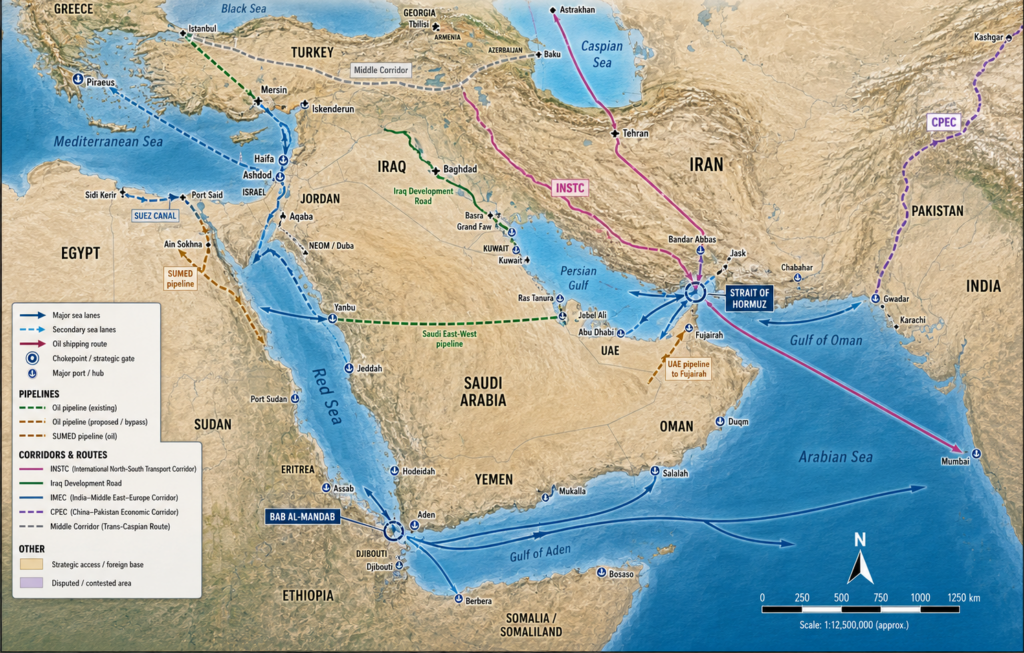
Iran has the ingredients of threshold sovereignty. It sits at the intersection of the Persian Gulf, the Caucasus, Central Asia, South Asia, the Levant, and the wider Indian Ocean system. It has access to energy resources, transit routes, civilizational networks, and conflict theaters that make it difficult to ignore. It possesses a strategic culture shaped by empire, revolution, war, sanctions, and regional competition. It has developed asymmetric instruments that complicate the freedom of action of superior military powers. It is embedded in the symbolic politics of the Islamic world, the security politics of West Asia, and the economic imagination of Eurasian connectivity.
These ingredients do not automatically produce power. They create a field of possibility. To become strategically consequential in the coming era, Iran must move from reactive endurance to formative statecraft. Reactive endurance means surviving pressure imposed by others. Formative statecraft means shaping environments before they harden into constraints. The difference is decisive. A state that only reacts becomes skilled at survival but poor at ascent. A state that forms its environment builds corridors, standards, partnerships, industries, narratives, and institutions before crisis forces improvisation.
The doctrinal implication is clear. Iran should pursue multi-vector autonomy rather than bloc attachment. Alignment with China or Russia against the West may produce tactical benefit, yet a great power never becomes a substitute for national strategy. China will pursue Chinese stability, Chinese access, Chinese markets, and Chinese bargaining leverage. Russia will pursue Russian depth, Russian status, and Russian negotiation space. Europe will oscillate between normative language and strategic dependence. The United States will remain powerful enough to punish, disrupt, and bargain even while its universality declines. The Global South will offer arenas of cooperation, but its internal diversity prevents any romantic doctrine of automatic solidarity.
Multi-vector autonomy requires Iran to cultivate relations across competing systems without surrendering strategic discretion to any of them. This means deepening eastern partnerships without becoming an appendage of eastern priorities. It means engaging the Global South through concrete developmental coalitions rather than symbolic anti-Westernism. It means preserving diplomatic channels with Europe where possible, even when Europe lacks full strategic independence. It means understanding the United States as an adversarial but enduring power whose decline should be studied with sobriety rather than celebrated with slogans. It means transforming regional diplomacy from crisis management into architecture building.
The regional dimension is crucial. West Asia has become one of the core theaters of atmospheric politics. Energy markets, maritime routes, religious legitimacy, drone warfare, proxy networks, normalization agreements, sanctions regimes, reconstruction economies, water stress, and external military deployments intersect in a dense field of insecurity. Iran cannot afford a purely negative regional doctrine built only around denial, deterrence, and resistance. Those instruments are necessary, but they do not by themselves produce a stable regional position. A mature Iranian doctrine would combine deterrence with economic regionalism, corridor diplomacy, water and energy bargaining, selective de-escalation, institutionalized neighbor policy, and the conversion of security influence into developmental interdependence.
The same logic applies to the Global South. Iran’s place in the Global South should be built through the politics of usable sovereignty. This would require practical initiatives around sanctions resilience, alternative payments, energy security, food security, pharmaceutical cooperation, infrastructure finance, academic exchange, media networks, and legal resistance to unilateral coercive measures. The Bandung spirit and the Non-Aligned Movement retain symbolic value, yet the twenty-first century requires operational non-alignment. Operational non-alignment means the construction of systems that allow states to say no without collapsing economically. It is a material doctrine, not a conference identity.
At the level of theory, Iran’s role may be understood through the interaction of four traditions. From realism, Iran must learn the discipline of power, threat perception, deterrence, and the limits of moral appeal. From historical sociology, it must learn that orders are made by long cycles of accumulation, war, state formation, and ideological production. From dependency and world-systems theory, it must learn that formal sovereignty can coexist with structural subordination. From constructivism, it must learn that legitimacy, identity, narrative, and recognition shape the field in which material power operates. A state that masters only one of these traditions becomes strategically incomplete.
The central theoretical claim can now be stated with precision. The current international transformation is the passage from hegemonic order to atmospheric contestation. In hegemonic order, hierarchy is stabilized by institutions that successfully universalize the preferences of the leading power. In atmospheric contestation, hierarchy persists, yet its legitimacy becomes unstable, its instruments become more openly coercive, and its opponents seek resilience rather than immediate replacement. The struggle of the age is therefore not the simple replacement of one order by another. It is the struggle over exposure. Who can expose whom to pressure? Who can withstand pressure? Who can transform pressure into leverage? Who can build enough internal density to remain politically sovereign under external turbulence?
This theory clarifies the stakes for Iran. The country’s future will be determined by its capacity to reduce involuntary exposure and increase chosen interdependence. Involuntary exposure means dependence on systems controlled by adversaries or unreliable partners. Chosen interdependence means the deliberate construction of ties that increase bargaining power, technological capacity, economic diversification, and diplomatic relevance. The first weakens sovereignty. The second operationalizes it.
Such a doctrine would judge policy by a simple but demanding criterion: does it increase Iran’s capacity to act under conditions of systemic turbulence? A foreign policy success that does not improve economic capacity, technological depth, financial resilience, regional stability, or institutional competence remains incomplete. A security achievement that produces endless economic isolation must be re-evaluated. An economic opening that produces strategic dependency must be treated with suspicion. A diplomatic victory that cannot be converted into investment, knowledge, infrastructure, or legitimacy is a temporary performance. Grand strategy begins when different instruments of power are forced to answer the same national question.
The coming world will not resemble the liberal optimism of the 1990s, the bipolar rigidity of the Cold War, or the imperial cartography of the nineteenth century. It will be plural, transactional, regionally dense, technologically stratified, financially weaponized, ecologically stressed, and narratively fragmented. It will contain American coercive capacity, Chinese industrial gravity, Russian disruption, Indian balancing, European regulatory power, Gulf capital, Turkish maneuver, African demographic significance, Latin American resource politics, and multiple forms of southern refusal. It will reward states that combine internal coherence with external flexibility. It will punish states that confuse rhetoric with capacity.
Iran’s historical opportunity lies in the fact that the old grammar of obedience has weakened. Its historical danger lies in the possibility that it may misread this weakening as sufficient in itself. A declining center does not automatically elevate the periphery. A contested order does not automatically empower the sanctioned. A fragmented world does not automatically favor the revolutionary. Advantage emerges only when a state possesses the administrative, productive, diplomatic, and intellectual means to turn turbulence into position.
The conclusion, then, should be neither triumphalist nor defensive. Iran stands before an international environment in which the inherited order has lost much of its innocence, the Global South has recovered a language of refusal, and great-power competition has reopened spaces that were previously closed. Yet the same environment is unforgiving. The age ahead will distinguish between states that merely denounce hierarchy and states that build the instruments required to survive and bargain within hierarchy. It will distinguish between civilizational memory and strategic doctrine, between resistance as identity and resistance as capacity, between geopolitical location and geopolitical power.
The exhaustion of order has created a rare theoretical and practical opening. For Iran, the question is whether this opening will be approached as a slogan, a mood, or a doctrine. Only the last matters. A doctrine adequate to the age would treat sovereignty as resilience, diplomacy as architecture, economy as security, technology as independence, region as depth, and the Global South as a field of structured cooperation rather than sentimental affiliation. It would recognize that the world is no longer governed by a single center of meaning, while also recognizing that the absence of a center can produce predation as easily as freedom.
Iran’s task is to become a state capable of acting under unstable skies. That requires a transformation in the quality of thought before it becomes a transformation in policy. The mist of the present will not clear soon. The point is to develop a theory of movement within it.