The old guard of the Persian Gulf still reaches for the cartel playbook. Abu Dhabi has stopped reading it. That split does more than shuffle a production quota. It reveals a region where fiscal clocks tick at different speeds, where geography now sells reliability instead of just volume, and where the Gulf Cooperation Council operates less like a bloc and more like a poker table where each player counts a different stack of chips.
The Real Measurement Is Fiscal Metabolism
Saudi Arabia and the UAE treat idle oil capacity with almost opposite arithmetic. Riyadh carries it as an insurance premium that stabilises the price floor. The Kingdom races an unforgiving domestic calendar. A young population needs jobs, housing and a social wage that the private sector cannot yet supply. Giga-projects like NEOM and the Red Sea developments demand simultaneous capital injections across multiple years. Spare capacity buys time. It keeps the price envelope wide enough to fund a simultaneous buildout that cannot be phased without political damage. Every barrel left in the ground underwrites the sequenced rollout of an entirely new economic geography.
Abu Dhabi looks at the same idle wells and registers a negative carry trade. The UAE sunk billions into upstream expansion over a decade. It linked new offshore capacity to a wholly owned trading arm. It carved out the Murban benchmark, a forward-priced crude that freed its barrels from the backward-looking formulas that long governed OPEC sales. Under a restrictive quota, that integrated system idles. Cash conversion stalls. The investment clock runs without returning revenue. In a state that funds its ambitions through velocity, that kind of delay costs more than a lower spot price.
Velocity defines the Emirati model. Dubai and Abu Dhabi do not need to build entire cities for a national workforce. They curate infrastructure, free zones and residency pathways that capture margin on movement. More activity means more port calls, more bunkering, more cargo, more warehouse leasing, more corporate registrations. That logic recoils from supply restraint. A barrel that cannot move robs the system of downstream margin. So the UAE’s preference for higher output is not impatience. It is metabolic.
Deliverability Has Become a Separate Market
Hormuz used to be a simple geography problem. Disruption meant panic. Panic lifted all prices together. That flattening effect is breaking apart. Buyers now discriminate between crude that might get stuck and crude that can route around the minefields.
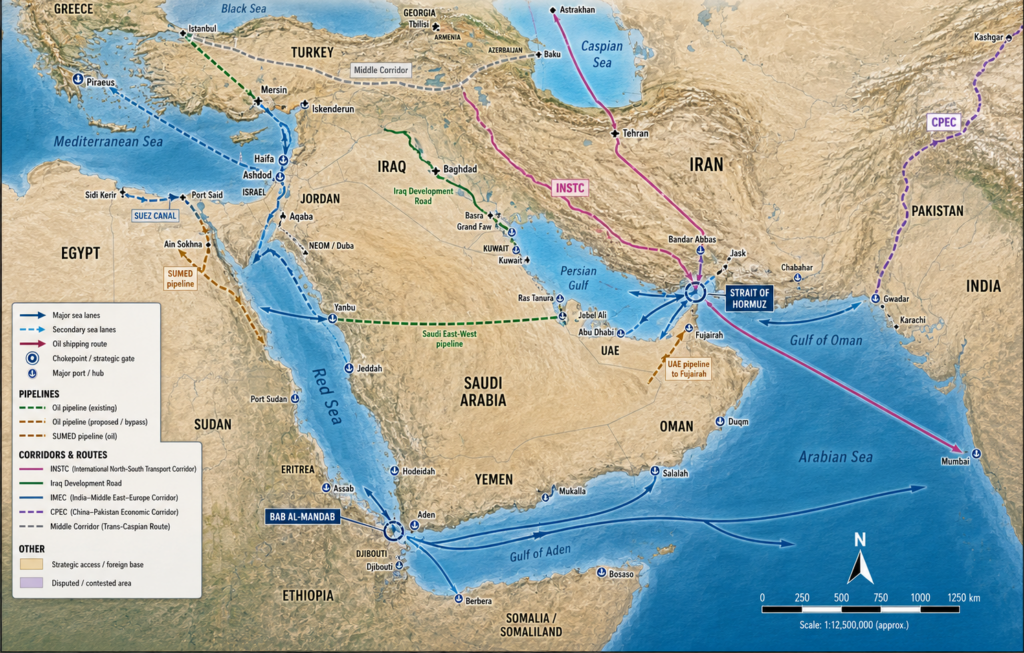
Abu Dhabi noticed early. The Habshan-Fujairah pipeline, bypassing the Strait entirely, moves up to 1.8 million barrels a day. Fujairah’s storage, blending and bunkering complex allows the UAE to stage crude and products outside the most exposed chokepoint. This is not just redundancy. It is a different product. Asian state refiners, particularly in India, China and South Korea, have started to price the advantage. A barrel from a supplier who can credibly guarantee delivery through a crisis carries a political and financial premium. The reliability premium shows up in term contracts, in the choice of strategic storage partners, in the blending deals that give a refiner flexibility when other crudes go dark.
Tehran’s strategic toolbox contains less leverage when this premium grows. Iran’s ability to generate geopolitical shock rests partly on the assumption that any Hormuz crisis automatically threatens all Arab shore crude. The UAE has spent years uncoupling its barrels from that assumption. The result is a fracturing of the Gulf energy map. Some crudes carry safety. Others carry a risk discount. Abu Dhabi actively markets the difference.
The GCC Fractures Have Hardened Into Divergent Paths
What gets called a “rift” within the GCC is really a sorting process. Each capital now bets on a distinct accumulation logic. The cartel covered that divergence. The post-cartel phase crystallises it.
Saudi Arabia builds a continent-scale domestic economy. State procurement steers demand. Sovereign investment in manufacturing, chemicals, mining and defence aims to pull supply chains inward. The regional headquarters ultimatum, obliging multinationals to locate in the Kingdom to access government contracts, is the sharp edge of that model. Riyadh wants a captive economic zone, dense and deep, that can survive the post-oil world as a self-contained production base.
The UAE aims for the opposite. Its model is the platform. It makes money when other people’s capital, goods and talent pass through a corridor it controls. Ports, air routes, data cables, financial free zones, visa regimes. The state does not need to own the factories. It wants to own the tollbooth. That logic demands constant flow and maximum connectivity. Quotas block the flow. The cartel blocks the connectivity. The Emirates now builds trade corridors with India, Indonesia, Turkey and Africa that bypass any Riyadh-centred industrial vision.
Qatar already executed its own exit. Gas supplied the insulation. Long-term LNG contracts lock in Asian buyers for decades. Prices often track different indices from crude. Doha’s withdrawal from OPEC in 2019 was a statement that its fiscal model had already decoupled from the cartel. But Qatar went further. It invested heavily in diplomatic autonomy, building partnerships with Turkey and Iran while the blockade attempted to starve that independence. The lesson Abu Dhabi took from the blockade was not that Qatar suffered. It was that a state with diversified logistics and a hard balance sheet can survive a regional siege. Today every GCC capital that can afford it seeks the same immunity.
Bahrain and Kuwait anchor the old order by necessity. Bahrain runs chronic deficits and needs regular support from Riyadh and Abu Dhabi to keep its currency and budget intact. The US Fifth Fleet headquarters provides a bargaining chip, but not one that generates self-sufficient revenue. Kuwait, despite deep reserves, remains politically gridlocked. Parliament blocks the kind of aggressive outward investment that would weaponise its sovereign fund. These states cannot join the high-velocity game. They become objects of Gulf power, not subjects.
Oman shops its neutrality. Muscat never joined OPEC. It maintains quiet channels to Tehran and Washington. Its expanding port at Duqm offers a conversation venue and a logistics alternative when threats spike. The Emirati bet on Fujairah as the reliability hub now competes with a quieter Omani offer. Asian buyers can choose between a high-speed commercial platform in the UAE and a low-profile diplomatic hedge in Oman. The market for safety starts to bifurcate.
Financial Coercion Replaces Bloc Solidarity
The old Gulf dispensed aid through ministries and multilateral funds. The new Gulf dispenses liquidity through central bank deposits, deferred oil payments and visa levers, each tied to political performance. Pakistan is the clearest laboratory. Abu Dhabi and Riyadh hold Pakistani dollar reserves, decide the timing of oil credit, and shape the remittance flow that millions of workers send home. These tools do not require any announcement. A delayed deposit, a slower rollover, a shift in worker recruitment targets. Islamabad reads the signal and adjusts its position on Iran, on maritime security coalition membership, on the China-Pakistan corridor.
The pattern repeats across the Red Sea arc. Egypt’s budget survival depends on Gulf deposits and investments. Cairo’s alignment on the Renaissance Dam, on Gaza security, on maritime boundaries in the eastern Mediterranean all reflect the price of that support. In Sudan, the UAE controls access to gold supply chains and port infrastructure through proxies. In Somaliland, Berbera port extends the same logic. The Gulf no longer buys influence with annual transfers. It takes a position on an economy’s balance sheet and manages the exposure like a investment fund, adjusting the terms continuously.
This financialisation destroys what remained of collective GCC diplomacy. Aid flows through bilateral channels. Conditions get set in quiet meetings between wealth fund managers and finance ministers. The weaker recipients find themselves managing multiple, sometimes conflicting, debt relationships with different Gulf overlords. The bloc becomes a set of competing creditor-debtor pairings, held together by nothing more than the dollar peg.
The Hidden Risk Is a Reversal of Global Capital Flows
Gulf sovereign wealth has outgrown its petrodollar recycling origins. ADIA, Mubadala, ADQ, the Saudi Public Investment Fund and the Qatar Investment Authority now supply long-duration dollar liquidity to the US technology sector, private credit markets and infrastructure funds that underpin the artificial intelligence buildout. This is no longer a passive portfolio allocation. It is a structural prop to the American innovation ecosystem.
A deep regional security crisis would reverse these flows almost instantly. Reconstruction of energy infrastructure, domestic security spending surges, currency support operations and emergency stockpiling would commandeer the available surplus. The Gulf funds would become liquidity absorbers rather than providers. The shock would transmit through venture capital, private equity and corporate bond markets faster than any oil embargo. Startups would struggle to close rounds. Pension funds that co-invest with Gulf capital would lose a partner. The cost of funding the AI race between Washington and Beijing would spike.
Abu Dhabi’s strategy feeds this latent risk. By uncoupling from Saudi-led OPEC management, the UAE increases the chance that Gulf producers move to a market-share logic that drives prices lower. Lower oil prices compress the surplus available for outward investment. A prolonged period of weakened petro-finance could dry up Gulf allocations to Western markets just when those markets are structurally dependent on that flow. The Emirati pivot to production maximisation is rational for its own balance sheet. It accelerates a systemic vulnerability elsewhere.
The UAE’s Wager: Convert the Gulf’s Disorder Into a Premium Offering
Abu Dhabi has drawn a sober map of the next Gulf decade. Hormuz will remain a fault line. US-Iran tension will cycle between escalation and stalemate. Iraq, Yemen, Sudan and the Horn will produce regular supply shocks that other producers struggle to manage. Climate adaptation costs will rise. The energy transition will eventually shrink the oil market’s long-term horizon.
Inside that map, the UAE sees a specific opportunity. Buyers will migrate toward supply chains that separate their crude from the regional security cycle. They will pay, in price terms and in strategic partnership terms, for guaranteed delivery, insured cargo and politically hedged infrastructure. The Emirates has built the physical plant, the trading framework and the diplomatic network to capture that migration. Its OPEC exit is the final piece. The quotas prevented it from scaling into the premium that disorder generates.
The wider GCC cannot follow. Saudi Arabia needs the cartel structure to fund a development race that depends on high prices and bloc leverage. Qatar already has its gas immunity. Kuwait and Bahrain lack the fiscal muscle to move. Oman competes on a different niche. The result is a clean break. The Gulf’s old order, built to manage scarcity collectively, gives way to an order where each national balance sheet fights for survival under its own logic. Abu Dhabi chose speed, optionality and the unsparing arithmetic of a platform state. The rest of the Gulf now has to decide whether to compete on those terms or cling to a cartel whose centre no longer holds.