The usual way of writing about China in the Persian Gulf is to ask whether Beijing will replace Washington as the region’s dominant power. That question is wrong. It assumes that the Persian Gulf’s political logic will remain what it has been for half a century: a single external patron supplying security in exchange for energy and diplomatic compliance. China is not trying to become that patron. It is trying to make that model of order feel old, unnecessary, and even risky. This memorandum argues that China’s strategic innovation in the Gulf is best understood as an effort to substitute continuity for command, economic presence for military bases, and diplomatic process for coercive guarantees. The result is not a clean Chinese victory over the United States but a slow, uneven erosion of the assumption that only American power can define what security in the Persian Gulf means.
The Core Distinction: Command versus Continuity
American power in the Gulf has always rested on command. Command means aircraft carriers that can launch strikes within hours, air bases that host thousands of American personnel, integrated missile defense systems that link Gulf radars to US Central Command, sanctions that can choke a country‘s economy, and the credible threat of force to protect oil flows. This model produces extraordinary hard power, but it also produces dependency, entanglement, and periodic backlash. Gulf monarchies know that American security guarantees come with strings attached: basing rights, intelligence sharing, arms purchases, and foreign policy alignment on major issues.
China offers something fundamentally different. Beijing provides continuity. Continuity means long term energy purchase agreements that lock in demand for decades. It means port financing that does not ask for political concessions beyond standard commercial terms. It means payment systems that can operate outside the SWIFT network if needed, reducing exposure to US sanctions. It means diplomatic mediation that emphasizes sovereignty and non interference rather than regime transformation. It means industrial demand so large that the Gulf‘s oil and gas have a guaranteed buyer regardless of who commands the waters of the Hormuz Strait. The Chinese offer is not protection; it is reliability. China will not defend you against an Iranian missile, but it will also not abandon you when American domestic politics turn inward. For Gulf states that have watched Washington’s commitments fluctuate with each presidential election, that reliability has genuine, if limited, appeal.
The 2026 Iran Crisis as a Test Case
The war that erupted around Iran in early 2026 provided a live demonstration of China‘s order making ambitions. While American forces engaged in direct strikes and naval interdiction, China pursued a different path. Foreign Minister Wang Yi spoke separately with his Saudi and UAE counterparts in early March and announced the immediate dispatch of a Middle East special envoy. That envoy, Zhai Jun, shuttled between Tehran, Riyadh, Abu Dhabi, and Islamabad throughout March and April, rarely appearing in headlines but consistently offering a diplomatic channel that did not require choosing sides. The resulting China Pakistan Five Point Initiative, unveiled in late March, called for an immediate ceasefire, rapid peace talks, protection of civilian infrastructure, and the restoration of normal navigation through the Strait of Hormuz.
On its face, this document is unremarkable. Any neutral party could have written it. Its significance lies not in the text but in the function it performs. By proposing a framework that all sides could endorse without losing face, China positioned itself as the defender of three principles simultaneously: the right of safe passage for commercial vessels, the sovereignty of all states involved, and the need for de escalation. That combination directly challenges the American habit of defining security through military access and unilateral sanctions. China cannot force a ceasefire; it proved unable to stop either Washington or Tehran from escalating when they chose to do so. But it can offer an alternative grammar of crisis management, one in which the United States is not the sole indispensable broker. Over time, this erodes the psychological monopoly that American power has enjoyed in the region since 1991.
Portfolio Security and the End of the Single Patron Model
The deeper structural shift is happening below the level of crisis diplomacy. Gulf states are quietly abandoning the idea that a single external guarantor can meet all their security needs. They are moving toward what several regional analysts now call portfolio security. The concept is simple. Instead of relying exclusively on the United States for hard power protection, Gulf capitals are assembling a diversified set of insurance policies. America remains the first call for conventional defense, weapons procurement, and intelligence sharing. China offers energy market stability, infrastructure financing, and diplomatic optionality. Russia provides tactical leverage and an alternative weapons supplier. Europe, when useful, supplies diplomatic cover and civilian technical assistance. India offers economic diversification and a counterweight to Chinese influence. And the Gulf states themselves are investing heavily in their own military capabilities, from Emirati drones to Saudi ballistic missiles.
China fits into this portfolio not as a replacement for the United States but as a hedge against American unreliability. This is a crucial nuance missing from much Western analysis. Gulf monarchies do not need to choose between Washington and Beijing. They need both. They need American F-35s and THAAD batteries to deter Iran. But they also need Chinese crude oil purchases, Chinese financed ports like Gwadar, and Chinese diplomatic support when Qatar or Turkey or Iran plays geopolitical games. The Chinese strategy does not demand exclusivity; it thrives on fragmentation. Each Gulf state that maintains a working relationship with Beijing, while keeping its American alliance intact, reduces Washington‘s bargaining power. The United States can no longer threaten to withdraw its protection as a means of extracting concessions, because Gulf states now have a second option. Not a perfect option, not a military option, but a real option nonetheless.
The UAE’s OPEC Exit and the Fragmentation of Energy Governance
The most dramatic illustration of this fragmented order appeared on May 1, 2026, when the United Arab Emirates announced its formal withdrawal from OPEC and the OPEC+ alliance, ending fifty nine years of membership. This decision was not, in its immediate causes, about China. The UAE left because OPEC+ production quotas had become intolerably restrictive. According to the May 2026 production plan, the Emirates faced a daily quota of 3.447 million barrels, while the Abu Dhabi National Oil Company had the capacity to produce more than 4.5 million barrels per day, with plans to reach 5 million barrels per day by 2027. In short, the UAE was carrying a massive volume of spare capacity that it could not monetize under Saudi led quota management. Energy Intelligence estimates that the Emirates‘ 4.75 million barrels per day of crude output capacity accounted for fourteen percent of all OPEC spare capacity. With the UAE gone, OPEC’s spare capacity drops from approximately 4.1 million barrels per day to just 2.8 million barrels per day, nearly eighty percent of that concentrated in Saudi Arabia alone.
The relevance of this decision to China’s strategy lies in its systemic implications. A fragmented OPEC is a weaker OPEC, and a weaker OPEC is less able to act as a unified cartel setting global energy prices. That creates space for alternative energy governance mechanisms. China has already launched the China Shanghai Cooperation Organization Energy Cooperation Platform, announced by President Xi in September 2025, which is explicitly designed to gradually construct unified regional energy governance rules. These rules are not meant to replace OPEC overnight, but they offer an alternative framework for energy producing states that feel constrained by traditional cartel discipline. The UAE, by leaving OPEC, is not aligning with China. It is pursuing its own national interest in production flexibility. But that very pursuit makes the UAE more open to Chinese led initiatives that promise less restrictive coordination. Beijing’s diplomats understand this dynamic perfectly. They do not need Gulf states to renounce OPEC; they simply need OPEC to become less cohesive, and for non OPEC mechanisms to become more attractive.
The Infrastructure Dimension: Ports, Corridors, and the Bypass of Maritime Chokepoints
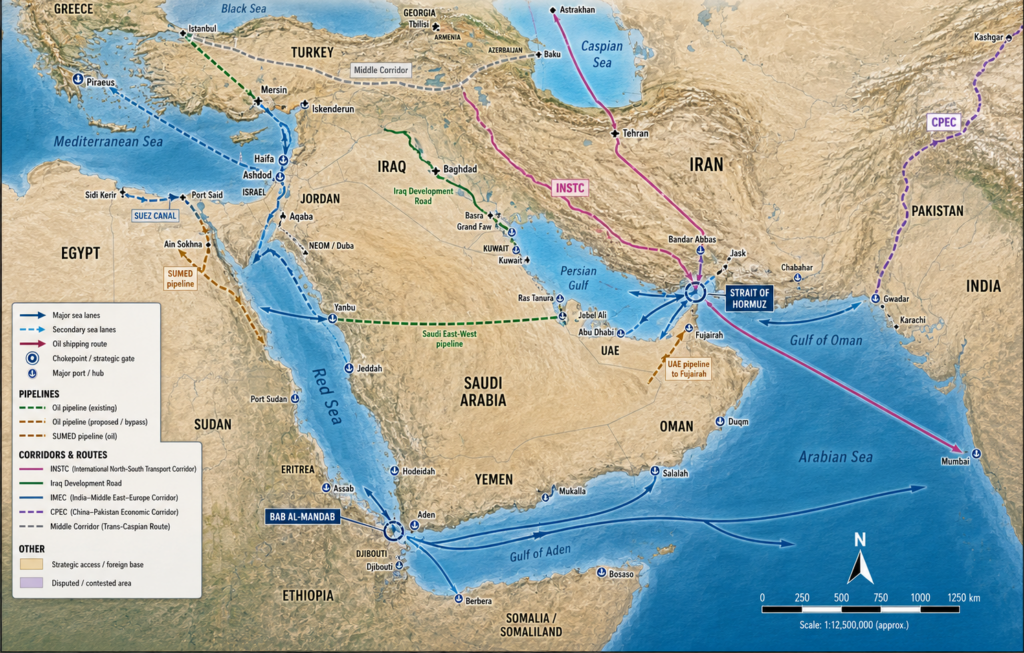
China‘s most visible presence in the Persian Gulf region is not military but infrastructural. The port of Gwadar in southwestern Pakistan, developed under the China Pakistan Economic Corridor as part of the broader Belt and Road Initiative, sits approximately four hundred kilometers east of the Strait of Hormuz. Its strategic importance to Beijing is immense. Nearly twenty percent of the world’s oil passes through the strait, along with over forty percent of China‘s imported oil. Gwadar offers a direct land sea link to China‘s western province of Kashgar, bypassing the Malacca Strait, which remains China’s most vulnerable maritime chokepoint. According to Pakistani officials, the route reportedly saves China approximately seventy one billion US dollars annually in trade to West Asia and Europe. Pakistan‘s Planning Minister Ahsan Iqbal has described Gwadar as the shortest trade route to the Gulf and Central Asia, with plans for ferry connections that leverage China’s strong trade presence.
Iran’s Chabahar port, located roughly seventy kilometers west of Gwadar, represents a competing infrastructure vision. India has historically been the primary backer of Chabahar, viewing it as a strategic counterweight to Chinese influence in Gwadar. But China has also maintained a working relationship with Chabahar, offering support for infrastructure development without displacing Indian investment. This dual port strategy exemplifies a broader Chinese approach: build presence everywhere, align with no one exclusively, and let the cumulative weight of Chinese demand and financing shift the region‘s center of gravity over time. The ports themselves are not military bases. They do not host Chinese warships, nor do they give Beijing the ability to close the strait. But they do give Beijing something arguably more useful in the long run: physical infrastructure that ties Persian Gulf energy producers to Chinese supply chains, creating a web of mutual dependence that no crisis can easily sever.
The Contradictions in China’s Security Discourse
No honest analysis of China’s Gulf strategy can ignore the contradictions it faces. The most important of these is geographic and thematic. In the Persian Gulf, China presents itself as a neutral mediator, a defender of sovereignty, and an advocate of non interference in the internal affairs of states. This language works well in a region where external intervention has a bloody and recent history. But in East Asia, specifically in the South China Sea and the Taiwan Strait, China speaks a different language. There, Beijing is simultaneously the claims maker, the rule interpreter, and the enforcement actor. The same sovereignty and territorial integrity principle that China invokes to protect Gulf states from American pressure is used by Vietnam, the Philippines, Malaysia, and the United States to challenge China‘s maritime claims.
This is not hypocrisy in any simple sense. It is strategic pragmatism, and every great power practices it. But it does create a credibility problem. When China calls for the inviolability of sovereignty in the Gulf, skeptical analysts in Washington or New Delhi can point to Chinese behavior in the Spratly Islands or the militarization of artificial features in the South China Sea. The more China builds its global security discourse around a principle it selectively applies, the harder it becomes to sustain that discourse as a universal standard. The contradiction is manageable for now, because Gulf states care little about the South China Sea and because Chinese mediation in the Middle East has produced tangible results, most notably the 2023 Saudi Iran rapprochement. But if the contradiction widens, if China’s own territorial assertiveness becomes more visible and more aggressive, the Gulf‘s willingness to accept Beijing as an honest broker may begin to erode.
China’s Persistent Energy Vulnerability
A second contradiction lies in China‘s own persistent dependence on the very sea lanes it seeks to reorder. Despite impressive efforts at diversification, including pipeline imports from Central Asia and Russia, long term LNG contracts with Qatar and Australia, and a rapid expansion of domestic renewable energy capacity, China remains deeply exposed to maritime chokepoints. Persian Gulf producers account for a major portion of China’s crude oil supply, and roughly three quarters of China‘s crude imports transit the Strait of Malacca. This means that for the foreseeable future, China depends on the safe passage of tankers through waters that the United States Navy, not the People’s Liberation Army Navy, guarantees.
This vulnerability is the hidden engine of China‘s Gulf strategy. Precisely because Beijing cannot secure these sea lanes on its own, it has an overwhelming incentive to build overland alternatives, to diversify suppliers, to lock in long term contracts, and to embed itself so deeply in the political economy of producer states that any disruption would harm China’s partners as much as it harms China. The vulnerability is not being eliminated. It is being reengineered into leverage. Each Chinese port built on the Arabian Sea, each yuan denominated oil contract, each Chinese financed refinery on the Gulf coast, incrementally reduces the asymmetry. But the underlying vulnerability remains. If a major power decided to test China‘s commitment to free navigation, or if a sustained conflict closed the Strait of Hormuz for months rather than weeks, China’s economy would suffer severe damage. The strategy of security without command works only as long as no one forces a direct test of its limits.
Strategic Implications for the Major Actors
For the United States, China‘s approach in the Gulf presents a dilemma that conventional military superiority cannot solve. The United States can sink any Chinese ship in the Persian Gulf. It can close the strait more effectively than Iran can. But it cannot force Gulf states to stop seeing China as a valuable partner. It cannot make its own security guarantees appear more reliable than they have been over the past two decades of war weariness and strategic contraction. China does not need to outfight the United States in the Gulf. It only needs to make American security provision appear insufficient, escalatory, or politically costly. Each Chinese mediation, each port completed, each energy contract signed, incrementally erodes the assumption that there is no alternative to the American guarantee. The United States can respond by doubling down on its military presence, but that would only reinforce China’s narrative that American power is coercive and interventionist. Or it can attempt to compete economically, but there it faces a Chinese system built precisely to win that competition.
For the Gulf states themselves, the emerging order is not a choice between Washington and Beijing. It is a series of overlapping insurance policies. The most sophisticated Gulf capitals, particularly Abu Dhabi and Riyadh, have learned to extract value from both powers. They accept American weapons and American bases because those provide genuine hard security against Iran. They accept Chinese investment and Chinese energy demand because those provide economic stability and diplomatic optionality. They maintain working relationships with Russia and Europe and India and Turkey, not because they trust any of these powers, but because dependence on any single patron has become too risky. The Gulf‘s future is not alignment but multi alignment, not loyalty but liquidity, not a single security provider but a portfolio of them. China understands this better than Washington does, and that understanding gives Beijing an edge in the long competition for influence.
For Iran, the strategic implication is paradoxical. China is not Iran’s natural ally. Beijing‘s first priority is the stability of energy flows, not the defeat of American power. A prolonged closure of the Strait of Hormuz would hurt China as much as it would hurt the United States. For this reason, Iran’s most effective form of leverage is not the ability to close the strait, which would turn China against Tehran, but the ability to make Persian Gulf order impossible without Iranian inclusion. If Iran can position itself as a necessary participant in any stable regional security architecture, then both China and the United States have an incentive to accommodate Iranian interests. That is a more durable form of power than simply threatening disruption. China can be useful to Iran in that second model. In the first model, disruption, China is a reluctant partner at best.
Conclusion: Making the Old Order Look Obsolete
China is not building a clean parallel order in the Persian Gulf. It is building escape routes from American monopoly. These routes do not yet amount to hegemony, but they are sufficient to change bargaining behavior across the region. The result is a world in which states do not have to abandon the United States centered system to reduce their dependence on it.
The concept of security without command is the best way to capture what China is attempting. It is an effort to reframe regional order around continuity of energy flows, economic interdependence, and diplomatic process, rather than military bases and coercive alliances. In the Persian Gulf, this has already altered the conversation. Gulf states now consult Beijing alongside Washington on major security questions. Chinese mediation efforts are taken seriously, even when they fail to produce immediate results. The assumption that American hard power is the exclusive legitimate guarantor of Gulf security has been broken, and it will not be restored, regardless of how many aircraft carriers the United States deploys.
Yet the strategy carries intrinsic contradictions. In East Asia, China‘s own territorial claims expose the limits of its non interference rhetoric. In the Persian Gulf, China cannot provide the hard security alternative that would be necessary if a true crisis erupted. Domestically, China’s energy vulnerability persists despite decades of diversification. The UAE‘s exit from OPEC is not a Chinese victory, but it is a symptom of the wider fragmentation that China can exploit. The Gwadar Chabahar competition gives China physical presence but also magnifies its exposure to regional instability.
The most important conclusion for strategic analysis is this. China’s strategy is not about winning in any conventional sense. It is about making the old way of winning look obsolete. The United States can still project more combat power into the Persian Gulf than any other nation. It can still protect oil tankers, destroy enemy missile sites, and evacuate American citizens. But it can no longer claim that its way of providing security is the only legitimate way. That loss of monopoly, that erosion of the assumption of indispensability, is more consequential in the long run than any single pipeline or port. China is not replacing America in the Gulf. It is making the concept of a single power‘s absolute primacy in security governance seem like a relic of a previous era. And that, for analysts of international relations, is the real story of China in the Persian Gulf today.