The crisis around Iran and the Strait of Hormuz should not be understood only as another Middle Eastern war, nor merely as a test of Iran’s military resilience or American coercive power. Its larger significance lies in the way it connects three strategic theaters that are usually analyzed separately: Gulf security, global energy stability, and the long-term rivalry between the United States and China. A conflict that begins with missiles, drones, maritime harassment, and nuclear brinkmanship can quickly become a wider contest over who can protect trade routes, discipline allies, absorb economic shocks, and impose costs without becoming overextended.
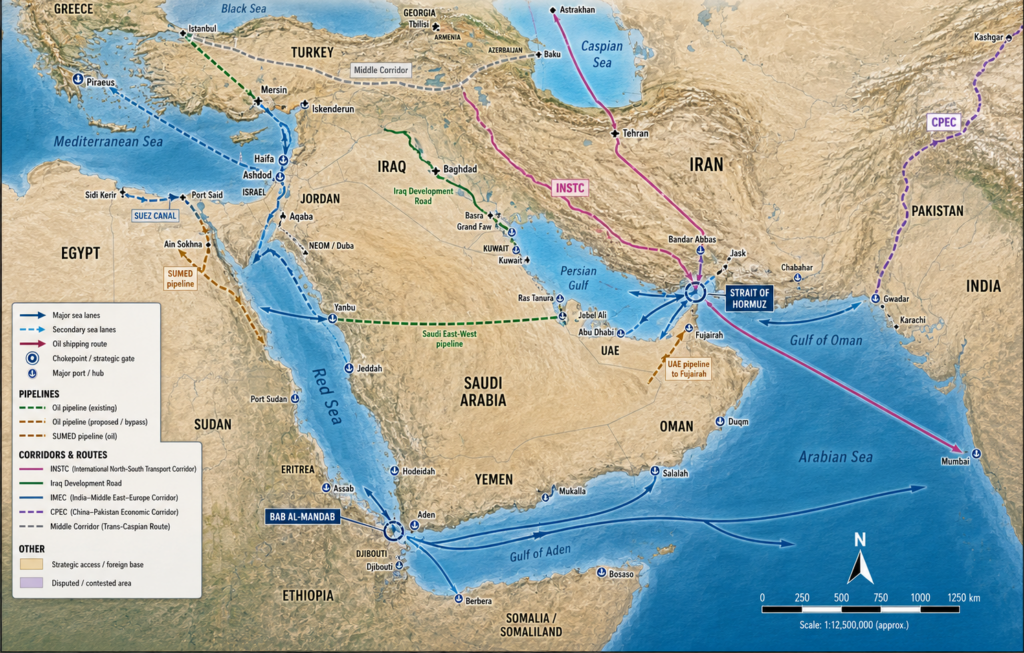
The central strategic fact is that the Strait of Hormuz is not simply a regional chokepoint. It is a hinge between military pressure and global economic pain. When access through Hormuz becomes uncertain, the consequences are transmitted through oil prices, LNG flows, freight insurance, refinery margins, diesel availability, food production costs, industrial output, and public tolerance for foreign policy risk. This means that the war’s geopolitical outcome may be determined less by the number of targets destroyed inside Iran than by the duration of disruption in maritime energy flows and the political reaction of energy-importing states.
The United States enters this crisis with overwhelming military advantages, but also with a familiar strategic vulnerability: it can punish adversaries faster than it can convert punishment into durable political settlement. China enters from the opposite position. It does not need to dominate the Gulf militarily in order to benefit from American difficulty there. Beijing can gain strategically if Washington appears unable to secure the global commons, if US allies begin to hedge under economic pressure, or if a prolonged campaign drains American military readiness that would otherwise be relevant in the Indo-Pacific.
The most likely near-term outcome is not a clean victory for either side. It is a contested pause, marked by partial de-escalation, incomplete maritime reopening, a damaged but still dangerous Iran, a cautious but opportunistic China, and allies that continue to support Washington publicly while quietly reassessing the economic and military costs of alignment. Such an outcome may look manageable in the first weeks after the guns fall silent, but its danger lies in the fact that it preserves nearly all the conditions for the next crisis.
The strategic meaning of Hormuz
Hormuz matters because it compresses global vulnerability into a narrow maritime corridor. A serious disruption does not merely affect Gulf producers or Asian importers. It unsettles the confidence on which global energy markets depend. Insurance premiums rise before physical shortages become visible. Refiners adjust before consumers understand why prices are moving. Governments release reserves before they know whether the crisis will last days or months. Markets respond not only to lost barrels, but to uncertainty over whether lost barrels will return.
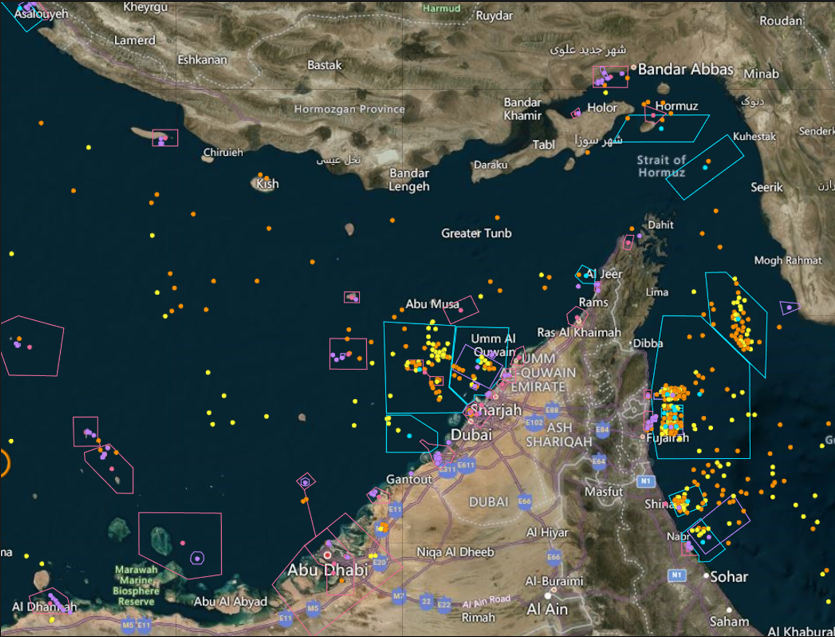
This is why the duration of disruption is more important than the symbolic question of whether the strait is formally “open” or “closed.” A formally open Hormuz can still function as a contested maritime zone if ships require pre-approved routes, military escort, special insurance, or political guarantees from hostile actors. In such a situation, the market may price risk as if the strait were partly closed, because commercial actors do not respond to diplomatic language. They respond to the probability that cargoes, crews, vessels, and contracts will be exposed to delay, seizure, attack, or arbitrary restriction.
The crisis therefore creates a hierarchy of outcomes. A short disruption is painful but absorbable, especially if strategic reserves, alternative routes, and coordinated diplomacy prevent panic. A medium disruption begins to change government behavior, because domestic political pressure rises and allies start asking how much economic pain they are expected to tolerate. A prolonged disruption becomes systemic, because it forces import-dependent economies to restructure consumption, prioritize essential sectors, ration fuel, and reconsider the reliability of the security architecture that allowed them to depend on Gulf energy in the first place.
The strategic center of gravity is not the strait itself, but the political consequences of uncertainty around the strait. If states conclude that Washington can restore secure passage quickly, the United States gains credibility even if the military campaign is costly. If they conclude that Washington can strike Iran but cannot restore predictable trade, then American power begins to look tactically impressive but strategically incomplete.
The deeper US dilemma
The United States faces a dilemma that has defined much of its post-Cold War military experience. Limited force may be sufficient to degrade adversary capabilities, but it often leaves the adversary with enough capacity and motivation to continue imposing costs. Decisive force may produce a clearer battlefield outcome, but it risks deeper entanglement, greater munitions expenditure, regional blowback, and reduced readiness for other contingencies.
In the Iranian case, this dilemma is sharper because Iran’s coercive power is distributed. It does not depend on a single platform, base, port, or command node. Its leverage comes from missiles, drones, mines, fast boats, coastal systems, proxy networks, intelligence assets, cyber tools, and the ability to operate in the gray zone between war and peace. The United States can destroy large portions of this architecture, but restoring confidence in maritime security requires more than destruction. It requires proving that Iran cannot repeatedly regenerate enough capability to keep Hormuz politically unstable.
This is where military success and strategic success begin to separate. A campaign may destroy high-value targets and still fail to reassure energy markets if commercial shipping remains nervous. It may weaken Iran and still fail to reassure allies if the political end state is vague. It may demonstrate American resolve and still strengthen China’s position if the cost of the campaign reduces US flexibility in the Indo-Pacific.
The question, then, is not whether the United States can defeat Iran in a direct military contest. It almost certainly can. The harder question is whether it can impose a settlement that is credible, enforceable, and economically stabilizing without exhausting the very resources and alliances that underpin its global position.
China’s advantage is not intervention, but optionality
China’s position is often misunderstood because analysts tend to ask whether Beijing will support Iran openly. That is the wrong starting point. China’s greatest advantage in this crisis is not the ability to intervene dramatically, but the ability to choose among several levels of involvement while Washington carries the visible burden of escalation management.
A passive China can still gain. It can purchase discounted energy where possible, deepen economic dependence in a weakened Iran, present itself to parts of the Global South as a critic of Western escalation, and observe how the US military performs under pressure. It can study American logistics, munitions consumption, command tempo, alliance coordination, naval vulnerabilities, and domestic political tolerance without firing a shot. In strategic terms, Beijing can let the crisis become a diagnostic tool.
A more active China would not necessarily send forces or enter the conflict directly. It could provide intelligence support, communications assistance, cyber capabilities, sanctions evasion channels, diplomatic protection, dual-use logistics, financial mechanisms, and reconstruction support. Such assistance would be designed not to win the war for Iran, but to prevent Iran from collapsing as a useful anti-US partner. Beijing’s objective would be to keep Washington tied down, raise the cost of American action, and preserve a pressure point on the western side of the Eurasian landmass.
The most dangerous Chinese move would not be in the Gulf itself. It would be simultaneous pressure in another theater. If China judges that US forces, attention, and political capital are absorbed by Iran, it may increase military activity around Taiwan, intensify pressure in the South China Sea, or test US alliance commitments in East Asia. Even if such moves remain below the threshold of war, they would force Washington to manage multiple crises at once, which is precisely the type of strategic overextension Beijing would like to expose.
This is why the Iran war matters for the Indo-Pacific. It does not need to directly involve Taiwan to affect Taiwan. It can change Beijing’s assessment of American readiness, alliance cohesion, stockpile depth, and decision-making under stress.
Four strategic pathways
1. Contested stabilization
The most likely scenario is a limited and uneasy stabilization in which the United States avoids deeper escalation, Iran accepts a temporary reduction in pressure, China remains publicly restrained, and Hormuz becomes formally navigable but practically insecure. This outcome would allow all parties to claim partial success while leaving the core strategic dispute unresolved.
For Washington, this would mean that military action succeeded in damaging Iranian capabilities but failed to produce a decisive settlement. For Tehran, survival itself would become a political asset, especially if the regime could argue that it endured US and Israeli pressure without capitulating. For Beijing, the result would be useful because Iran would remain available as a weakened but valuable partner, while the United States would appear unable to fully convert military superiority into political closure.
The long-term effect of this scenario would be gradual erosion rather than sudden rupture. Gulf states would continue to rely on the United States but would accelerate diversification toward China, India, and other partners. Asian allies would remain tied to Washington but would ask for more concrete guarantees on energy security. European governments would support deterrence in principle while resisting policies that worsen inflation and fuel costs. The US alliance system would not collapse, but it would become more transactional, more anxious, and more sensitive to domestic economic pressure.
This scenario is dangerous precisely because it may be mistaken for success. A crisis that stops short of catastrophe can still weaken the strategic position of the leading power if it leaves allies less confident, adversaries less deterred, and markets less certain.
2. Energy shock and strategic fragmentation
A more damaging scenario emerges if the disruption around Hormuz persists long enough to impose visible economic pain on import-dependent states. In this pathway, the key driver is not battlefield escalation but the cumulative political effect of shortages, price spikes, diesel stress, freight disruption, and inflation.
Once fuel costs become a domestic political problem, allied unity becomes harder to sustain. Governments that were willing to support pressure on Iran during the early phase of the war may begin to prioritize economic stabilization over geopolitical discipline. Sanctions enforcement may weaken. Quiet exemptions may multiply. Asian importers may seek practical arrangements that preserve energy access. European governments may resist further escalation if it worsens already fragile industrial conditions. Developing economies may reject alignment choices altogether and frame the crisis as another example of great-power conflict imposing costs on the rest of the world.
This is the environment in which China gains most without fighting. Beijing can present itself as a pragmatic economic actor rather than a military spoiler. It can deepen ties with Iran through discounted energy, infrastructure support, and diplomatic protection while encouraging the narrative that US policy is responsible for instability in global markets. The value of this narrative is not that everyone will believe it. Its value is that enough states under economic pressure may find it convenient.
In this scenario, the United States does not lose because it lacks military power. It loses ground because the economic consequences of the crisis begin to separate its partners from its strategy. The battlefield remains regional, but the political damage becomes global.
3. Decisive US action with limited Chinese response
A more favorable scenario for Washington would require a decisive campaign that not only damages Iran’s coercive infrastructure, but also restores confidence in Hormuz and produces a credible political framework after the fighting. This would likely involve systematic destruction of missile and drone networks, neutralization of coastal threats, disruption of command structures, seizure or removal of sensitive nuclear materials, and pressure sufficient to force Iranian capitulation or major political change.
If China remains passive, the result would strengthen the image of US primacy. Gulf partners would draw the conclusion that Washington remains the only actor capable of guaranteeing maritime security at scale. Iran would lose much of its value as a Chinese strategic partner. Regional actors that had been hedging might move closer to the United States, at least in the short term, because security dependence becomes clearer when danger is immediate.
Yet even this scenario is not cost-free. A decisive campaign against Iran would require sustained expenditure of high-end munitions, naval capacity, intelligence assets, air defense resources, and political attention. Some of these resources are difficult to replace quickly. If the United States emerges from victory with depleted stockpiles and reduced readiness for an Indo-Pacific contingency, China may conclude that Washington won the immediate contest while weakening itself for the larger one.
This is the paradox of decisive action. It may restore credibility in the Gulf while creating new questions about capacity elsewhere. For American strategy, the problem is not whether victory is possible, but whether victory can be achieved at a cost that strengthens rather than narrows US global options.
4. Multi-theater confrontation
The most dangerous scenario occurs if the United States escalates decisively and China responds by turning the crisis into a broader test of American power. Beijing would probably avoid direct war, but it could make the conflict far more difficult through indirect support to Iran and parallel pressure in East Asia.
This pathway would create a multi-theater strategic crisis. Washington would need to suppress Iran, keep Hormuz open, reassure Gulf partners, maintain support for Ukraine, deter China around Taiwan, protect global energy flows, and manage domestic inflationary pressure at the same time. Such a burden would test not only American military power, but the entire architecture of US global leadership.
The real danger would be cumulative strain. Iran would not need to defeat the United States. China would not need to enter the war. Russia would not need to open a new front. Each actor would only need to increase pressure in ways that stretch US attention, resources, and alliance discipline. Under such conditions, the crisis could harden the emerging alignment among China, Russia, Iran, and North Korea into something more operationally meaningful, even if it stops short of a formal alliance.
A US military victory in this scenario could become strategically ambiguous. It might eliminate major Iranian capabilities, but at the cost of deeper bloc formation, greater Chinese hostility, munitions depletion, energy market trauma, and allied fatigue. The United States would win the campaign while entering a more dangerous international order.
Energy policy as geopolitical strategy
The crisis also exposes a weakness in how governments think about energy security. Too often, energy policy is treated as a domestic economic issue until a crisis turns it into a national security issue. By then, the available options are already narrower.
In a prolonged Hormuz disruption, governments will face a choice between politically comfortable measures and strategically sound measures. Subsidies, tax cuts, price caps, and broad consumer compensation may reduce anger in the short term, but they also weaken the price signal that reduces consumption. If supply remains constrained, policies that protect demand today can produce deeper shortages tomorrow.
A more serious response would begin with demand prioritization. Essential sectors should be protected first, including food production, emergency services, freight transport, ports, agriculture, defense logistics, and critical manufacturing. Discretionary consumption should be reduced before shortages force indiscriminate rationing. Public transport should be expanded where possible. Work-from-home policies should be used for nonessential office activity. Freight rail and maritime efficiency should receive emergency priority. Governments should prepare the public for managed conservation rather than pretend that strategic reserves can absorb an open-ended disruption.
Diesel deserves particular attention because it sits at the center of the physical economy. Gasoline prices shape public anger, but diesel shortages threaten logistics, agriculture, construction, mining, shipping, and military mobility. A diesel crisis would not simply raise household costs. It would weaken the systems that move food, goods, equipment, and raw materials.
The political challenge is that demand reduction must be presented as a national resilience measure, not as technocratic austerity. Citizens are more likely to accept hardship when the purpose is clear, the burden is shared, and leaders explain why early discipline prevents later chaos. Sudden price shocks produce anger. Managed rationing may be unpopular, but it can be understood as fairer than a market scramble in which wealthy consumers buy access while essential sectors compete for supply.
Alliance cohesion is the real battlefield
The most important target for US adversaries is not necessarily a military asset. It is the political cohesion of the US-led system. Energy stress is one of the most effective ways to attack that cohesion because it translates distant conflict into domestic pain.
Asian allies face the most direct exposure because their energy security is deeply connected to Gulf flows. European states face industrial and inflationary vulnerability. Gulf monarchies face retaliation risk and must balance security dependence on Washington with economic ties to Asia. Developing economies face the most severe social consequences because fuel and food costs can destabilize fragile political systems. Each group experiences the same crisis differently, which makes a unified response difficult.
For Washington, this means that military planning cannot be separated from alliance management. A strategy that is clear to military commanders but unclear to allies will not hold. Partners need to know the objective, the expected duration, the energy mitigation plan, the burden-sharing mechanism, and the conditions under which escalation will stop. Without this clarity, hedging becomes rational.
The United States therefore needs a political strategy as much as a military one. It must define what level of Iranian capability is unacceptable, what guarantees are required to keep Hormuz secure, how energy costs will be shared, how strategic reserves will be coordinated, and how the crisis will be prevented from recurring. If these questions remain unanswered, even successful strikes will not produce strategic confidence.
What the crisis reveals about the global order
The Hormuz crisis shows that the next phase of great-power competition will not be decided only by military balances in the Taiwan Strait or technological competition in artificial intelligence. It will also be shaped by chokepoints, energy reserves, shipping insurance, refinery configurations, diesel inventories, sanctions compliance, domestic price tolerance, and the ability of governments to discipline demand under pressure.
This is a less glamorous form of power, but it may prove more decisive. The state that can protect supply chains, coordinate allies, absorb shocks, replace munitions, manage public expectations, and prevent adversaries from linking crises across theaters will have a strategic advantage. The state that wins battles but loses coherence across these systems will find its victories increasingly expensive.
For China, the crisis is an opportunity to test whether the United States remains a provider of order or has become a reactive crisis manager. For Iran, the crisis is a chance to prove that survival and disruption can compensate for conventional weakness. For US allies, it is a test of whether American leadership still reduces risk or increasingly imports risk into their domestic economies. For the United States, it is a test of whether military superiority can still be translated into political order.
The most probable outcome is an incomplete settlement that reduces immediate violence without resolving the underlying contest. Iran will likely remain weakened but capable of disruption. Hormuz may reopen in a limited or conditional form while remaining vulnerable to renewed coercion. China will probably avoid overt confrontation at first, but it will continue to extract strategic value from American difficulty. Allies will remain aligned with Washington, but their willingness to bear prolonged energy costs will depend on whether the United States can present a credible end state.
The greatest danger is complacency after partial de-escalation. A pause in fighting should not be confused with strategic settlement. If Iran retains enough capability to threaten shipping, if China sees an opportunity to exploit US overstretch, and if allies doubt the coherence of Washington’s objectives, then the crisis will not have ended. It will merely have entered a quieter and more unstable phase.
The central lesson is that Hormuz is no longer just a regional security problem. It is a test of global order under stress. The outcome will shape perceptions of US power, Chinese opportunity, alliance reliability, energy resilience, and the future behavior of states that are watching for evidence of whether the American-led system can still protect the flows on which the world economy depends.
The war may pause, but the strategic contest will not. The next phase will be decided by whether Washington can turn military pressure into political settlement, whether Beijing chooses patience or disruption, whether allies remain disciplined under energy stress, and whether governments recognize that control over demand, reserves, and maritime confidence is now inseparable from geopolitical power.