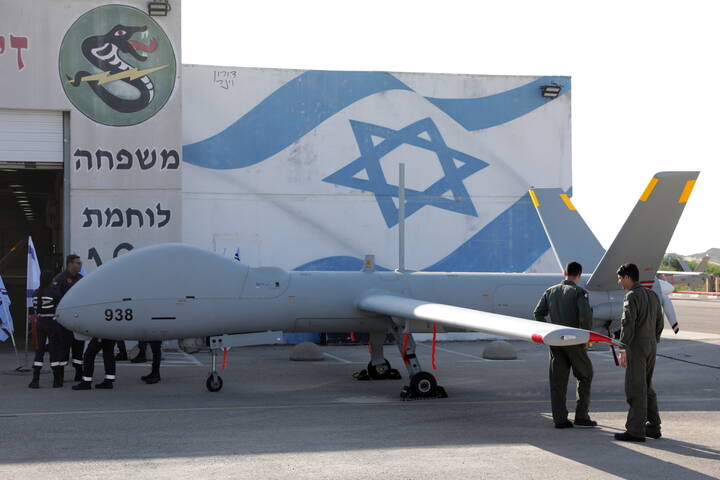
For more than three decades, the dominant strategic assumption in Western capitals held that the future of warfare would belong to a small number of exquisitely engineered platforms. The logic was seductive. Precision munitions would replace massed artillery. Stealthy airframes would penetrate any air defense network. Networked sensors would deliver a common operating picture so complete that the enemy would effectively fight blind. This was the Revolution in Military Affairs as understood by the Pentagon and its European allies after the 1991 Gulf War. It prioritized quality over quantity, software over steel, and long development cycles over battlefield improvisation.
The war in Ukraine has not merely challenged that assumption. It has dismantled it piece by piece, often using components purchased from commercial electronics suppliers and assembled in makeshift workshops. What is emerging from the trenches of Donbas and the skies above the Black Sea is not a refined version of Western doctrine. It is an alternative military logic built on radically different principles of mass, cost, adaptation, and visibility. This new logic does not erase the need for advanced systems. But it fundamentally alters what it means to generate combat power and who gets to do so at a competitive scale.
The Economics of Attritable Precision
The defining feature of the Ukrainian battlefield is not any single weapon but a systemic shift in the cost structure of destruction. In the Western RMA model, precision was expensive and therefore scarce. A single Tomahawk missile or a JSOW air to ground munition could cost between one and three million dollars. Such weapons were reserved for high value targets. Their use was carefully vetted. Stockpiles were limited.
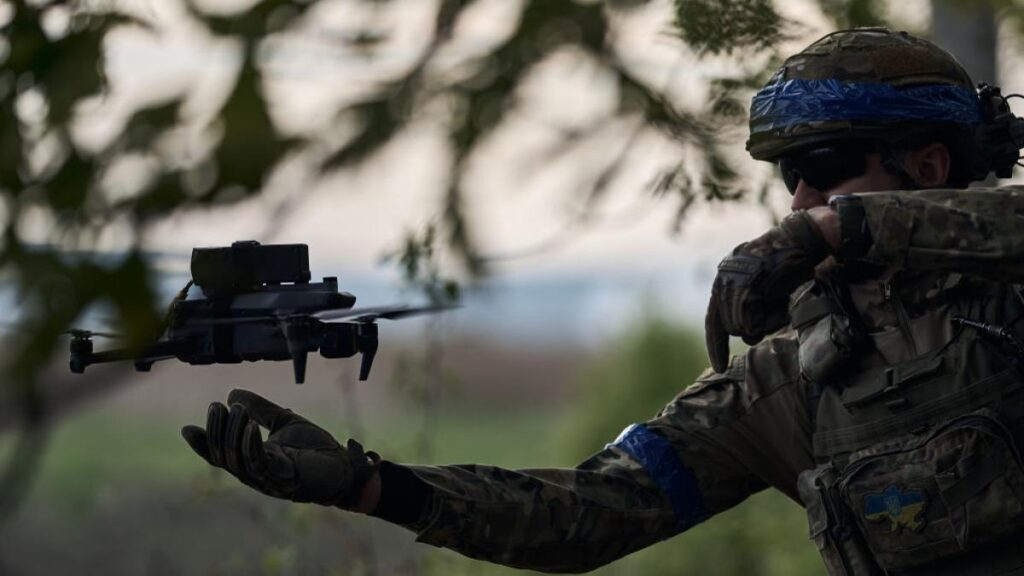
In Ukraine, precision has become a commodity. A first person view drone equipped with a commercially available camera and a small explosive charge can hit a tank hatch with near certainty from several kilometers away at a total system cost of five hundred dollars or less. The operator sitting in a trench or a reinforced bunker uses a video game style controller and a head mounted display. The connection is often maintained through a simple radio link or, increasingly, a fiber optic tether that resists electronic jamming. The consequences for military economics are staggering.
An attacking force that fields ten thousand such drones per month imposes a defensive cost that far exceeds the production cost of the drones themselves. Each interception may require a surface to air missile worth hundreds of thousands or even millions of dollars. Alternatively the defender may accept the loss of armored vehicles, artillery pieces, and logistical trucks at a rate that rapidly depletes its combat power. No modern military has designed its force structure to withstand a sustained siege by disposable precision guided munitions. That is precisely the condition that now defines high intensity conventional warfare.
Russia has learned this lesson and applied it in reverse. Its mass production of Shahed type one way attack drones, now numbering in the hundreds per night, has turned the cost exchange ratio of air defense on its head. Ukrainian forces have improvised solutions involving truck mounted machine guns, electronic warfare systems, and even interceptor drones. But the fundamental imbalance remains. The attacker can produce a thousand threats for the price of a single defensive missile. The defender must either find radically cheaper ways to kill drones or accept a steady erosion of its protective umbrella.
The Fragmentation of Air Control
Western air superiority doctrine rests on a unitary concept of the sky. Control of the high altitude regime through fighter aircraft and long range surface to air missiles was assumed to confer control of the entire air domain. Low altitude airspace was a transit zone for attack helicopters and close air support. It was not considered a separate battlespace capable of independently determining the outcome of ground operations.
Ukraine has exposed this as a dangerous simplification. The air domain has fragmented into distinct vertical layers, each with its own weapons, sensors, and countermeasures. A force that dominates the upper layer through advanced fighters and long range radars may still lose the lower layer to small drones operating at treetop height or below. These low altitude systems are difficult to detect with conventional radars. They are even more difficult to intercept because their small size and slow speed frustrate the guidance logic of most air defense missiles, which were designed to track fast moving jet aircraft.
The operational consequence is that air superiority no longer guarantees freedom of maneuver on the ground. A mechanized brigade advancing under the cover of friendly fighters can still be spotted, tracked, and destroyed by a swarm of low cost drones that the friendly air force cannot effectively suppress. This reverses a core assumption of Western operational art. Maneuver warfare was premised on the idea that once the enemy air force was neutralized, ground forces could concentrate rapidly to achieve a decisive breakthrough. In the drone saturated battlefield, concentration is precisely what gets you killed. Large formations are visible from miles away. They attract drone strikes within minutes. They cannot hide.
The result has been a tactical reorientation toward dispersed small unit operations. Russian assault groups now advance in squads of four to eight soldiers, often without direct vehicle support. Ukrainian defensive positions are structured around independent teams operating in mutually supporting strongpoints rather than continuous trench lines. This style of combat is slower, more attritional, and less decisive than the maneuver warfare that Western armies have trained to fight. It favors the defender, who can build hardened shelters and maintain concealed supply routes, over the attacker, who must expose his forces to cross open ground under persistent surveillance.
The Architecture of Total Visibility
The drone revolution is not primarily about the drone itself. It is about the network of sensors, data links, and battle management software that turns a simple flying camera into a weapon system of extraordinary precision. This is where Ukraine has achieved its most significant and least understood advance.
The Ukrainian Delta system represents a working implementation of net centric warfare, a concept that Western militaries spent billions of dollars pursuing with mixed results. Delta fuses inputs from commercial satellite imagery, electronic intelligence gathered by signals units, acoustic sensors that detect gunfire and engine noise, and the continuous video feeds of hundreds of reconnaissance drones operating along the front line. The resulting common operating picture is distributed to battalion and company commanders, artillery batteries, and drone strike teams through a secure tablet based interface. Update cycles are measured in seconds.
What appears to outside observers as remarkable drone accuracy is in fact a triumph of systems integration. The drone operator often does not need to search for targets. The target is already identified, geolocated, and prioritized by the network. The drone is merely the delivery mechanism for a firing solution that has been refined by multiple sensors working in concert. This is why Ukrainian forces can destroy a Russian ammunition depot or a command post with a single low cost drone while Western forces would typically require a targeting pod equipped fighter or a satellite guided missile.
The political implications of this capability are profound. Net centric warfare of this kind requires a level of trust and decentralization that most large militaries find uncomfortable. Unit commanders must be empowered to act on intelligence without waiting for higher approval. Sensor data must flow laterally between units, not just vertically through the chain of command. Electronic warfare systems must be configured to jam the enemy without disabling friendly communications. These are not purely technical problems. They are problems of organizational culture, command authority, and risk tolerance.
Adaptation as a Core Military Competence
Perhaps the most difficult lesson of the Ukraine war for Western defense establishments concerns the speed of adaptation. The traditional military acquisition cycle, which can take five to fifteen years from requirements definition to initial fielding, is wholly incompatible with a battlefield where electronic warfare countermeasures change week to week and new drone types appear month to month.
Ukraine has built a decentralized innovation ecosystem that bypasses the formal acquisition system almost entirely. Hundreds of small domestic drone manufacturers maintain direct relationships with frontline units. Engineers receive feedback from operators through encrypted messaging channels. Design changes are prototyped, tested, and fielded in a matter of days. In some cases, unit level workshops are performing modifications and repairs that would be contractually prohibited for a Western military because intellectual property restrictions prevent soldiers from altering proprietary systems.
Russia has pursued a different model, relying on state owned defense conglomerates to scale production of standardized systems. This centralized approach has advantages in raw volume. Russia now produces long range attack drones at a rate that Ukraine cannot match. But the centralized model struggles with rapid iteration. A design flaw discovered in combat may take months to correct because the production line and the engineering team are separated by layers of bureaucracy and security restrictions.
The Ukrainian model is chaotic, inefficient by peacetime metrics, and heavily dependent on volunteer funding and commercial component imports, particularly from China. But it is also highly responsive. When Russian electronic warfare systems began jamming a particular frequency band, Ukrainian drone operators and manufacturers collectively shifted to new frequencies within weeks. When fiber optic tethers proved resistant to jamming, both sides rapidly adopted them. The competitive advantage now belongs to the force that can cycle through the observe orient decide act loop faster, not the force that has the most technologically sophisticated hardware at the start of the war.
**The Political Economy of Drone Warfare**
The transformation of warfare currently underway has political dimensions that extend far beyond the Ukrainian battlefield. The diffusion of cheap precision strike capabilities alters the strategic calculus of deterrence for states and non state actors alike. A small country that cannot afford an air force of fourth generation fighters can now field a drone force capable of striking targets hundreds of kilometers behind enemy lines. A non state group with access to commercial supply chains can produce rudimentary attack drones in garage workshops. The monopoly of violence that advanced states have enjoyed for decades is eroding.
This has immediate implications for NATO readiness. An analysis of recent exercises and war games conducted in 2025 suggests that alliance forces are not prepared for a conflict in which the enemy denies air superiority through massed low cost drones rather than advanced fighter aircraft. Russian doctrine already emphasizes the use of reconnaissance strike complexes that integrate drones with electronic warfare and long range fires. In a confrontation on NATO’s eastern flank, Russia would likely begin with sustained drone campaigns designed to attrit air defense assets, disrupt logistical networks, and force ground forces to disperse before any major ground offensive.
The United States and its allies have begun to respond. The United Kingdom’s 2025 Strategic Defence Review explicitly acknowledges that uncrewed systems must generate mass and lethality as part of a high low force mix. Several NATO members are investing in counter drone technologies, including directed energy weapons, electronic warfare systems, and low cost interceptors. But the scale of the challenge remains poorly understood. Winning the drone war requires not just better technology but a different industrial base, a different acquisition system, and a different training pipeline. These changes cannot be achieved through incremental budget increases. They require a doctrinal and organizational shift on the order of the shift from industrial warfare to maneuver warfare in the interwar period.
The Autonomy Horizon
The current phase of the war remains dominated by human operators. Each FPV drone requires a pilot. Each reconnaissance drone requires a sensor operator. The intelligence in the system is still human intelligence, distributed across thousands of soldiers who have learned to fly, fight, and improvise under fire. That will not remain true indefinitely.
Both Russia and Ukraine are investing heavily in autonomy. Computer vision systems can now identify and track military vehicles without human assistance. Inertial navigation and terrain matching algorithms reduce dependence on GPS, which is heavily jammed on both sides. Swarming coordination, in which multiple drones share targeting data and deconflict their flight paths, is moving from research laboratories to field testing. When these capabilities mature, they will change the character of drone warfare more fundamentally than any development since the first FPV drones appeared in 2023.
A fully autonomous drone swarm does not require a one to one ratio of operators to platforms. It can be launched in the hundreds from a single command post. It can search a defined area, identify targets based on pre programmed criteria, and execute strikes without further human input. This capability, if realized, would break the remaining constraints on affordable mass. The defending force would face not a stream of individually guided munitions but a coordinated wave of intelligent weapons that adapt to the defense in real time.
The political and ethical implications of autonomous weapons are already the subject of intense debate. But the battlefield is moving faster than the debate. Neither Russia nor Ukraine has shown restraint in deploying new technologies. If one side achieves a meaningful autonomy advantage, the other will have no choice but to follow. The only question is whether the international community can establish norms and limitations on autonomous weapons before they become standard equipment rather than experimental novelties.
The revolution in military affairs now unfolding in Ukraine is not a clean break with the past. Artillery still matters. Armor still matters. Infantry still matters. But the relative weight of these components has shifted, and the enabling conditions for their effective use have become more demanding. A force that cannot control the drone layered airspace cannot maneuver. A force that cannot adapt its equipment faster than the enemy cannot survive prolonged combat. A force that cannot generate affordable precision at scale cannot contest the deep battle.
Western militaries have spent three decades optimizing for the wrong scenario. They built exquisite systems for a war of high end attrition against a near peer adversary who would fight on familiar terms. That adversary has instead learned to fight a war of mass, transparency, and decentralized adaptation. Whether the alliance can learn these same lessons before the next confrontation arrives remains an open question. The cost of failing to learn will be measured not in budget overruns or acquisition delays but in the lives of soldiers sent to fight a war their doctrine no longer understands.