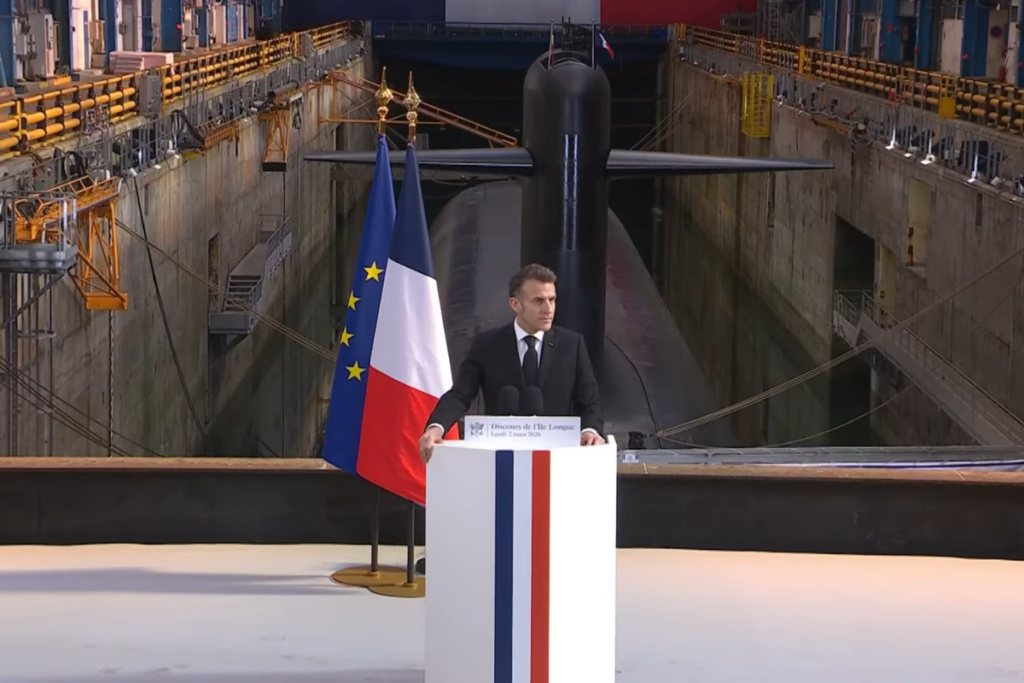
France’s nuclear posture is entering a more explicitly European phase, not because Paris has abandoned the traditional principles of its deterrent, but because the strategic environment around those principles has changed faster than the older formulas could comfortably absorb. President Emmanuel Macron’s March 2, 2026 speech at Île Longue did not announce a French nuclear umbrella for Europe, nor did it overturn the sovereign foundations of French deterrence. What it did do was more consequential in practical terms: it gave political form to a gradual evolution that had been underway for several years and signaled that France now sees a stronger European role for its deterrent as strategically necessary, politically manageable, and operationally worth developing.
The speech came at a moment when several long-term pressures had converged. Russia’s war against Ukraine had already transformed European threat perceptions and reopened questions that many governments had preferred to leave implicit after the Cold War. Nuclear signaling returned to the center of European security debates. China’s expanding arsenal and more complex global deterrence environment added another layer of uncertainty. At the same time, the weakening of confidence in the long-term reliability of American guarantees under a renewed Trump presidency sharpened European interest in alternatives, supplements, and hedging strategies. In that setting, France was under pressure to clarify what its nuclear force means not only for its own defense, but for the security architecture of Europe more broadly.
Macron’s answer was carefully calibrated. He sought to reassure European partners that France is prepared to think more seriously about deterrence in a continental framework, while also reassuring French domestic audiences that no sharing of sovereignty, decision-making, or nuclear control is under consideration. That balance is central to understanding the speech. The point was not to revolutionize doctrine but to make doctrine more usable in a harder European context. The most important contribution of the speech therefore lies less in rhetorical novelty than in the attempt to translate old principles into a new strategic language that can be understood by allies, competitors, and domestic critics alike.
A European Turn Without a French Nuclear Umbrella
The most discussed element of the speech was the concept of “advanced deterrence.” This phrase matters because it gives a more concrete shape to France’s long-standing claim that its vital interests cannot be reduced to the simple geography of its metropolitan borders. That idea is not new. French leaders have said in different ways for decades that events beyond the national frontier can affect the country’s vital interests. What is new is the effort to make that principle operational in a European setting that now feels markedly less theoretical.
This distinction is important because much of the external commentary on French nuclear policy still falls into an unhelpful binary. Either France is assumed to be offering a full extended deterrence commitment comparable to the American model, or it is assumed to be doing little more than restating old doctrine in symbolic language. Neither interpretation is satisfactory. France is not replicating the U.S. nuclear umbrella. It is also doing more than repeating familiar language about the European dimension of its vital interests.
The speech suggests a middle ground: France aims to create additional uncertainty in the mind of any adversary contemplating coercion or aggression against Europe, while preserving its sovereign freedom to decide when and how its vital interests are engaged. In strategic terms, that is a meaningful shift. Deterrence works not through legal precision but through the management of uncertainty and the imposition of risk. By signaling that the security of close European partners is tied more explicitly to France’s own strategic calculus, Paris is seeking to complicate an adversary’s assumptions without locking itself into rigid commitments that it considers strategically imprudent.
That remains a very French approach to deterrence. The speech did not dilute the classic pillars of French nuclear sovereignty. There is no sharing of the final decision, no transfer of planning authority, no joint control over employment, and no move toward NATO-style nuclear sharing. Those limits were not peripheral details inserted for domestic consumption. They are fundamental to the political legitimacy and doctrinal identity of French deterrence. Any departure from them would have fractured domestic consensus and transformed the strategic meaning of the French force itself.
What Macron appears to be offering instead is a more explicit political and strategic backstop for Europe, grounded in sovereign French doctrine but opened to structured consultation, signaling, and selected forms of operational cooperation. That is a narrower offer than many Eastern European governments might desire if they were seeking a contractual nuclear guarantee. Yet it is also a more serious offer than previous French formulations, which often invited dialogue in principle without identifying a credible mechanism through which that dialogue might shape deterrence posture.
From Strategic Culture to Strategic Mechanisms
One of the limitations of earlier French efforts was that they remained trapped at the level of conversation. Paris frequently called for a shared strategic culture on nuclear matters, but that ambition often lacked institutional content. European allies could accept the need for deeper discussion while still wondering what, in practice, France was prepared to do differently. The March 2026 speech attempted to answer that question.
The identification of a group of European states for more intensive consultations points to a deliberate effort to move from abstract openness to structured interaction. The likely purpose of these mechanisms is not to create a collective French-European nuclear doctrine, which would be neither politically acceptable nor strategically coherent. Rather, it is to establish habits of consultation around threat assessment, escalation dynamics, intelligence sharing, and the relationship between conventional and nuclear signaling in crisis conditions. That may sound modest, but in European nuclear affairs even modest institutionalization can have lasting consequences.
These consultative organs could serve several important functions. First, they would reduce ambiguity among allies about what France means when it speaks of the European dimension of its vital interests. Second, they would allow selected governments to understand better how Paris reads escalation, threshold management, and adversary behavior. Third, they would help anchor nuclear questions within a broader conversation about European defense posture rather than treating them as a separate and almost theological domain reserved for a tiny national elite. This matters because deterrence credibility in Europe increasingly depends on the interaction between nuclear signaling, conventional resilience, and alliance cohesion.
There is also a practical military dimension. Participation by European partners in French strategic exercises, or at least in selected phases of them, would represent a notable evolution. Such involvement would not amount to shared control, but it would increase familiarity with French signaling practices and make the European dimension of the deterrent more tangible. In addition, the speech seems to leave open the possibility of dispersal measures or temporary deployments of elements associated with strategic forces on allied territory under specific circumstances. Here again, one should be careful not to exaggerate. This is not a move toward permanent basing of French nuclear weapons abroad. It is better understood as a survivability and signaling option designed for crisis conditions.
The distinction is not semantic. A permanent deployment model would require a profound political, legal, and infrastructural transformation and would invite the conclusion that France had moved closer to an extended deterrence model it has long rejected. A temporary, circumstance-driven posture, by contrast, allows France to strengthen signaling flexibility and survivability while maintaining the sovereign integrity of its deterrent. For European partners, such a possibility may still be reassuring even if it falls short of a formal guarantee.
Subtle but Significant Doctrinal Adjustments
Beyond the headline concept of advanced deterrence, the speech contained several more discreet doctrinal changes that deserve attention. These are not cosmetic matters. In nuclear strategy, small shifts in language often reveal deeper adjustments in how a state wants its deterrent to be understood.
One noteworthy point is the explicit inclusion of overseas territories within the frame of France’s vital interests. This is a logical development in light of a more contested geopolitical environment, particularly as strategic competition reaches further into maritime spaces, the Indo-Pacific, and areas where sovereignty questions can no longer be treated as peripheral. France has long insisted that its deterrent protects national independence and territorial integrity, but giving greater visibility to overseas territories reflects a wider appreciation of the geographic spread of strategic vulnerability.
Another important change is the retreat from some of the older vocabulary associated with French nuclear targeting and deterrent effect. Previous presidential speeches often relied on the notion of “unacceptable damage” and on a recognizable description of strikes against an adversary’s centers of power. The March 2026 speech appears to prefer a broader and less doctrinally precise formulation, emphasizing instead that no state, however powerful or large, could escape the consequences of French nuclear use. Such language may reflect a conscious decision to preserve uncertainty over the exact contours of French targeting logic.
This evolution should not be overstated, but neither should it be dismissed. More ambiguous language can widen deterrent effect by making it harder for an adversary to assume that French nuclear retaliation would remain confined to a narrow set of targets. It may also reflect the reality that strategic competition is now more complex than in the earlier post-Cold War years, with integrated military, industrial, cyber, and political systems making it increasingly difficult to define “centers of power” in the older sense. Whether Paris has fully revised its targeting philosophy is less important than the fact that it is choosing to speak about deterrence in a less formulaic and more open-ended way.
A third shift lies in the fading visibility of the concept of strict sufficiency. The spirit of that principle has not disappeared. France is still not presenting itself as a participant in a nuclear arms race, nor is it abandoning the idea that its arsenal should remain proportionate to deterrent effectiveness rather than prestige or numerical competition. Yet the speech’s willingness to announce an increase in the arsenal, even without disclosing figures, indicates that the old vocabulary no longer fully captures the policy direction. Paris is not rejecting sufficiency; it is redefining what sufficiency means under altered strategic conditions.
Arsenal Growth and the Return of Quantitative Questions
The decision to increase the French nuclear arsenal is the speech’s most tangible capability announcement. For years, France maintained a posture in which restraint and transparency formed part of its identity as a responsible nuclear power. By indicating that the arsenal will grow, while declining to specify the scale or precise timeline, Macron introduced a different logic: controlled ambiguity in service of strategic flexibility.
Several factors likely inform this decision. One is the steady improvement of missile defense capabilities among major competitors, particularly Russia and China. Another is the possibility that future crises may require more complex targeting assumptions, including the management of simultaneous or coordinated challenges involving more than one adversary. There is also an alliance-management dimension. Even if French officials reject any direct link between arsenal size and Europe’s reassurance needs, the political reality is that a deterrent presented as more visibly robust is easier for nervous allies to treat as strategically meaningful.
At the same time, the lack of numerical detail is revealing. From a deterrence perspective, ambiguity can be useful. It complicates adversary planning and preserves room for maneuver in future arms control discussions. From a political and diplomatic perspective, however, it comes at a cost. France had built part of its reputation on comparatively open communication about the size and nature of its force. That transparency helped distinguish Paris from both more secretive adversaries and some allies whose declaratory positions were broader but not necessarily more candid. Pulling back from this practice may improve deterrent opacity, but it also weakens one of the country’s longstanding normative advantages.
Technically, the expansion is feasible. France retains the industrial and material basis to produce additional warheads, and the modernization of supporting infrastructure has been underway for some time. The more difficult question is not whether an increase is possible, but how it will be distributed across the force and what strategic logic will govern it. More warheads per sea-based missile, additional air-launched systems, or some mix of both are all conceivable. What remains clear is that Paris is not, at least for now, changing the number of delivery platforms in a dramatic way. The emphasis remains on improving the effectiveness, resilience, and adaptability of an existing two-component deterrent rather than redesigning the architecture altogether.
The modernization roadmap itself remains intact. The next generation of ballistic missile submarines, the continued development of the M51 family, and the hypersonic ASN4G program all confirm that France is investing for durability over the long term. These programs are expensive but unsurprising. The more strategically interesting question is whether they will be matched by a broader rethinking of how nuclear signaling interfaces with Europe’s conventional defense requirements.
Nuclear Deterrence Cannot Substitute for Conventional Weakness
One of the most serious risks in the current European debate is the temptation to treat nuclear adjustment as compensation for conventional insufficiency. Macron’s speech did not explicitly fall into that trap, but it touched on an issue that will become increasingly important: the articulation between nuclear and conventional forces.
French strategic documents in recent years have spoken of mutual support between the two. That concept is sound. Nuclear deterrence does not operate in isolation; it draws credibility from a broader military posture that includes conventional resilience, escalation management, intelligence, command and control, and the ability to shape the theater before the nuclear threshold is reached. If European states remain weak below that threshold, nuclear signaling alone will not restore strategic balance.
This is where the speech is both promising and incomplete. It mentions deep-strike capability, early warning, and wider air defense, all of which are highly relevant to a more integrated deterrence posture. Yet on several of these fronts, Europe remains closer to intention than to delivery. Long-range conventional strike, in particular, is still underdeveloped in both doctrinal and industrial terms. France itself has not yet fully resolved what precise system it wants for land-based deep strike. Early warning cooperation is politically important but remains embryonic. Air and missile defense is advancing, but unevenly and with familiar fragmentation across Europe.
The strategic point is straightforward. If France wants advanced deterrence to carry real weight in Europe, it will need to be embedded in a broader architecture of conventional credibility. That means not only French capabilities, but also European contributions to logistics, intelligence, missile defense, military presence, and the political endurance needed to manage escalation in a prolonged confrontation with Russia. Deterrence on the continent will not be strengthened by nuclear signaling alone. It will be strengthened when nuclear ambiguity is backed by conventional solidity.
European Reactions and the Politics of Sustainability
The reception of the speech matters because the future of this initiative will depend less on the elegance of its language than on whether it produces durable political relationships. Initial European reactions appear to have been broadly favorable precisely because France avoided two mistakes: it did not present its offer as a substitute for NATO, and it did not imply that Washington was being pushed aside. This was essential. Most European governments, including those most interested in stronger French engagement, still view the American role as indispensable even if they have become more anxious about its reliability.
The fact that countries already involved in NATO nuclear arrangements showed interest in deeper discussion with France is particularly revealing. It suggests that European governments are not treating French deterrence as an alternative bloc, but as an additional layer of reassurance in a more uncertain environment. That is probably the most viable political basis for the initiative. Paris is unlikely to gain support for a grand autonomous European nuclear architecture, but it can gain support for a denser web of strategic consultation and signaling that complements NATO while preserving French sovereignty.
Domestic politics in France were also more manageable than many had expected. That is not because the issue ceased to be sensitive. It remains highly sensitive. Rather, the speech was crafted carefully enough to deny critics the easiest lines of attack. By insisting that there would be no sharing of the decision, no transfer of control, and no abandonment of sovereign doctrine, Macron preserved the essential elements of the traditional French nuclear consensus. That consensus is never absolute, and it can be manipulated by electoral rhetoric, but it still provides a powerful constraint on what any French government can do.
The longer-term challenge is sustainability. Advanced deterrence will only endure if it survives the usual irritants of European politics, including bilateral disputes, industrial rivalries, leadership changes, and differing threat perceptions across the continent. It will also depend on whether France can produce enough concrete practice to convince partners that this is more than an elegant doctrinal formula. Consultation without implementation will not hold strategic attention for long.
To sum up, we can say that Macron’s March 2026 speech should be read as a strategic adaptation rather than a doctrinal rupture. France has not abandoned the sovereign logic of its nuclear deterrent, nor has it embraced an American-style model of extended deterrence. What it has done is more subtle and, in some respects, more significant: it has begun to organize the European implications of French deterrence in a way that is more operational, more legible to partners, and more responsive to the realities of a harder security environment.
The concept of advanced deterrence is the clearest expression of that shift. Its value lies not in offering a rigid guarantee, but in generating new strategic uncertainty for adversaries while building a thicker framework of consultation, signaling, and potential operational cooperation with European states. That is a credible French answer to the current moment precisely because it does not attempt to become something France is not.
At the same time, the speech leaves unresolved the central question facing Europe’s deterrence posture as a whole: how to connect nuclear reassurance to a conventional defense structure strong enough to manage escalation below the threshold of existential war. On that front, the French move is important but insufficient on its own. A more Europeanized French deterrent can strengthen the continent’s strategic posture, but it cannot compensate for delays in long-range strike, air defense, early warning, military mobility, industrial mobilization, and forward conventional readiness.
The significance of the March 2026 speech therefore lies in opening a new phase rather than completing one. It shows that France is willing to move beyond the abstraction of a merely declaratory European nuclear role. Whether that shift becomes a durable pillar of European security will depend on follow-through, institutionalization, and the ability of France and its partners to translate strategic intent into lasting practice. In the present climate, that may prove more important than the speech itself.