When the ceasefire agreement came into effect on 8 April 2026, it brought a temporary end to the direct military confrontation between the United States, Israel, and Iran. But the ceasefire did not restore the prewar status quo. It froze a conflict that had already inflicted staggering military costs on all sides, disrupted global energy supplies on a scale not witnessed since the oil shocks of the 1970s, and laid bare an uncomfortable truth that Western strategic planners had long chosen to ignore. The era of uncontested maritime hegemony in the Persian Gulf, in which a single naval power could guarantee the free passage of oil tankers through the Strait of Hormuz without any political concession to the littoral state controlling the chokepoint, has come to an end. Iran’s demonstrated ability to close the strait using asymmetric tactics, at a fraction of the cost of the American and Israeli air campaigns, has fundamentally altered the bargaining power between Tehran and the global oil market. In response, Iran has placed on the negotiating table a proposal that would have been dismissed as fantastical before the war: a formal toll system enforced by Iranian naval assets, under which each oil tanker would pay a per‑vessel fee in exchange for safe passage. This paper examines the economic logic of that proposal, the distribution of its costs across different actors, and the deeper theoretical frameworks that explain why a toll may now represent the least bad option for European policymakers, the Persian Gulf monarchies, and the global economy.
The Theoretical Foundations of Chokepoint Rents
To understand the economics of a Hormuz toll, one must move beyond the simplistic notion that any payment to Iran constitutes a reward for aggression. Three interconnected bodies of economic theory provide a more nuanced framework. The first is the theory of rent extraction from a scarce natural bottleneck, which builds on the monopoly pricing models of Cournot and the subsequent literature on natural resource rents. The Strait of Hormuz is not a manmade canal with an identifiable owner but a narrow passage of international waters. However, its physical geography creates a natural monopoly: there is no commercially viable alternative route for the approximately twenty percent of globally traded oil that originates in the Persian Gulf and must exit through the strait. Iran, by virtue of its geographical position and its military capacity to interdict shipping, has acquired the ability to act as a gatekeeper. The toll is therefore best understood as a monopoly rent, a payment extracted not because Iran has a legal right to charge but because it has the power to impose costs on those who refuse to pay. The economic logic of such a rent is identical to that of any other monopoly: the rent maximising price is determined by the elasticity of demand for the bottleneck and the elasticity of supply from alternative sources.
The second theoretical framework is the public goods theory of maritime security. Freedom of navigation through international straits is a classic public good: it is non‑rivalrous, meaning that one ship’s passage does not reduce the ability of another to pass, and it is non‑excludable, meaning that in principle no ship can be prevented from passing. In practice, however, the provision of that public good requires a security guarantee, typically supplied by a naval hegemon. Before the conflict, the United States provided that guarantee through the Fifth Fleet based in Bahrain. The United States bore the cost of patrolling the strait, deterring Iranian harassment, and maintaining the global commons. But the public goods literature also recognises the free rider problem: the benefits of the security guarantee accrue to all oil consumers, including Europe, China, India, and Japan, while the costs are borne almost entirely by the United States. The Iranian challenge to that guarantee has exposed the fragility of a system in which a single country, facing rising domestic political constraints and competing strategic priorities, can no longer be relied upon to underwrite the security of a chokepoint that is far more vital to the energy security of others than to its own. The toll proposal can be reinterpreted as a mechanism to internalise the externalities of providing secure passage, shifting some of the cost from the Persian Gulf oil exporters to the global consumers, but as the tax incidence analysis will show, the actual burden falls predominantly on the exporters themselves.
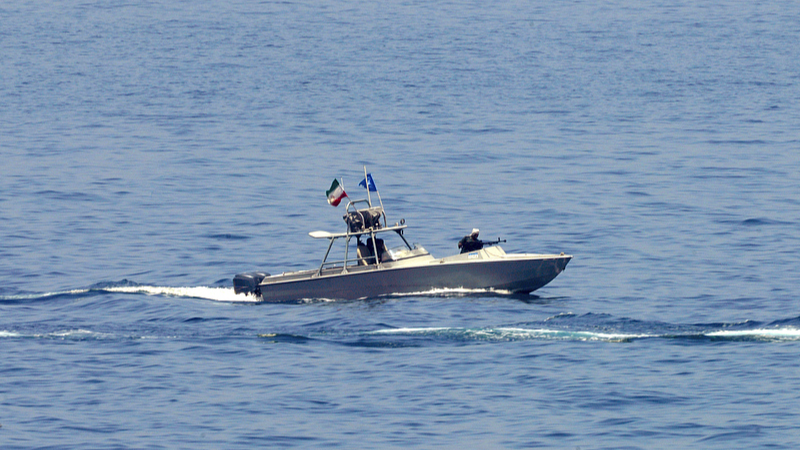
The third theoretical lens is the bargaining theory of asymmetric conflict, which draws on the work of Schelling and subsequent scholars of coercion. In an asymmetric conflict, a weaker actor can achieve leverage not by defeating a stronger opponent on the battlefield but by threatening to impose costs that the stronger actor finds unacceptable. Iran has demonstrated that it can shut down the strait at relatively low cost to itself, using swarms of small attack craft, naval mines, and anti‑ship missiles that are orders of magnitude cheaper than the carrier strike groups and air defence systems that the United States would need to keep the strait open. The United States and Israel discovered during the conflict that even the most advanced military technology cannot reliably protect commercial shipping from a determined asymmetric campaign. The resulting stalemate has created a bargaining range: the United States and its allies would prefer free passage with no toll, Iran would prefer a toll as high as possible, and the parties must find a mutually acceptable point within that range. The ceasefire and the announcement of US‑Iran talks indicate that such a bargaining range exists. The toll is the price of ending the asymmetric campaign and restoring the flow of oil.
The Tax Incidence of a Hormuz Toll
With these theoretical foundations in place, we can turn to the core economic question: who would actually bear the burden of a Hormuz toll? The intuitive answer, that consumers in oil‑importing countries would pay through higher gasoline prices, turns out to be largely incorrect. A careful application of tax incidence theory, adapted to the specific structure of the global oil market, reveals that the overwhelming share of the toll would be absorbed by the oil exporting states of the Persian Gulf themselves.
Consider the global oil market as a single integrated market with a world price determined by the interaction of total demand, supply from the Persian Gulf, and supply from the rest of the world. Let the Persian Gulf account for a share of approximately twenty percent of global supply. A toll imposed by Iran acts as a per‑barrel tax on all Gulf oil that transits the strait. The toll creates a wedge between the price received by Gulf exporters and the world market price. Gulf exporters receive the world price minus the toll, while rest‑of‑world producers receive the full world price. As the toll rises, Gulf exporters reduce their supply because their net price has fallen. This reduction in total global supply pushes up the world price. However, because Gulf supply is only one‑fifth of the total, the reduction in global supply is limited, and the world price rises by only a fraction of the toll. The precise fraction, known as the pass‑through rate, depends on three elasticities: the price elasticity of global oil demand, the price elasticity of Gulf oil supply, and the price elasticity of rest‑of‑world oil supply.
The standard formula for the pass‑through rate of a partial supply tax is given by the share of the taxed supply in total supply multiplied by the supply elasticity of the taxed region, divided by the sum of the absolute value of the demand elasticity and the supply elasticity of the taxed region adjusted for the share. More intuitively, the pass‑through is low when the taxed supply is a small share of the total, when global demand is inelastic, and when rest‑of‑world supply is elastic. In the case of the Persian Gulf, the share is only twenty percent. Empirical estimates of oil market elasticities, most notably from Caldara, Cavallo and Iacoviello in their 2019 Journal of Monetary Economics article, place the short‑run global demand elasticity at approximately minus 0.08 to minus 0.10 and the short‑run supply elasticity for both Gulf and rest‑of‑world producers at around 0.08 to 0.10. Plugging these numbers into the pass‑through formula yields a consumer share of the toll of only about ten percent. In other words, for every dollar of toll that Iran collects, the world oil price rises by only ten cents. The remaining ninety cents are effectively paid by the Gulf exporters, who receive a lower net price per barrel after the toll is deducted.
This result is robust to a wide range of alternative assumptions. If rest‑of‑world supply is completely rigid, perhaps because sanctions prevent Russian oil from reaching global markets or because other producers are already operating at capacity, the consumer share rises to about seventeen percent, still a minority. If global demand is more elastic over longer time horizons, as consumers gradually switch to electric vehicles, heat pumps, and renewable energy, the consumer share falls to six or seven percent. In all plausible scenarios, the Gulf states bear between eighty and ninety‑five percent of the toll. The world economy would barely notice the toll’s impact on the oil price. The restoration of Persian Gulf supply, which has been largely shut in during the conflict, would lower the world price dramatically, and the additional toll component of five to forty cents per barrel would be lost in the noise of daily price volatility.
Quantifying the Toll and Its Distribution
Iran has reportedly proposed a toll of approximately two million dollars per very large crude carrier, the dominant tanker class for Persian Gulf exports. Each such vessel carries roughly two million barrels of oil, so the toll translates to one dollar per barrel. At that level, the world oil price would rise by only five to forty cents per barrel, depending on the elasticities assumed. This is a trivial amount compared to the thirty‑five to forty dollar per barrel increase that markets have already priced in since the outbreak of hostilities. The Gulf states would face an annual toll bill of between six and fourteen billion dollars, assuming export volumes of approximately 20.4 million barrels per day. That sum is not negligible, but it is dwarfed by the revenue losses they would continue to suffer if the conflict persisted and their oil remained unsold. With extraction costs in many Persian Gulf fields as low as ten dollars per barrel, any toll that leaves the net price above that level is preferable to no exports at all. The Gulf states would still earn substantial profits, just slightly lower profits than they would earn in a world without a toll but with free passage.
From Iran’s perspective, a toll of one dollar per barrel generates annual revenues of roughly seven to eight billion dollars. This is a significant sum for an economy that has endured decades of sanctions and a devastating war. But it is far below the maximum monopoly rent that Iran could theoretically extract. If Iran were to set the toll at ten dollars per barrel, the world price would rise by roughly one to two dollars, and Gulf exporters would still have a strong incentive to continue shipping as long as the net price remained above their extraction costs. The reason Iran has proposed a relatively modest toll is likely political rather than economic. Tehran wants the proposal to be seen as reasonable by the Persian Gulf monarchies and by major oil importers. It wants to avoid triggering a military or economic backlash that would make the toll uncollectable. The toll is therefore best understood as an opening bid in a negotiation, not as the final expression of Iran’s monopoly power. The economic theory of bilateral bargaining with asymmetric information suggests that Iran is signalling a willingness to accept a moderate rent in exchange for a stable, long‑term arrangement that would end the conflict and provide a predictable revenue stream.
The Russian Revenues Counterargument
Critics of the toll proposal raise two major objections, each of which requires careful theoretical examination. The first objection concerns the indirect benefits that would flow to Russia under a continued conflict scenario. With Persian Gulf oil largely blocked, the world price of oil has risen by thirty‑five to forty dollars per barrel. Russia, as one of the world’s largest oil exporters, has been a major beneficiary of that price spike. Estimates from the Kyiv School of Economics, published in March 2026, suggest that Russia could gain between forty‑five and one hundred and fifty billion dollars in additional oil revenues over the course of the supply interruption, depending on its duration. These revenues directly fund Russia’s war effort in Ukraine and its broader geopolitical ambitions. A toll‑based resolution that restores Persian Gulf supply would cause the world price to fall sharply, eliminating the vast majority of Russia’s windfall gains. Under the toll scenario, with the world price rising by only five to forty cents above the pre‑war level, Russia’s additional revenues would be reduced to between eighty and six hundred and fifty million dollars per year. From the perspective of Western policymakers who seek to constrain Russian power, the toll scenario is vastly preferable to the current conflict situation. The theory of unintended consequences applies here: the United States and Israel launched their military campaign against Iran with the stated goal of curbing Iranian influence, but the campaign has instead enriched Russia to an extraordinary degree. A toll settlement would reverse that outcome.
The Precedent and International Law Objection
The second objection is more profound and touches on the foundations of the international legal order. Paying a toll to Iran would legitimise the use of military coercion to extract rents from a global commons, setting a precedent that other countries with control over strategic chokepoints might seek to emulate. If Iran can charge for passage through the Strait of Hormuz, why could Malaysia not charge for the Strait of Malacca, or Indonesia for the Lombok Strait, or Turkey for the Turkish Straits? The United Nations Convention on the Law of the Sea is unambiguous: all ships enjoy the right of transit passage through straits used for international navigation, and that passage must be continuous, expeditious, and unobstructed. The Strait of Hormuz falls squarely under this provision. Unlike the Suez Canal, where an international treaty authorises the Suez Canal Authority to levy dues based on its ownership of the infrastructure, no such legal basis exists for Hormuz. Iran’s toll would be a violation of customary international law.
However, the legal objection must be weighed against the practical realities of the post‑conflict situation. International law is not self‑enforcing. It relies on the willingness of states to uphold norms and on the existence of enforcement mechanisms. The war has demonstrated that the United States, despite its military preponderance, cannot enforce the right of transit passage against a determined Iran without incurring unacceptable costs. The theory of legal realism reminds us that law without enforcement is merely a recommendation. The choice facing the international community is not between a lawful world and an unlawful world. It is between a negotiated settlement that restores oil supplies and stabilises energy markets while acknowledging Iran’s de facto control over the chokepoint, and a continued state of conflict that violates international law far more egregiously through aerial bombardment, economic sanctions, and the killing of civilians. From a consequentialist perspective, a toll agreement that ends the war and saves lives may be preferable to an abstract adherence to legal principles that no one is willing or able to enforce.
Moreover, there are precedents for negotiated payments for passage through strategic waterways that have not led to the collapse of the international order. The Suez Canal tolls are universally accepted. The Panama Canal tolls are universally accepted. The difference between those cases and Hormuz is one of legal ownership and treaty recognition, not of economic function. If the international community were to negotiate a formal agreement under which Iran’s toll was recognised and regulated, with guarantees of non‑discriminatory access, transparent accounting, and dispute resolution mechanisms, the precedent might be more manageable than a unilateral Iranian imposition. The theory of institutional bargaining suggests that the best way to contain the damage from a violation of norms is to embed the violation in a broader institutional framework that imposes constraints on the violator. A treaty that permits a modest toll in exchange for Iran’s commitment to keep the strait open, to refrain from harassment of shipping, and to accept international monitoring would be preferable to the current chaos.
The Military Investment and Pipeline Diversification Response
The most sophisticated theoretical response to the Hormuz toll proposal is not to reject it outright but to accept it as a temporary measure while investing in the capabilities that will make it obsolete. Iran’s asymmetric leverage over the strait derives from its ability to deploy large numbers of small, fast attack craft, naval mines, anti‑ship missiles, and drones at a fraction of the cost of the carrier strike groups and air defence systems that the United States would need to maintain a permanent escort operation. The theory of comparative advantage in military technology applies here: Iran has a comparative advantage in cheap, distributed, asymmetric systems, while the United States has a comparative advantage in expensive, centralised, high‑technology systems. The war has demonstrated that even the most advanced air defence systems cannot reliably protect commercial shipping from swarming attacks and distributed minefields. The logical response for the Persian Gulf states and Europe is to invest heavily in capabilities specifically designed to counter asymmetric maritime threats. These include autonomous mine‑clearing drones, low‑cost interceptor vessels, coastal surveillance networks, and perhaps most importantly, overland pipeline infrastructure that reduces dependence on the Hormuz chokepoint.
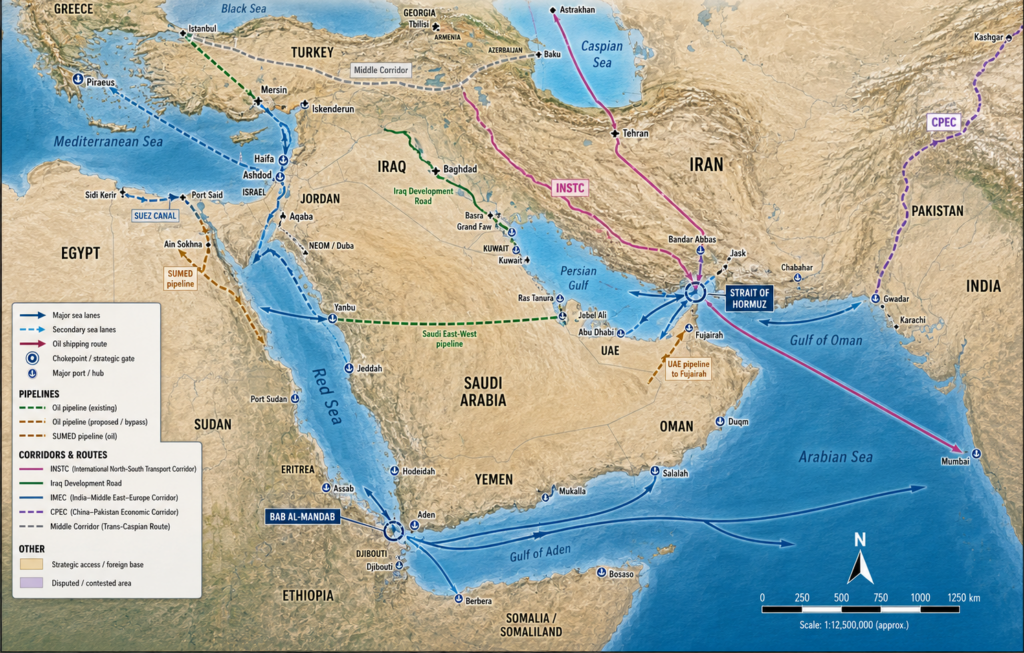
The Persian Gulf monarchies have long discussed the possibility of expanding the Abu Dhabi‑Fujairah pipeline, which already bypasses the strait by transporting crude oil from the Persian Gulf to a terminal on the Gulf of Oman. Similar projects have been proposed for Saudi Arabia and Kuwait, including pipelines to the Red Sea and the Arabian Sea. These projects have always been considered too expensive relative to the low cost of tanker transport through Hormuz. The war has changed that calculation. A toll of one or two dollars per barrel, maintained indefinitely, would provide a permanent incentive to diversify export routes. The capital cost of new pipelines could be amortised over decades, and the reduction in geopolitical risk would be a significant additional benefit. The theory of investment under uncertainty suggests that the optimal response to a persistent threat is to invest in real options that reduce exposure to that threat. For the Persian Gulf states, pipelines are such real options. For Europe, the optimal response is to accelerate the energy transition, reducing overall dependence on oil and thereby reducing the strategic importance of the Hormuz chokepoint. The toll, by raising the effective price of Persian Gulf oil very slightly, would provide a marginal incentive for both oil substitution and pipeline investment.
What European Policymakers Must Accept
The deepest lesson of the Hormuz crisis is that European policymakers can no longer rely on the United States to guarantee the free flow of energy supplies at no political cost. The theory of hegemonic stability, which holds that a single dominant power can provide global public goods such as freedom of navigation, has been tested to destruction. The United States remains the world’s most powerful military, but it has shown that it cannot or will not bear the costs of suppressing Iranian asymmetric warfare indefinitely. The American and Israeli military campaign against Iran was, from the perspective of European interests, a catastrophic miscalculation. It failed to destroy Iran’s asymmetric capabilities, it destabilised the entire Persian Gulf region, and it handed Tehran a bargaining power that it did not previously possess. The status quo ante, in which oil tankers passed through the strait without obstruction and without payment, is not coming back. Not without a major and costly military re‑engagement that the United States has shown neither the appetite nor the capacity to undertake, and not without a ground invasion that would be prohibitively expensive in blood and treasure.
European policymakers must therefore confront a second‑best world, in which every option involves costs and compromises. A negotiated toll agreement with Iran is unattractive for all the reasons that critics have pointed out. It violates international law. It rewards Iranian coercion. It sets a dangerous precedent. But the alternatives are even less attractive. The first alternative is continued conflict, with oil prices permanently elevated, Russia reaping enormous windfall revenues, and the risk of escalation to a wider war that could draw in European forces. The second alternative is a permanent United States‑led naval escort operation, which would cost tens of billions of dollars annually, would require a sustained American military commitment that may not be forthcoming, and would still not guarantee safety against determined asymmetric attacks. The third alternative is an open‑ended blockade that would eventually force a recession in every major oil‑importing economy, with devastating consequences for European industry and households. The markets, which are notoriously unsentimental, reacted to the ceasefire announcement and the news of United States‑Iran talks with a sharp decline in oil prices. That market signal is not a moral endorsement of Iran’s actions. It is a rational assessment of relative harms. It tells us that investors believe a toll‑backed restoration of supply is preferable to the continued uncertainty of war.
The way forward requires European policymakers to hold two contradictory thoughts in their heads simultaneously. On the one hand, they must work to negotiate the best possible toll agreement. That means pushing for as low a toll rate as possible, ideally less than one dollar per barrel. It means insisting on transparent collection mechanisms, with revenues deposited in an escrow account that can be monitored by an international body. It means demanding guarantees against arbitrary increases in the toll, with a clear dispute resolution mechanism. And it means establishing a clear pathway towards eventual redundancy, with sunset clauses and review provisions that tie the toll to measurable reductions in the strategic importance of the chokepoint. On the other hand, European policymakers must invest in the capabilities and infrastructure that will, over a decade or more, reduce the strategic importance of the Strait of Hormuz to the point where no single country can hold the global economy hostage. That means accelerating the energy transition to reduce oil dependence. That means building overland export routes from the Persian Gulf to the Arabian Sea, the Red Sea, and the Mediterranean, potentially with European financing and technical assistance. That means developing European naval forces that can contribute to a credible, multilateral maritime security framework, reducing the reliance on an overstretched United States. None of these measures is easy, quick, or cheap. But the alternative is a world in which the lessons of the Hormuz war are learned by every aspiring regional power with a strategic chokepoint, from the Malacca Strait to the Bab el‑Mandeb to the Turkish Straits. The era of free maritime transit, underwritten by American naval power, may not be over yet. But it is entering a period of profound and dangerous transition. European policymakers who fail to prepare for that transition will find themselves paying much higher prices than a one dollar per barrel toll.