The most rigorous way to classify the present war is as a limited but theater wide coercive campaign conducted through aerospace penetration, maritime denial, proxy frontage, and strike reconnaissance competition. It is not a classical war of territorial occupation because the coalition has not organized its main effort around seizure and administration of Iranian territory. It is not a simple attritional exchange because the coalition’s opening method was not linear reduction of fielded forces but parallel attack against the functional architecture of the Iranian military system. It is not even adequately described as hybrid war in the lazy journalistic sense, because the war’s center of gravity lies in the interaction between precision deep strike, ISR dominance, missile survivability, and regional coercive diffusion. The conflict opened on 28 February 2026 with a large joint U.S.-Israeli strike sequence preceded by cyber and space action, the coalition established air superiority over Tehran within the opening phase, and by late March the coalition had still only confirmed destruction of about one third of Iran’s missile arsenal despite striking more than 10,000 military targets. That combination of facts defines the war’s character more than any headline can. It is a war in which one side has obtained access and initiative, while the other has prevented strategic closure through survivable retaliatory depth.
For a general staff audience, the essential distinction is between operational dominance and strategic decision. The coalition has achieved the former in important domains, especially offensive counterair, deep strike access, and dynamic targeting. It has not yet achieved the latter because Iran’s retaliatory system has not been reduced below the threshold of coercive relevance. This is why the correct doctrinal frame is not “who is winning” but “which theory of victory is exhausting itself first.” The coalition theory of victory has been to disintegrate Iran’s warfighting system faster than Tehran can translate residual means into punitive effect. The Iranian theory of victory has been to survive disintegration with enough missile, drone, proxy, and maritime capacity intact to deny disarmament and prolong reciprocal coercion. In other words, the coalition seeks paralysis, Iran seeks non closure. That is the central military dialectic of the campaign.
I. Clausewitzian Grammar, Clausewitzian Logic
Clausewitz remains useful here if read properly. The grammar of this war is highly military, highly technical, and recognizably contemporary. It is dominated by JISR, SEAD and DEAD, time sensitive targeting, PR and CSAR, deep strike against HDBTs, and maritime interdiction. Yet the logic remains coercive and political. Neither side is seeking a Napoleonic battlefield decision. Neither side is aiming at total military annihilation in the literal sense. The coalition is trying to make Iran’s military system incapable of sustaining a politically credible response. Iran is trying to make continued coalition operations costlier, broader, and harder to politically absorb than the coalition expected. That means the war’s logic is closer to compellence and endurance than to conquest and occupation. The practical consequence is that battlefield asymmetry does not automatically translate into strategic resolution. A state can lose the upper air contest and still succeed if its war aim is not battlefield mastery but survival with retaliatory agency.
This is where shallow analysis usually breaks down. It confuses tactical access with strategic finality. In Clausewitzian terms, the coalition has struck Iranian means with great effect, but it has not yet destroyed the enemy’s ability to continue willing resistance through military instruments. Iran has been hit hard, yet it retains enough coercive instruments to keep the war open, which means the enemy will has not been operationally disconnected from the means required to express it. That is why this campaign has become a study in the limits of aerospace advantage when confronted by prepared survivability, hard depth, and a state that built its force for punishment endurance rather than conventional parity. The fact that the coalition achieved early air superiority and still, a month later, could only confidently verify destruction of about a third of the missile stockpile is not an anecdote. It is the doctrinal problem in one sentence.
II. The Coalition Theory of Victory, Warden Refined by the Realities of Mobile HDBTs
The coalition’s operational design has followed a recognizably Wardenian impulse, but in a more modern and more technically mature form. The opening campaign did not merely service frontline tactical targets. It struck command nodes, intelligence organs, naval assets, ballistic missile sites, and air defense systems in parallel after cyber and space enabled disruption of Iranian communications and perception. That is textbook systems attack. The object is to produce dislocation across the enemy’s functional architecture rather than grind linearly through units in sequence. It is what airpower becomes when it is married to a strong JISR enterprise and to the institutional confidence that parallel attack can generate shock more efficiently than sequential attrition.
Yet the campaign is not reducible to Warden’s ring theory in its more naive form, because the Iranian military problem is not a static industrial system awaiting orderly servicing. Iran’s center of operational resilience lies in buried launch complexes, TEL mobility, dispersed infrastructure, proxy frontage, and maritime leverage. That forces the coalition beyond classical effects based rhetoric and into an ugly reconnaissance strike contest in which the decisive question is not whether targets exist, but whether they can be located, classified, fixed, engaged, and correctly assessed before they move, go dark, or disappear into underground architecture. Here the coalition’s true strength is not aircraft alone. It is the F2T2EA chain, the ability to move from find to assess rapidly enough that fleeting targets remain fleeting only in theory. The operational superiority is therefore epistemic before it is kinetic. The coalition sees, fuses, and retasks faster.
Boyd is more useful than Warden for understanding the live mechanics of the war. The coalition’s objective has been to collapse the Iranian OODA cycle by saturating it with simultaneous shocks. Cyber action, air defense suppression, decapitation strikes, dynamic targeting, and reattack cycles all serve the same purpose, namely to ensure that Iranian orientation is always lagging reality. If Iran cannot build a stable air picture, cannot confidently move launchers, cannot know which nodes remain unobserved, and cannot synchronize surviving assets at acceptable speed, then the coalition’s decision cycle enters inside the Iranian one and stays there. The opening phase clearly reflected that ambition.
Still, a campaign can win the decision cycle contest in the air and lose the closure contest at the level of strategy. This is where the coalition has encountered the structural limits of its method. By late March U.S. intelligence could confirm destruction of only around one third of Iran’s missile arsenal, with another third damaged, buried, or uncertain. Israeli officials claimed over 335 launchers neutralized, or about 70 percent of launch capacity, while privately acknowledging that the surviving 30 percent would be much harder to eliminate. That is exactly what the theory of diminishing target observability would predict. The first tranche of targets includes emitters, fixed sites, exposed support functions, and mobile systems caught in vulnerable transition. The final tranche consists of the best hidden, best disciplined, best protected residue. Counterforce thus becomes asymptotic. Every additional increment of degradation costs more ISR, more sorties, more time, and more risk than the previous increment.
The coalition’s air operations therefore illustrate a mature but incomplete model of operational disintegration. They have broken much of Iran’s visible military machinery, but they have not yet broken the latent architecture that allows Iran to preserve retaliatory agency. That distinction is critical. It is the difference between destroying a force in being and destroying the force’s capacity to remain militarily consequential. The coalition has done much of the former. It has not yet fully achieved the latter.
III. The Iranian Theory of Victory, Schelling Through the Medium of Surviving Military Architecture
Iran’s strategic adaptation has been more intellectually serious than casual commentary admits because Tehran has not spent effort trying to solve the wrong problem. It has not tried to recreate full theater air denial against a coalition that established air superiority in the first days of the war and preserved it even after later aircraft losses. Instead it has shifted the conflict into domains where a weakened but not disarmed military can still impose consequential costs. This is Schelling in military form. The object is not to win the immediate exchange of force. The object is to manipulate the enemy’s expectations of future pain, widening burden, and uncontrolled escalation. A coercive strategy does not require symmetric battlefield performance. It requires credible punishment and credible persistence.
CSIS correctly identifies the Iranian method as a multidomain punishment campaign and as an escalation strategy built around both horizontal and vertical expansion. That description is militarily precise. Horizontal escalation means widening the battlespace across states, infrastructures, and theaters so that the coalition’s defense burden grows faster than its offensive gains. Vertical escalation means increasing the intensity and seriousness of the threatened target set, moving beyond narrow military retaliation toward economic, maritime, cyber, and civilian critical infrastructure pressure. Such a design is rational for a power that has lost symmetric air contestation but still retains missiles, drones, proxy frontage, and command willingness. It substitutes region wide insecurity for local parity.
The missile force is the backbone of that approach, but its significance is often misunderstood. The relevant issue is not how many missiles are fired per day in comparison with day one. The relevant issue is whether the surviving missile force retains enough penetrative credibility to preserve deterrent ambiguity and punish high value targets intermittently. A missile architecture under heavy attack does not need daily massed salvos to remain strategic. It needs survivability, unpredictability, and the ability to remind the adversary that disarmament has not been accomplished. The continued Iranian strikes after late March, despite the coalition’s confident public narrative, show that Tehran retains exactly that sort of residual capacity. The force has moved from abundance logic to husbandry logic. It is preserving coercive value through controlled expenditure.
The drone arm plays a different doctrinal role. It is not primarily the instrument of decisive physical destruction. It is the instrument of theater taxation. Cheap one way systems compel expensive interceptions, persistent alert states, wide defensive distribution, and infrastructure management burdens. In modern operational economics this is a rational high low employment scheme. Higher end missiles are reserved for penetrative and political effects. Lower cost unmanned mass creates defensive exhaustion, uncertainty, and cost imbalance. Iran’s strike method in the Persian Gulf has used drones less as war winning munitions than as fiscal and operational levers. This is economy of force in the pure sense. Expendable platforms are used to force a superior adversary into disproportionate defensive expenditure and force dispersal.
The most intelligent Iranian adaptation, however, lies in the relationship between punishment and survivability. Tehran built a military system that was never optimized for symmetric battlefield excellence. It was optimized for what might be called punishment persistence under aerospace duress. Buried storage, TEL mobility, uncertain stockpile denominators, proxy frontage, and maritime chokepoints form one architecture. Their purpose is to ensure that even after losing control of the air, Iran remains strategically armed. This is why the war has not ended on coalition terms. The Iranian military system was not designed to prevent entry. It was designed to survive entry. On the evidence so far, that design has worked better than many predicted.
IV. Corbett in the Gulf, Sea Denial as Strategic Leverage Rather Than Tactical Ornament
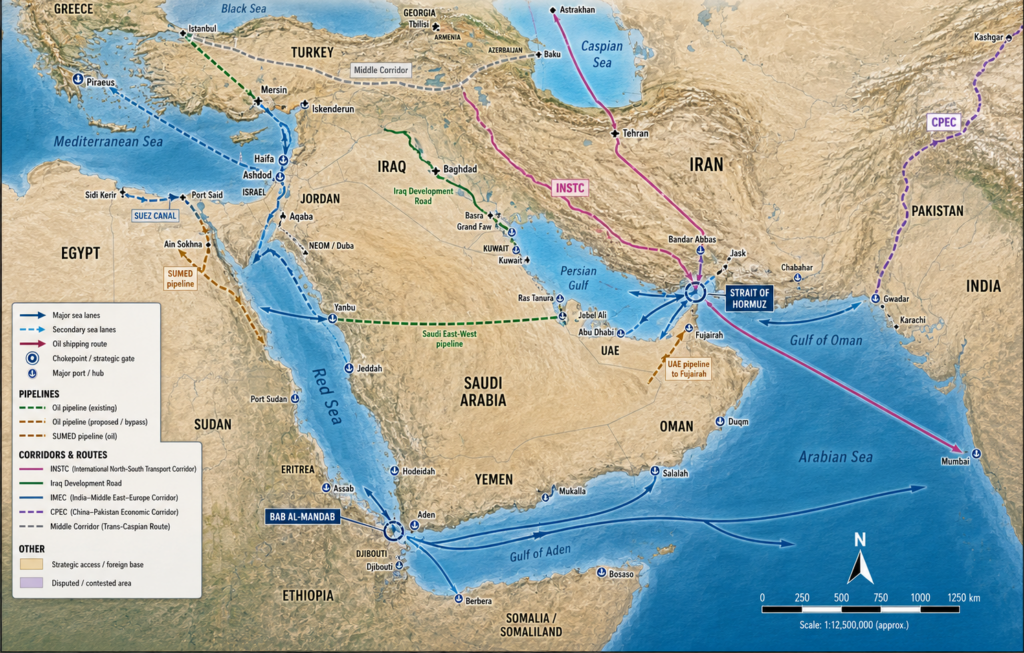
The maritime theater is not subordinate to the air campaign. It is one of the war’s decisive arenas because it changes the operational burden structure. Iran is not trying to command the Gulf in the Mahanian sense. It is not seeking decisive fleet action or unrestricted maritime movement for itself. It is practicing Corbettian sea denial, making the adversary’s use of the sea sufficiently dangerous, politically costly, and economically disruptive that the maritime system itself becomes a bargaining arena. That is exactly what has happened in Hormuz. Iran’s effective control over passage conditions, partial filtering of transits, and the ensuing global supply shock have shifted the conflict’s center of gravity outward from Iranian territory to the security of circulation. More than 12 million barrels per day of regional shut ins and damage to around 40 energy facilities have been cited as part of the shock. Brent rose about 60 percent in March. Iran’s own revenues rose while several Persian Gulf producers lacking bypass routes suffered steep losses.
The doctrinal significance is profound. Once the stronger side is compelled to defend circulation, it ceases to be simply an attacker. It becomes guardian of key terrain in the Corbettian sense, even if that terrain is maritime passage rather than land. CSIS notes explicitly that the United States would need to pivot from pulse strikes and decapitation to defense of key terrain and convoy operations if it wants to defeat Tehran’s punishment campaign. That is a major operational transition. It means the stronger side must now divide effort between continued offense into Iran and restoration of secure commercial movement across an extended maritime battlespace. This is precisely how a weaker power uses sea denial to impose force dilution on a stronger coalition.
Corbett would immediately recognize the asymmetry of advantage. The coalition is superior in open battle and deep strike. Iran is superior in its ability to create a condition of threatened passage that no one can ignore. An oil tanker need not be sunk to create strategic effect. It need only turn around, be delayed, or impose an insurance panic. That is coercion through threatened circulation rather than through fleet destruction. It is also why the maritime front has arguably strengthened Iran’s bargaining position even as the coalition has devastated other parts of its military system. Once Hormuz has been shown to be closeable in wartime, the strategic fact persists even after any future reopening. That is a lasting military achievement in the logic of denial warfare.
V. Center of Gravity, Critical Capabilities, Critical Requirements, Critical Vulnerabilities
If one applies a proper center of gravity methodology, the coalition’s center of gravity is not simply airpower. It is the integrated strike reconnaissance system that allows dispersed platforms and networks to behave as one operational organism. Its critical capabilities include persistent collection, data fusion, target discrimination, dynamic retasking, long range reach, tanker support, battle management, and defensive shielding of rear area enablers. Its critical requirements are access to bases, bandwidth, protected C2, munitions throughput, tanker survivability, and partner state cooperation. Its critical vulnerabilities lie in defensive overextension, dependence on a finite inventory of high end interceptors and specialized enablers, exposure of high value airborne nodes, and the risk that widening rear area defense obligations will progressively cannibalize offensive concentration. The downing of coalition aircraft after weeks of pressure, and the need to conduct a large and risky PR operation deep inside Iran, underscore that the coalition’s exquisite system remains tactically vulnerable at selected points even while operationally dominant overall.
Iran’s center of gravity is not its leadership alone, nor its visible missile inventory, nor its air defense network in isolation. It is the survivable coercive architecture that links buried missile stocks, remaining launch capacity, local air defense lethality, proxy frontage, and maritime leverage into a continued ability to impose costs. Its critical capabilities are retaliatory persistence, theater diffusion, and coercive uncertainty. Its critical requirements are tunnel survivability, launcher mobility, residual command cohesion, continuing access to launch corridors, and enough protected infrastructure to regenerate at least part of the force after the war. Its critical vulnerabilities lie in the storage to launcher to firing chain, in the exposure of exposed logistics and production nodes, in leadership decapitation that might desynchronize surviving forces, and in the difficulty of translating surviving inventory into effective mass under persistent ISR pressure. The coalition has attacked these vulnerabilities heavily, but it has not yet broken the architecture as a whole.
This is why the center of gravity contest remains unresolved even though the visible exchange of damage is not close. The coalition has badly damaged Iranian critical capabilities. Iran has preserved enough of them to avoid collapse into irrelevance. That is the essence of strategic non closure. The proper military judgment is therefore not that the coalition failed, because it plainly did not. The proper judgment is that Iranian force design succeeded in its deepest purpose, which was to ensure that even major military defeat in some domains would not automatically produce final strategic helplessness. That is a more serious military accomplishment than many are willing to admit.
VI. Operational Reach, Tempo, Interior and Exterior Lines
Operational reach in this war has favored the coalition in the penetrative sense and Iran in the distributive sense. The coalition can reach deep into Iran with relative regularity because air superiority and a superior battle network have preserved freedom of action over large parts of the country. Iran, by contrast, uses missiles, drones, proxies, and chokepoints to extend the war laterally across the region. This produces a fascinating asymmetry. The coalition enjoys vertical reach into enemy depth. Iran enjoys horizontal reach across the theater. In doctrinal terms, the coalition can penetrate. Iran can dilate. Those are not identical forms of reach, and the war’s unresolved character arises precisely because one can exist without automatically cancelling the other.
The same asymmetry appears in tempo. Coalition tempo has been fast in strike generation, target servicing, and adaptation. Iranian tempo has been selective in fires but persistent in coercive timing. Tehran has not sought to outpace the coalition sortie for sortie. It has sought to preserve the ability to interrupt the coalition’s political and economic timetable. This is an important distinction. Tactical tempo and strategic tempo are not the same. A force may strike more frequently and still lose the larger rhythm if the other side dictates when the war becomes politically unbearable, economically unstable, or regionally uncontained. The Iranian use of Hormuz and Gulf infrastructure pressure is therefore a tempo intervention at the level of strategy. It interferes with the coalition’s preferred sequencing.
Interior and exterior lines also require more careful use than usual. Geographically, Iran benefits from interior lines inside its own underground and dispersed military architecture. Launchers, tunnels, command nodes, and local security forces operate within a home terrain advantage. Strategically, however, Tehran has tried to externalize the war by activating or leveraging fronts and vulnerabilities outside Iranian territory. This creates a hybrid line geometry. The coalition must fight inward against Iranian depth while also fighting outward across a widened theater. Iran fights defensively on interior lines at home and coercively on exterior lines through regionalized vulnerability. That dual geometry is one reason why the war has become so resistant to clean operational closure. The stronger coalition cannot reduce it to one map.
VII. Mission Command and Failure Points Under Degradation
Mission command in this war should be examined not as a management slogan but as a practical issue of command resilience under interruption. The coalition’s campaign presupposes a highly integrated command system in which dynamic targeting, ISR fusion, electronic warfare, and strike execution remain mutually legible. Such a system is powerful but can also be brittle if enablers are stressed, if rear bases become less secure, or if multiple defensive emergencies force competing priorities into the same decision cycle. High integration increases combat power, but it also creates failure points where network friction can produce disproportionate operational effects. This is especially true when the coalition must prosecute TSTs, protect shipping, defend partner infrastructure, and conduct PR operations at once.
Iran’s mission command problem is different. Tehran’s military system benefits from doctrinal centralization at the level of strategic intent and from distributed execution at the level of survivability. This can be a strength in punishment warfare. Local forces and surviving launch elements do not require elegant theater-wide synchronization every hour to remain useful. They require enough command coherence to preserve political discipline and targeting logic. In that sense, mission command under attrition may actually favor a defender whose residual weapons can still create strategic effects with low sortie density. The coalition needs high integration to exploit fleeting opportunities. Iran needs sufficient integration to preserve retaliatory credibility. Those are different thresholds of command performance. A defender built for endurance can therefore remain strategically coherent even after losing a level of command fluidity that would badly hurt an expeditionary precision coalition.
VIII. Intelligence Doctrine, Counter ISR, and the Real Center of the War
This war is above all a struggle over battlespace legibility. The coalition opened with cyber and space action aimed at communications and perception, which is another way of saying that the war began with an attack on Iran’s ability to know, decide, and orient. That is not a side note. It is the deepest clue to how contemporary high intensity coercive war works. The coalition’s real weapon is not the aircraft or the missile in isolation. It is the architecture that produces targetable knowledge. Once that architecture is functioning, airpower becomes devastating. If that architecture is deceived, saturated, or denied, kinetic superiority loses sharpness.
For that reason, the Iranian answer has been less about invisibility than about expensive uncertainty. Tunnel systems, HDBTs, TEL movement, denominator opacity, and inconsistent emissions are all methods of degrading the attacker’s confidence. One of the most striking facts of the war is not simply that many missiles survived, but that the coalition could not confidently determine the size and state of the entire surviving inventory because so much depended on what had been underground, what could be excavated, and what remained inaccessible but not destroyed. This is an intelligence problem before it is a bombing problem. When the attacker cannot distinguish dead capability from dormant capability at acceptable confidence, strategic closure recedes. In effect, Iran has transformed underground survivability into epistemic friction.
This also explains why later aircraft losses matter analytically even if they do not negate coalition air superiority. Air superiority means the coalition can operate without prohibitive interference. It does not mean all local threat envelopes are gone. Critical Threats made exactly that point after the losses on 3 April. From an intelligence perspective, the real lesson is that Iran preserved enough local cueing, enough engagement opportunity, or enough opportunistic short range air defense viability to create lethal micro pockets even inside a generally coalition dominated air environment. A degraded IADS can still produce ambush zones if the attacker must descend, loiter, rescue, or repeatedly revisit a constrained battlespace. That is a triumph of local counter ISR and local defensive persistence, even if it falls far short of theater denial.
IX. The Rescue of the Downed American Airman as a Study in PR, Isolation, Authentication, and Deception
The rescue of the downed F 15E crewman should be studied as a doctrinal case of personnel recovery inside a battlespace that remained contested despite coalition air superiority. Reuters’ detailed account is extremely revealing. The airman survived with an injured ankle, hid in a crevice, established contact, and had to authenticate himself so that rescuers would not be lured into a trap. A CIA deception effort fed narratives inside Iran suggesting U.S. forces had already located him and were moving him. Meanwhile U.S. forces jammed electronics and struck key roads to isolate the area. Roughly 100 special operations forces were inserted. When two MC 130 aircraft became unavailable for extraction, the force had to improvise a staged airlift with smaller aircraft, after which the United States destroyed the disabled platforms and additional helicopters rather than leave sensitive equipment behind.
In doctrinal terms, this was not just a rescue. It was a combined intelligence, deception, EW, fires, and mobility operation. Personnel recovery in such an environment begins with isolation and authentication, not with flight. The survivor becomes both a friendly asset and a potential vector of enemy deception. The recovery force therefore requires positive identity confirmation, local ISR confidence, and control of the approach geometry. Electronic attack and road interdiction were not ancillary. They were isolation measures designed to slow the enemy’s ability to compress its own find and fix process. The CIA deception effort likewise served a military function by distorting Iranian search prioritization and local timing. This is PR doctrine fused with operational level deception.
Yet the mission also illuminates Iranian competence in a less appreciated way. A force that truly possessed uncontested freedom of action would not need to conduct PR in such a densely orchestrated and risky manner. Two helicopters had earlier been hit by Iranian fire during the search. A separate A 10 was hit over Kuwait. The rescue package nearly faced a local culmination when extraction platforms failed. From an Iranian perspective, the tactical achievement was not preventing the rescue altogether. It was forcing the coalition to expose sensitive methods, commit significant special operations and air assets, and accept real operational risk to retrieve one surviving crew member. That means Iran retained enough local denial, local cueing, or local response capacity to make PR inside its territory a high cost exercise even after weeks of heavy bombardment. For a defender under aerospace assault, that is not trivial. It is evidence that tactical friction survived strategic shock.
A general staff reading of the episode therefore yields two conclusions. The first is that the coalition’s PR complex remains formidable, adaptive, and deeply integrated with intelligence and deception. The second is that Iran’s defensive system remains dangerous precisely where rescue, loiter, descent, and localization compress airpower into narrower temporal and spatial windows. PR missions are doctrinally valuable because they expose the limits of broad operational control. This one did so clearly. The coalition controlled enough of the battlespace to retrieve the man. Iran controlled enough of the local problem to make the retrieval a major operational event.
X. Lebanon, Frontage Multiplication, and the Geometry of Denial
The Lebanese front is best understood not as a subsidiary theater but as frontage multiplication. Once Hezbollah entered the war and Israel began speaking openly about a security zone up to the Litani River, the conflict ceased to be a single aerospace campaign against Iran and became a geometry problem for Israeli and coalition planners. A buffer to the Litani is not simply retaliation. It is an attempt to alter the geometry of fires by pushing elite Hezbollah formations and shorter range launch possibilities farther from northern Israel. This is classical denial through spatial restructuring. The enemy’s preferred launch and infiltration belts are to be displaced, sterilized, or depopulated so that immediate border threat density declines.
From the Iranian perspective, however, the value of the Lebanese front does not depend on battlefield victory there in the narrow sense. Its value lies in denying the coalition a clean single axis war. The stronger camp must now prosecute Iranian depth, defend maritime circulation, protect Gulf partners, and reshape northern border geometry at the same time. This is a coercive use of allied frontage. It imposes concurrency. In operational art, concurrency is costly because it fragments attention, munitions allocation, and command focus. A weaker coalition of actors can thus deny simplicity to a stronger coalition by forcing simultaneous problem sets across distinct tactical environments. Iran’s wider strategic method has repeatedly aimed at exactly this outcome.
XI. Culminating Points and the Future of the Campaign
The coalition’s culminating point will not arise because it runs out of airframes. It will arise if the marginal military gain from continued deep strike against increasingly elusive residual targets begins to fall below the mounting cost of rear area defense, maritime security, PR risk, and partner reassurance. CSIS has already argued that the United States must pivot from offense to defense of key terrain in order to break Tehran’s punishment campaign. That recommendation is important because it implies a change in the center of operational effort. Once convoy protection, infrastructure shielding, and wide defensive cooperation begin to absorb the coalition’s attention, offensive concentration becomes harder to sustain at previous intensity. Culmination in this war thus means diffusion of operational focus rather than classic battlefield exhaustion.
Iran’s culminating point would look different. Tehran culminates only when its surviving coercive architecture falls below the threshold of credible punishment. That means not merely losing missiles, but losing enough missile survivability, enough maritime leverage, enough proxy frontage, and enough local defensive persistence that the coalition can credibly conclude the war on its own timetable without expecting consequential aftershocks. That threshold has not been crossed. Iran continues to shape the economic environment through Hormuz, continues to preserve uncertainty about residual strike assets, and continues to keep the theater open through regionalized vulnerability. In a coercive war, that means the defender has not culminated strategically even if it has absorbed immense material losses.
XII. Final Doctrinal Judgment
A professional judgment for generals should therefore be severe and precise. The coalition has demonstrated superiority in operational art, especially in access generation, systems attack, parallel warfare, JISR integration, and the maintenance of air superiority despite residual losses. It has shown that a mature strike reconnaissance complex can rapidly dislocate a much larger but less integrated military system. That part of the record is clear.
The deeper judgment, however, is less flattering to the coalition’s theory of victory and more favorable to the seriousness of Iranian military preparation. Iran built for the war after air superiority was lost, not for the impossible war of preventing air superiority altogether. It invested in buried depth, launcher survivability, coercive residuals, proxy frontage, and maritime leverage. Those investments have not prevented devastation. They have done something more important in this kind of war. They have prevented final decision. Tehran has shown that a state can lose the upper air, lose much of its visible industrial and naval machinery, and still remain strategically armed if it can preserve enough of its punishment architecture to keep the stronger side from translating operational success into political closure. That is not a romantic claim. It is the cold military meaning of the campaign so far.
If one forces the matter into the doctrinal vocabularies we are looking for, Clausewitz explains why the war remains political despite technical ferocity. Warden explains the coalition’s impulse toward parallel systemic attack. Boyd explains the coalition’s opening effort to break Iran’s orientation cycle. Corbett explains why Hormuz matters more than naval tonnage. Schelling explains why Iran’s residual punishment capacity continues to shape decision. None of those frameworks alone is sufficient. Together they reveal the essential fact. The coalition has won the contest for access. Iran has so far won the contest against closure. In strategic terms, the latter may prove the more consequential achievement.