The Tomahawk expenditure data should not be read as a procurement curiosity. It is a doctrinal event. When a coalition fires more than 850 Tomahawks in the first four weeks of a campaign, against a Navy procurement profile of 110 missiles in FY 2026 and an estimated total stockpile in the low 3,000s, the issue ceases to be one of tactical effectiveness alone and becomes one of strategic consumption, launcher boundedness, and cross-theater risk. This is especially true when the weapon in question is not a marginal theater asset but one of the principal instruments of long-range conventional coercion in the American way of war, and when the campaign already demands simultaneous strike, suppression, and maritime cover functions across a region whose geometry favors the defender’s ability to widen the burden of defense faster than the attacker can close the burden of offense. The delay now reportedly affecting Japan’s Tomahawk order is significant not because of alliance embarrassment, but because it reveals that munitions expenditure in the Iran war is already reaching beyond the immediate battlespace and beginning to deform U.S. allocation choices in other theaters. That is the point at which a campaign moves from being operationally impressive to being strategically expensive in the full sense of the term.
A serious military analysis must therefore begin by rejecting the two most common analytical errors. The first is to confuse access with closure. The second is to confuse destruction with decision. The coalition has won access in the air domain. It has not yet won closure against the Iranian retaliatory architecture. That is why the Tomahawk story matters. Long-range standoff munitions are the currency of a campaign whose theory of victory depends on repeated servicing of fixed infrastructure, industrial nodes, command points, air defense sites, and the visible components of the strike complex while minimizing risk to manned platforms. If these munitions are consumed at exceptional rates, then the campaign reveals a structural truth about itself. It is not merely a precise campaign. It is a magazine-intensive campaign. Its effectiveness depends on depth of inventory, reloadability of launch architecture, and the ability to keep the strike-reconnaissance machine supplied long enough to turn operational dislocation into strategic disarmament. If that final transition does not occur, heavy expenditure begins to work against the attacker’s wider posture even while the immediate campaign appears tactically successful.
The war imposed on Iran is best understood as a contest between an expeditionary precision-strike system and a survivability-oriented retaliatory state. The coalition has pursued a recognizable operational design. Cyber and space actions preceded the opening assault, which then concentrated on command and control, ballistic missile sites, naval forces, intelligence institutions, and the integrated air defense problem. Once air superiority over Tehran and key portions of western Iran had been established, the campaign widened into parallel attack against the broader strike ecosystem, including production facilities, shipyards, launch infrastructure, and the organizational machinery that converts latent capability into actual salvos. By late March, U.S. strikes had hit more than 10,000 Iranian military targets, sunk 92 percent of Iran’s large naval vessels, and repeatedly attacked the industrial layer that underpins Iranian drone and missile regeneration. None of this is tactically ambiguous. The coalition has achieved operational dominance in penetrative warfare. The ambiguity begins at the next stage, namely whether such dominance can achieve counterforce closure against a missile state that organized its key capabilities around depth, redundancy, and uncertainty rather than around exposed conventional parity.
What the Tomahawk figure reveals is that the coalition is prosecuting not simply an air campaign, but a form of arsenal-intensive systems attack. Tomahawks are especially useful in the early and middle phases of such a war because they allow dispersed platforms to participate in high-volume, low-risk attacks against fixed or relocatable targets without committing scarce manned aircraft to every target set. Yet they also expose the central weakness of a strike model that relies on exquisite, non-trivial, non-reloadable precision mass. The Navy’s launchers at sea cannot be reloaded underway. Vertical launch cells are shared among mission types, meaning every Tomahawk salvo must be understood not as pure strike output but as an opportunity cost inside the launcher economy of the fleet. A destroyer’s strike contribution is bounded not only by missile inventory but by the mixed mission loadout required for self-defense and wider force protection. Even if a ship carries enough missiles to remain tactically relevant, heavy Tomahawk expenditure depletes one dimension of its combat utility while preserving others. The result is a paradox familiar to serious planners. The fleet may remain present in theater while the campaign-specific offensive magazine begins to hollow out. In doctrinal terms, this is not merely munitions expenditure. It is a gradual degradation of offensive persistence within a fixed launcher architecture.
This is where the war becomes academically interesting. The coalition’s theory of victory presumes that operational access plus repeated precision strike can compress Iran’s retaliatory system below the threshold of consequential use. Yet the data suggest that even after severe and prolonged attack, the United States could still confirm destruction of only about one third of Iran’s missile arsenal, with another significant tranche damaged, buried, inaccessible, or simply uncertain because the denominator itself remains obscure inside underground storage and tunnel networks. Israeli officials have said that over 335 missile launchers have been neutralized, representing roughly 70 percent of launch capacity, while also acknowledging that the remaining tranche is much harder to suppress. This is exactly what the doctrine of diminishing target observability would predict. The early phase of a counterforce campaign destroys fixed sites, exposed support functions, emitters, and mobile systems caught in vulnerable transition. The final phase becomes a contest against the force that has best concealment discipline, best mobility practice, best subterranean protection, and the smallest electromagnetic signature. At that point the kill chain remains intact, but the density of targetable certainty declines. Counterforce becomes asymptotic.
Iran’s force design deserves to be read with more seriousness than most Western commentary allows. Tehran did not build for the fantasy of denying U.S. and Israeli access indefinitely in the upper air. It built for the more realistic objective of remaining strategically armed after such access had been gained. That distinction is everything. Buried launch infrastructure, uncertain stockpile distribution, TEL mobility, dispersed production, proxy frontage, and maritime chokepoint leverage form a coherent architecture when viewed through the correct lens. Their function is not to prevent punishment. Their function is to ensure that punishment does not automatically translate into strategic helplessness. A force designed on that principle accepts visible losses in exchange for residual coercive credibility. It yields much of the air domain while preserving enough strike survivability to keep the attacker from declaring the war militarily settled. That is precisely what has happened. Iran has lost heavily in visible military terms, yet the coalition has not achieved the decisive threshold it requires, which is not merely superiority but closure.
The doctrinal vocabulary for this is strategic non-closure. The coalition has imposed operational disintegration. Iran has preserved strategic non-closure. That is not rhetoric. It is a precise description of the interaction between deep strike and surviving punishment capacity. A missile state under air inferiority does not need to match sortie generation or strike volume. It needs only to preserve enough of its retaliatory architecture that the enemy must continue to defend, continue to search, continue to allocate interceptors, and continue to plan under uncertainty. As long as that condition persists, the attacker’s operational success remains strategically incomplete. The defender has then failed tactically in some domains but succeeded in the higher military task of denying final decision. This is why simple battle damage metrics are insufficient. In a coercive war, residual force matters more than peak force if residual force is what prevents termination on enemy terms.
The Tomahawk story sharpens this further because it shows that the coalition’s preferred mode of war is entering the stage at which magazine depth becomes part of operational art. Early campaign success often conceals this problem. The initial surge of ready munitions creates the appearance of effortless precision abundance. Yet as the campaign matures, the burden of repeated servicing against HDBTs, reattack cycles against partially damaged infrastructure, and continued suppression of residual air defense and launch capacity begins to reveal the true cost structure of the offensive method. In the abstract, 850 missiles is a number. In doctrinal terms, it is evidence that the coalition’s operational grammar relies on consuming expensive precision inventory at a rate that invites questions about endurance, reserve posture, and the relationship between one theater’s needs and another theater’s deterrence requirements. The reported delay to Japan’s acquisition is therefore not peripheral. It is proof that the Iran campaign has begun to draw against the stockpile assumptions that underwrite American credibility elsewhere. In military planning language, the war is no longer just shaping the Iran theater. It is now imposing shadow costs on force posture in the Western Pacific.
The most rigorous comparison here is between the coalition’s magazine depth and Iran’s salvo husbandry. The coalition depends on premium precision at large scale. Iran depends on preserving enough residual launch capability that each surviving salvo retains outsized political value. These are two very different economies of war. The coalition seeks repeated certainty. Iran seeks recurring uncertainty. The coalition spends to service targets. Iran conserves to preserve threat credibility. One side wins by maintaining high confidence kill chains. The other side survives by ensuring that the kill chains can never quite complete the war’s strategic equation. Once framed this way, the asymmetry becomes clear. The coalition is stronger militarily in the immediate sense, but it is also more sensitive to premium munitions expenditure because its mode of coercion is capital-intensive, launcher-bounded, and inventory-dependent. Iran is weaker in the conventional sense, but its surviving strike logic is comparatively cheap at the margin because it only needs enough retained capability to keep the coalition’s defensive burden active and to prevent closure.
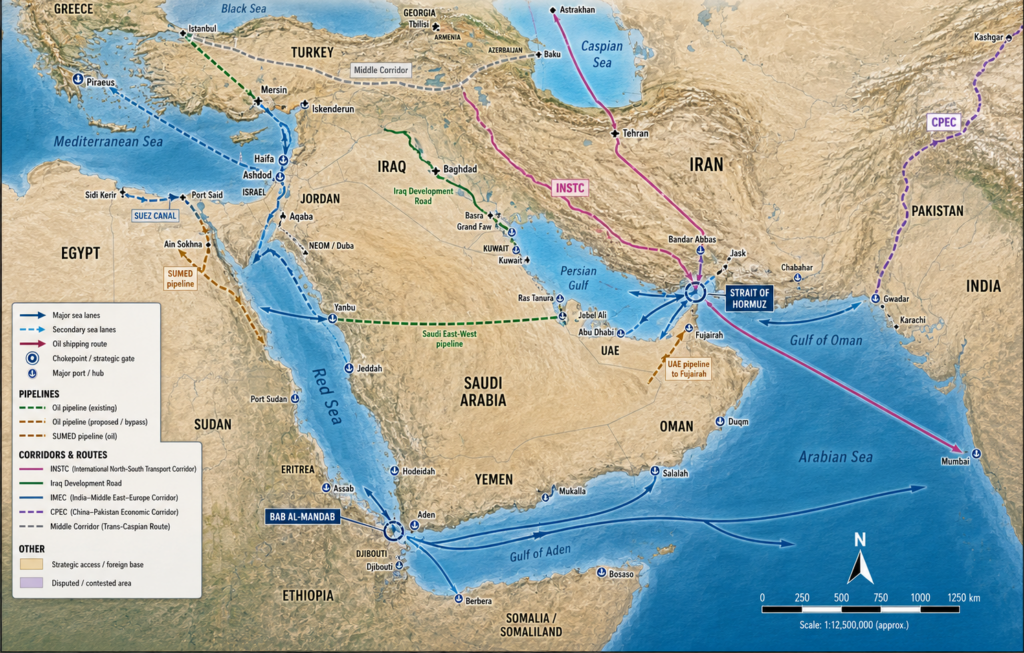
A related point concerns the relationship between precision strike and maritime denial. Iran’s closure of Hormuz, and the documented economic effects on regional exporters and global oil prices, shows that Tehran has succeeded in imposing a second operational problem on the coalition. It is not enough now to strike Iran effectively. The coalition must also stabilize circulation. This is where Corbett becomes more useful than Mahan. Iran has not sought command of the sea. It has sought to weaponize uncertainty in maritime use. Once that succeeds, the stronger side must divide effort between offensive coercion and defensive restoration of transit. That is a major doctrinal shift. It means the attacker is pulled away from pure offensive concentration and toward protection of key terrain and lines of communication. CSIS has already argued that the United States would need to transition from pulse strikes and decapitation toward defense of key maritime terrain if it wants to defeat Tehran’s punishment campaign. That shift matters because every convoy mission, escort requirement, and maritime ISR commitment is also an allocation decision made against some other offensive priority. The defender thus uses denial at sea to reduce the attacker’s freedom of concentration ashore.
The same logic applies in the intelligence war. The coalition’s core advantage is not merely aircraft or missiles. It is the integrated strike-reconnaissance complex that compresses find, fix, track, target, engage, and assess against fleeting opportunities. Yet that advantage only translates into strategic decision if the target set can be rendered sufficiently legible over time. Iran’s use of buried storage and denominator opacity attacks precisely that requirement. It converts hardening into epistemic friction. The question is no longer only how many targets were hit. The question becomes how much of the surviving missile architecture can be confidently accounted for, how much remains accessible, and how much launch capacity has been suppressed versus destroyed. Once those questions stop admitting high-confidence answers, operational superiority remains real but strategic closure recedes. That is why the campaign has had to keep striking despite already impressive damage figures. The target system is not exhausted because the uncertainty surrounding its latent residue is itself a military problem.
The rescue of the downed American airman is particularly revealing in this regard. Personnel recovery under such conditions exposes the true state of a battlespace more honestly than triumphalist sortie counts do. The reported mission involved survivor authentication, CIA deception, electronic jamming, isolation of the area through road strikes, insertion of approximately 100 special operations forces, mechanical failure of two MC-130 aircraft, and the subsequent destruction of stranded aircraft to prevent sensitive technology compromise. Read doctrinally, this was not just a rescue. It was a combined PR, ISR, EW, deception, and fires operation conducted in a battlespace the coalition broadly dominated yet did not fully sanitize. Iran’s achievement was not that it ultimately prevented the rescue. Its achievement was that it retained enough local defensive danger, cueing, and pursuit potential to turn the recovery of a single crew member into a major operational event requiring significant assets and risk acceptance. That is a valuable reminder that tactical dominance in aggregate does not eliminate lethal local pockets, especially where rescue, descent, and localization compress the geometry of operations into narrower windows.
For a doctrinal audience, the pilot rescue also underlines the difference between air superiority and air supremacy. The coalition has clearly maintained air superiority in the operational sense. It continues to fly, strike, and recover in depth. Yet the losses of crewed aircraft and the danger surrounding the personnel recovery effort show that Iranian defensive persistence survives below the level required for theater denial but above the level of trivial nuisance. This matters because the coalition’s method is optimized when the air domain is permissive enough to allow predictable, repeated, and low-risk use of enablers. Every surviving threat pocket forces changes in routing, timing, altitude, escort, EW support, and recovery planning. In other words, even a badly degraded defender can still impose friction that matters for the attacker’s operational economy. When that friction coincides with heavy premium munitions consumption, the overall efficiency of the campaign begins to change.
The broader lesson is severe. The coalition has demonstrated superior operational art in access generation, systems attack, and dynamic targeting. Iran has demonstrated superior preparation for the post-access phase of war. That preparation took the form of underground resilience, launcher survivability, retaliatory husbandry, theater diffusion, and the ability to convert maritime leverage into globalized pressure. The heavy Tomahawk expenditure should therefore be read not as proof of coalition excess power alone, but as evidence that the coalition is paying a high premium to prosecute a closure problem that remains unresolved. If the war had already reached disarmament, such expenditure would be a footnote. Because the war has not, the expenditure becomes analytically central. It marks the point at which the attacker’s preferred coercive instrument begins to encounter the limits imposed by inventory, launcher economics, and broader deterrence commitments.
The conclusion, stated in purely military terms, is not that the coalition is failing. It is that its campaign has entered a more difficult phase than early airpower euphoria suggested. The coalition has achieved operational dislocation but not counterforce closure. Iran has suffered immense material degradation but has not yet been stripped of strategic agency. Tomahawk expenditure at current levels reveals that the coalition’s method of war is deeply magazine-dependent and therefore vulnerable to duration, reattack requirements, and cross-theater opportunity costs. Iran’s force design, by contrast, was built precisely to survive into that stage. It was designed to absorb the opening shock, concede the upper air, and still preserve enough retaliatory architecture to keep the war alive, the sea dangerous, the rear vulnerable, and the attacker’s inventories under pressure. Measured against that harsh but correct standard, Iran’s military design has performed with greater strategic intelligence than many of its enemies expected.