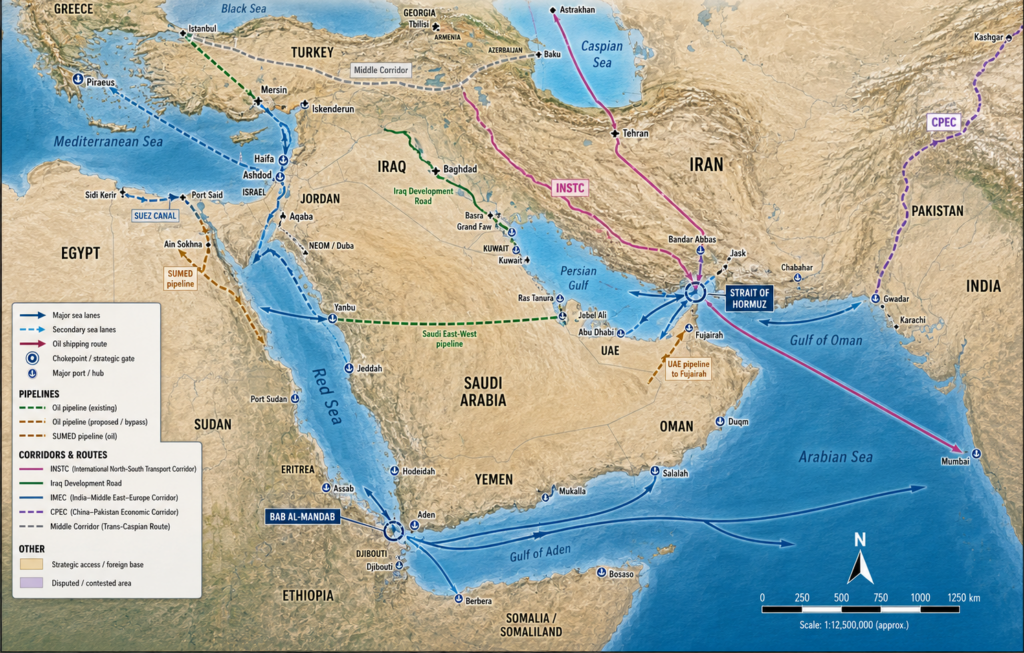
The Pacific Island countries are not being hit by the war only through sympathy, diplomacy, or distance-adjusted market sentiment. They are being hit through the hard mechanics of energy dependence, shipping vulnerability, and external-account fragility. The closure of the Strait of Hormuz matters to the Pacific not because the region sits close to the battlefield, but because it sits at the far end of a fuel system whose upstream crude, refining economics, freight rates, and inventory discipline remain deeply tied to the Persian Gulf. Nearly 20 million barrels per day moved through the strait in 2025, equivalent to about one fifth of global oil trade, while the available bypass capacity through alternative routes has been far smaller, roughly 3.5 to 5.5 million barrels per day. That mismatch is the first geoeconomic fact that matters. It means substitution exists, but not at the scale needed to neutralize the shock.
For the Pacific, the danger is not simply that crude from the Persian Gulf has become scarcer or more expensive. The deeper problem is that most island economies do not import crude and refine it themselves. They import refined fuels, often from Asian refining centers such as Singapore, South Korea, and Japan, which are themselves exposed to disruptions in Persian Gulf crude flows and are already searching for alternative supply arrangements, reserve drawdowns, and emergency rerouting. When the upstream supply system tightens, small import-dependent islands do not just inherit a higher benchmark price. They inherit the priorities, constraints, and bargaining hierarchies of much larger Asian buyers. In other words, the Pacific buys at the end of a chain in which the strongest actors secure barrels first and the weakest absorb the residual instability.
That is why price and availability must be treated separately. Large economies can often survive a price shock if physical supply remains intact. Small island economies can be destabilized by a supply delay even before the price shock fully works its way through domestic markets. Much of the Pacific lacks substantial strategic storage, has no domestic petroleum production to cushion external disruption, and depends on infrequent shipping schedules serving relatively small markets. Under those conditions, a disturbance in tanker scheduling, refinery allocations, marine insurance, or port delivery timing can become macroeconomically significant very quickly. The issue is not simply whether the fuel arrives at a higher price. It is whether it arrives reliably enough to keep power systems, aviation links, inter-island shipping, fisheries, and public services operating without rationing or emergency subsidy.
The macroeconomic exposure is unusually severe because petroleum remains embedded across the productive structure of Pacific economies. Oil still dominates transport and remains central to electricity generation across much of the region, even where renewable capacity has expanded. In the Pacific, imported fossil fuels still account for around four fifths of total energy use, and petroleum has historically remained the main energy source in both power generation and transport. This means the Persian Gulf shock is not a narrow energy event. It is simultaneously an inflation event, a current-account event, a freight-cost event, and a fiscal event. Once fuel prices rise, power costs, shipping rates, airline costs, food distribution, construction inputs, public transport, and government operating costs all move with them. In island economies with limited scale, those effects compound rather than cancel.
The balance-of-payments consequences are therefore central. In many Pacific Island countries, fuel imports already absorb a high share of foreign exchange and national income. Earlier regional and development work has often placed fuel import costs in the range of about 10 percent of GDP for many island economies, with some cases materially above that. Newer estimates generated under the current shock imply much larger near-term stress if elevated prices persist. One scenario suggests that a year of post-shock refined fuel prices could raise Fiji’s fuel import bill by about $670 million, with Vanuatu and Tonga also facing increases large enough to register as high single-digit or even double-digit shares of GDP. In economies with narrow export bases and modest reserve buffers, that kind of deterioration is not just painful. It can become a sovereign-stability issue.
Fiji captures the wider regional logic with unusual clarity. Tourism has historically contributed close to 40 percent of GDP and remains one of the principal sources of foreign exchange. That means a fuel shock hits Fiji from both sides at once. It raises the import bill while also threatening the service sector that earns the foreign exchange needed to pay that bill. If aviation fuel becomes more expensive, flight schedules tighten, or long-haul travel weakens under global energy inflation, tourism receipts soften just as the fuel account worsens. The result is not a one-sided commodity shock but a pincer movement on the current account. One recent estimate suggests that under sustained high refined-product prices, Fiji’s import cover could fall toward levels that materially narrow policy room and intensify fiscal and exchange-rate stress.
Tourism-dependent economies across the Pacific face a similar, if uneven, mechanism. Aviation in the Pacific is not a luxury overlay. It is part of the productive core. It connects labor, goods, medical access, state administration, and visitor flows across widely separated islands. When jet fuel costs rise, airlines reduce margins first, then frequencies, then routes. For countries where tourism, remittances, and imported consumption form the basic economic triangle, fewer flights can mean fewer visitors, lower tax receipts, weaker hotel occupancy, and slower turnover across retail and services. In such economies, fuel inflation becomes external-sector inflation, not merely consumer inflation. The war’s transmission mechanism is therefore geoeconomic before it is social.
Shipping is the second front of the problem. Inter-island and international shipping costs matter more in the Pacific than in continental economies because geography converts freight into a structural tax. Higher bunker costs, insurance premia, route uncertainty, and tighter tanker allocation all feed directly into domestic prices. Food, medicine, building materials, machinery, and consumer goods all become more expensive to move, especially to smaller and more remote islands that already operate on thin commercial margins. In a large economy, logistics inflation can be partially absorbed across dense networks. In the Pacific, it tends to pass through quickly because there are fewer alternative routes, fewer warehousing buffers, and less domestic competition. The energy shock therefore broadens into a trade-cost shock.
Agriculture and food security are also more exposed than they first appear. The Persian Gulf is not only an oil chokepoint. It is also deeply tied to the trade in fertilizer inputs. Recent reporting indicates that the region is central to globally traded sulfur and urea, and that fertilizer shipments through the Strait of Hormuz have fallen sharply since the war began. For Pacific economies this matters in three ways. It raises direct input costs for agriculture. It increases the cost of transporting food. And it amplifies retail food inflation in markets already vulnerable to import dependence and freight volatility. Once fuel and fertilizer move upward together, the burden on household budgets becomes much harder to contain.
The fishing sector adds another layer of exposure. Fisheries are not only export earners in many Pacific economies. They are also a pillar of household nutrition and local livelihoods. Yet the sector is highly fuel-intensive, from vessel operations to cold storage and inland distribution. Higher diesel costs reduce margins for commercial operators, raise distribution costs for local markets, and can weaken food security if catch becomes costlier to land and move. In regions where fish is both an export commodity and a core protein source, energy shocks rapidly become welfare shocks. The same fuel that powers the vessel also underwrites the food basket.
Papua New Guinea remains the major regional exception, but only in relative terms. Its LNG exports and larger resource base provide an offsetting channel that most other Pacific economies simply do not possess. Higher hydrocarbon prices can raise revenue expectations and strengthen the economics of future gas projects, even as imported oil still becomes more expensive. Yet even there the picture is not straightforwardly positive. Recent forecasts point to slower growth, higher inflation, and balance-of-payments pressure linked in part to rising oil import costs and weaker external demand conditions. The correct reading is therefore not that Papua New Guinea escapes the shock. It is that it experiences a more mixed transmission than the rest of the Pacific, where the effect is overwhelmingly negative.
The more serious geoeconomic point is that the Pacific’s vulnerability is not temporary or accidental. It is structural. A region that imports most of its fuel, stores relatively little of it, depends on long shipping lines, and buys refined products from Asian hubs exposed to Persian Gulf crude cannot treat a Hormuz disruption as a one-off market disturbance. It is a stress test of its development model. The same remoteness that raises ordinary trade costs also magnifies crisis pass-through. The same small market size that limits diversification also reduces bargaining power in tight fuel markets. The same narrow fiscal bases that constrain public investment also restrict the ability to subsidize transport, power, or food for long periods. In that sense, the war has not created Pacific vulnerability. It has revealed it in a more brutal form.
That is why the appropriate response cannot be confined to short-term fuel procurement. Emergency supply management matters, but it does not solve the underlying geoeconomic problem. A more serious agenda would treat energy security, shipping resilience, and external-balance management as one policy field rather than three separate ones. That means larger and better-managed storage where feasible, faster substitution away from diesel-fired power, more aggressive electrification of land transport where island grids can support it, stronger regional procurement coordination, and a much clearer understanding that renewable deployment is not only a climate measure but also a foreign-exchange and sovereign-resilience measure. The Pacific’s energy transition is often discussed in environmental language. The Persian Gulf shock shows that it is equally a question of macroeconomic defense.
The final lesson is blunt. Distance from the Persian Gulf does not insulate the Pacific from wars fought there. On the contrary, the region’s position at the far end of fuel, freight, and food chains makes it acutely sensitive to disruptions in that corridor. The Strait of Hormuz is thousands of kilometers away, but its closure transmits directly into electricity costs, airline economics, reserve adequacy, food prices, and debt risk across the Pacific. That is what geoeconomic exposure looks like in small island economies. The battlefield is elsewhere. The balance-sheet damage is local.