The Iran strike global impact is unfolding far beyond the battlefield. What began as a targeted military operation has triggered recalculations across global energy markets, alliance systems, and great-power strategy. Governments are not reacting only to events in Tehran. They are reassessing deterrence credibility, legal precedent, and the future architecture of international security.
When a major power helps eliminate the leader of another sovereign state in an overt military operation, the event does not remain confined to its immediate battlefield. It becomes a diagnostic moment for the international system. Governments everywhere are forced to reassess assumptions about deterrence, alliance reliability, economic exposure, and the durability of legal norms. The strike on Iran has produced precisely that effect. The military action itself lasted hours. The strategic consequences will unfold over years.
What distinguishes this crisis is not only the scale of force employed but the clarity with which it was owned. There was no sustained ambiguity, no prolonged effort to obscure attribution. The operation was acknowledged and defended. That choice matters. It signals that regime-level targeting is no longer relegated to covert margins but can be integrated into declared strategy. The ripple effects of that shift are already visible in how capitals across the globe are positioning themselves.
This is not a story about alignment or condemnation in simple blocs. It is about structural interests. Each major actor is responding through the lens of its economic dependencies, domestic politics, alliance commitments, and threat perceptions. The result is a fragmented but revealing map of strategic behavior.
The Iran Strike Global Impact on China’s Strategic Position
China’s response has been measured to the point of understatement. Public messaging emphasizes stability and civilian safety. The language is procedural, not passionate. This restraint is not indifference. It reflects constraint.
Beijing’s relationship with the Middle East has deepened over the past decade, primarily through trade, energy imports, and infrastructure investment. A large proportion of China’s crude imports flows from Gulf states. Chinese firms are embedded in logistics networks, industrial zones, and port facilities throughout the region. Chinese nationals reside in significant numbers in the United Arab Emirates and elsewhere. Escalation that disrupts energy shipping or threatens expatriate populations touches core economic interests.
Iran occupies a particular niche within China’s broader regional portfolio. It has been a discounted energy supplier and a diplomatic partner in multilateral forums that seek alternatives to Western-dominated institutions. Yet it has never been the central pillar of Beijing’s Middle East strategy. The Gulf monarchies collectively carry more economic weight for China than Tehran does. That reality narrows Beijing’s options.
China lacks the military architecture to shape the immediate battlefield. It cannot credibly deter U.S. or Israeli operations in the region without a dramatic escalation that would contradict its preference for gradual influence-building. Its tools are economic and diplomatic, not kinetic.
The deeper tension lies in narrative. China presents itself as a champion of sovereignty and non-interference. A regime-level strike strains that principle. Yet Beijing also avoids direct confrontation with Washington in crises where it has limited leverage. The result is rhetorical criticism paired with practical caution.
If escalation spreads to Gulf infrastructure or shipping lanes, China’s balancing act will grow more complex. It may attempt mediation or increased diplomatic engagement, but it is unlikely to assume a security guarantor role. The crisis exposes a gap between China’s global economic reach and its willingness to shoulder commensurate security burdens.
Russia’s Position Under the Iran Strike Global Impact
Moscow’s reaction follows a familiar pattern. Official condemnation was immediate. Material intervention was absent.
Russia’s capacity is constrained by its ongoing war in Ukraine. Military resources, logistics networks, and political focus are concentrated closer to home. Providing substantial support to Iran would stretch capabilities already under strain. The optics of alliance solidarity clash with operational reality.
The reputational cost is real. Russia has positioned itself as a leader of a multipolar order resistant to Western dominance. Repeated episodes in which partners receive rhetorical backing but little else chip away at that claim. The perception of unreliability weakens Moscow’s appeal as a security partner.
Yet Russia’s strategic ledger is not uniformly negative. Elevated oil prices support state revenues. Western attention diverted toward the Middle East eases pressure on the Ukrainian front. A protracted U.S. engagement elsewhere could dilute focus and resources.
Moscow’s optimal scenario is contained instability that distracts and economically benefits without requiring Russian intervention. It will likely pursue diplomatic positioning that criticizes Western unilateralism while avoiding commitments that exceed its capacity. The Kremlin’s priority remains survival and advantage in its primary theater.
Europe and the Iran Strike Global Impact on International Law
For European governments, the strike confronts a persistent dilemma. The European Union’s foreign policy identity rests heavily on the defense of international law and multilateral processes. At the same time, transatlantic cohesion remains central to European security.
The immediate responses reveal divergence. Some leaders emphasize the need to uphold legal norms governing the use of force. Others stress the importance of maintaining solidarity with Washington amid broader geopolitical competition. A third current expresses quiet relief at the weakening of a regime associated with regional destabilization and nuclear ambiguity.
These currents are not easily reconciled. Europe lacks a unified replacement for its earlier Iran strategy centered on nuclear containment through diplomacy. The present crisis highlights that absence.
Energy vulnerability and migration risk amplify the stakes. Escalation that disrupts Gulf exports or produces refugee flows would directly affect European stability. The bloc’s influence lies more in sanctions design, humanitarian assistance, and diplomatic convening than in decisive military action.
The longer the conflict persists without a clear political objective, the more pressure will build inside Europe to articulate a coherent stance. Internal fragmentation risks diminishing Europe’s ability to shape outcomes rather than merely react to them.
The United Kingdom: Alliance Loyalty and Legal Scrutiny
London’s posture reflects domestic memory as much as strategic calculation. The experience of the Iraq war continues to inform British skepticism toward rapid military escalation absent clear legal justification and defined objectives.
Public discourse in the United Kingdom has focused on two questions. First, was there sufficient legal grounding under international law. Second, what is the achievable end state. Even critics of Iran’s internal repression and regional activities question whether force replaced diplomacy prematurely.
The government faces a balancing act. Close alignment with Washington is a foundational element of British security policy. Yet overt participation without robust legal framing would invite domestic political backlash.
The British position is therefore cautious. Direct attacks on British assets or personnel could alter the calculus swiftly. Absent that trigger, London appears inclined toward restraint while monitoring developments.
Ukraine: Strategic Symbolism and Resource Anxiety
In Ukraine, the strike carries symbolic resonance. Iranian drones have played a visible role in Russia’s campaign against Ukrainian cities and infrastructure. Seeing Iran itself under military pressure provides psychological satisfaction.
However, Ukrainian officials are acutely aware of material trade-offs. Escalation in the Middle East could compete for limited stocks of air-defense interceptors and advanced munitions. Rising global energy prices strengthen Russian revenue streams.
Kyiv’s assessment is pragmatic. The demonstration of U.S. capability reinforces deterrence credibility. Sustained support and resource availability matter more. Ukraine benefits from a perception of Western resolve but cannot afford dilution of material assistance.
Canada: Middle-Power Calibration
Canada’s response illustrates the logic of middle-power alignment. Ottawa affirms support for preventing nuclear proliferation while emphasizing civilian protection and diplomacy. It avoids direct combat involvement.
Domestic considerations play a role. A sizable Iranian-Canadian community watches developments closely. Social cohesion and vigilance against potential retaliatory activity are internal priorities.
Canada’s approach aims to maintain alliance credibility without assuming disproportionate exposure. It is a strategy of balance rather than bold initiative.
Latin America: Divergence Shaped by History
In Latin America, reactions vary widely. Some governments call for restraint and adherence to international law. Others issue sharper condemnations of the strike. Argentina stands out for its explicit support.
Argentina’s position cannot be understood without reference to the bombings of the early 1990s in Buenos Aires, widely attributed by Argentine authorities to Iranian-linked actors. Those events remain embedded in national memory and shape contemporary perceptions of Tehran.
President Javier Milei’s alignment with Washington and Jerusalem reinforces this orientation. Elsewhere in the region, ideological differences and domestic political landscapes produce more cautious or critical responses.
The regional divergence underscores a broader point. Historical experience and domestic political identity influence foreign policy as much as present-day strategic calculus.
The Iran Strike Global Impact on Global Deterrence Norms
Perhaps the most consequential dimension of the strike is normative rather than operational. By openly targeting a head of state, the intervening powers have expanded the boundaries of acceptable force in contemporary geopolitics.
The legal arguments advanced to justify such actions will be scrutinized closely. Smaller states, which rely heavily on established norms to shield themselves from coercion, observe this development with concern. If regime-level targeting becomes a normalized instrument, the threshold for similar actions elsewhere may lower.
Great powers may calculate that such tools enhance deterrence. Over time, however, a world in which political assassination is openly integrated into statecraft carries higher systemic volatility. Precedents do not remain confined to their initial context.
Energy Markets and the Iran Strike Global Impact
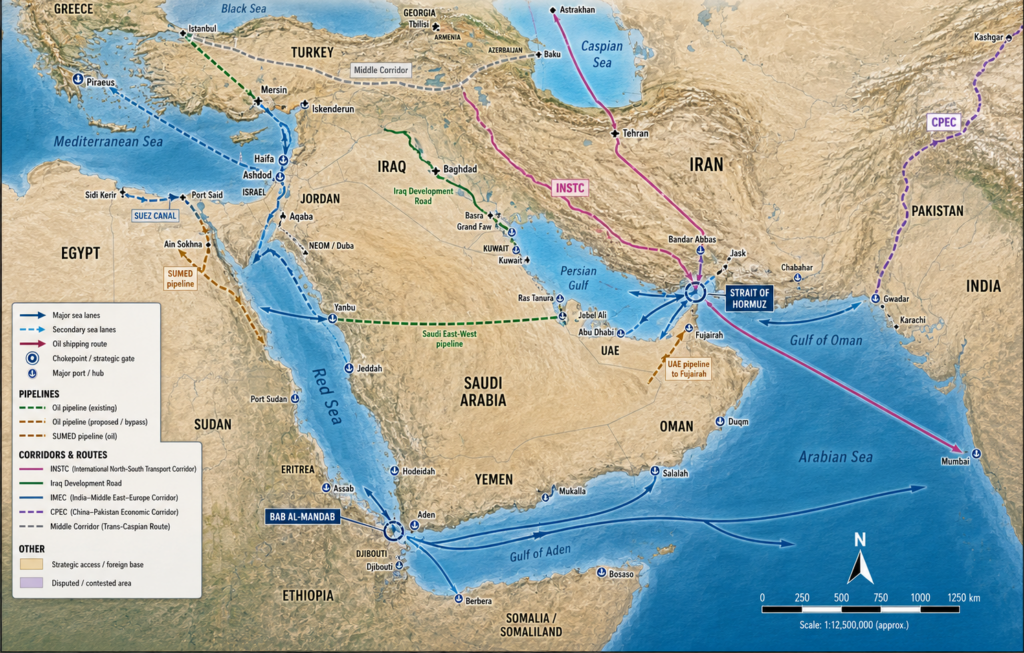
Initial market responses suggested limited panic. That should not be mistaken for structural safety. The Strait of Hormuz remains a critical transit corridor for oil and liquefied natural gas. Even limited disruptions or elevated insurance costs can reverberate globally.
Energy-importing economies in Asia and Europe face inflationary risk if escalation persists. Shipping reroutes increase costs and delivery times. Financial markets incorporate uncertainty into risk premiums.
For developing economies already managing fiscal strain, energy volatility compounds existing vulnerabilities. The economic dimension of the conflict may ultimately shape global reactions as much as military developments.
Conclusion: A System Under Strain
The strike on Iran has produced a moment of clarity about the international system’s current state. Alliances remain important but not uniform. Economic interdependence constrains bold rhetoric. Normative commitments collide with security imperatives.
No major actor appears eager to widen the war. Yet no actor fully controls its trajectory. Escalation can occur through miscalculation, proxy action, or political pressure within states already engaged.
The broader consequence lies in perception. If regime targeting becomes a visible and defended instrument of policy, strategic calculations worldwide will adjust. Deterrence frameworks, alliance assurances, and legal doctrines will evolve in response.
The conflict’s immediate theater is Iran. Its longer-term implications extend far beyond. The coming months will reveal whether the system absorbs this shock through recalibration or enters a more permissive era in which force at the highest political level becomes a normalized tool rather than an exceptional act.