The joint U.S.-Israeli strike that killed Iran’s supreme leader has been read in many capitals as the end of a man and the beginning of an era. That instinct is understandable, and still dangerously incomplete. Leadership decapitation in a system built for continuity rarely produces clean political succession, and almost never produces the kind of orderly transformation that outside powers would prefer. What it reliably produces is a struggle over who controls the coercive instruments of the state and what story can hold the country together while that struggle plays out. Iran is now entering a phase where missiles, drones, energy chokepoints, and legal norms are intertwined with internal legitimacy, elite cohesion, and the incentives of actors who assume they may not survive the month.
The real question is not whether the Islamic Republic “falls” or “holds.” The question is what forms of survival become rational for the people who command armed men, money flows, and intelligence files, and what costs they are willing to impose externally to stabilize their position internally. The likeliest trajectory is not an immediate democratic opening or an abrupt regime replacement; it is an unstable hybrid period in which a narrower security elite attempts to preserve the system’s core while rebranding its leadership. In that world, escalation can be both instrument and alibi: instrument to raise the price of continued bombing, alibi to justify repression and discipline rivals at home.
At the same time, the strike has exported a precedent. It signals that assassination-adjacent regime targeting can be conducted openly and framed as a tool of liberation, not merely self-defense. Even if the operation remains militarily contained, it expands the menu of acceptable action for states that previously hid behind ambiguity. That is the wider danger: not only a war in Iran, but a loosening of the global restraints that made certain crises survivable.
What follows is a strategic assessment of the post-strike landscape, built around Iran’s internal survival math, the regional escalation ladder, energy and shipping risks, great power reactions, and the domestic political constraints in Washington and allied capitals. The concluding section offers policy choices that treat this crisis as what it is: a contest between escalation incentives and governance realities, not a morality play with a neat third act.
1. The day after is not a day; it is a system test
States with personalized power can fracture when the person vanishes. States with institutionalized coercion often do the opposite: they harden. Iran is not a mere personalist regime, even after decades of concentrating authority in the supreme leader’s office. It is a layered architecture where the security apparatus is both shield and shareholder. Parts of the state are ideological, parts are transactional, and many are both at once.
This matters because decapitation creates two simultaneous competitions.
The first is the competition for command. Who controls the Revolutionary Guards, the intelligence networks, the internal security forces, the financial conduits, and the relationships with proxies? Those are not symbolic assets; they are the levers that decide whether elite bargaining is peaceful or lethal.
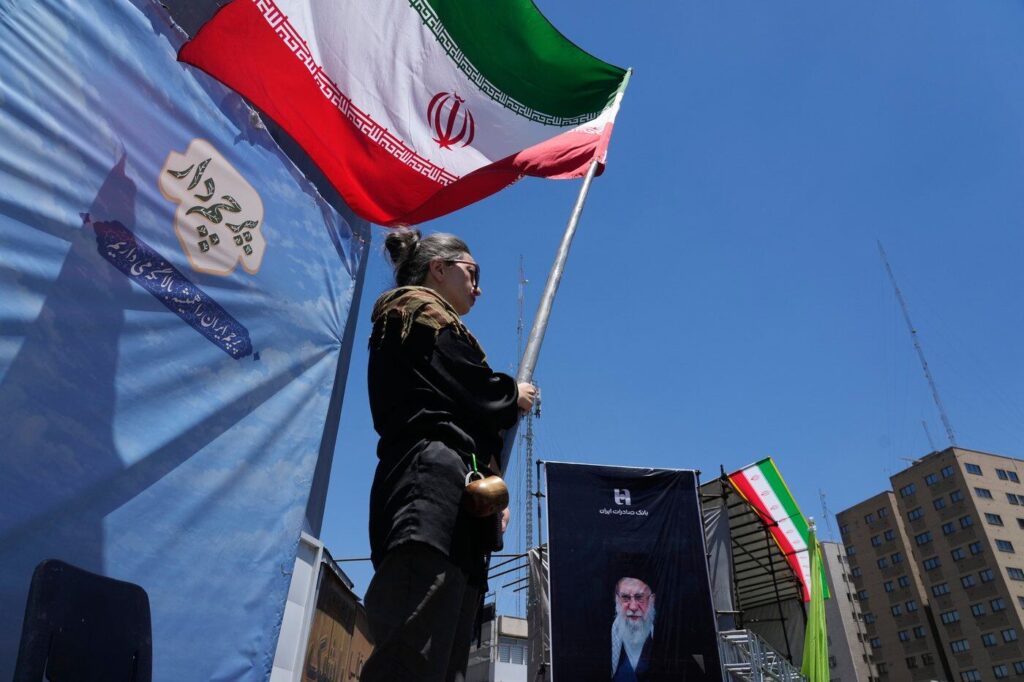
The second is the competition for narrative. A regime under bombardment needs a legitimizing story that can unify enough constituencies to deter defections. Nationalism is the easiest available story because it is portable across factions. A government can be hated and still become the vehicle for national resistance if the alternative looks like collapse, fragmentation, or foreign occupation.
This is why celebratory scenes after the leader’s death, however real, do not automatically translate into a durable opposition wave. Many Iranians may despise the system and still fear what comes after it. A vacuum in a country of Iran’s size, geography, and ethnic complexity is not an abstract concept; it is a map of possible wars.
If the outside expectation is that removing the leader removes the regime, the inside expectation is often the opposite: that survival now depends on proving the system cannot be coerced. When that belief sets in, restraint becomes politically expensive within the ruling coalition, while escalation becomes a credential.
2. Iran’s strategic logic under existential pressure
Once a regime believes it is fighting for its life, it prioritizes three objectives.
First, preserve internal cohesion. That typically means rapid consolidation by the most security-competent faction, purges masked as emergency governance, and a tightening of information space. It also means preventing elite flight. Money and families leaving the country are not merely corruption stories; they are signals that the insiders think the game is over.
Second, create external leverage. Iran’s core leverage has never been symmetrical conventional power. It is the ability to distribute risk across a region in ways that force adversaries and bystanders to pay attention. The tools include missiles, drones, covert action, cyber operations, and maritime harassment, plus the political ability to activate networks that can claim plausible deniability.
Third, keep an off-ramp available. Even the most radical faction usually wants optionality. The off-ramp does not need to be “peace.” It can be a ceasefire that preserves enough capacity to claim survival, then converts the crisis into a bargaining position.
This triad produces a pattern: escalation designed to be frightening but not suicidal, paired with signals that negotiations could resume if the bombing stops. The paradox is that a regime may simultaneously appear reckless and transactional because it is trying to be both.
3. Why leadership targeting rarely delivers the intended political outcome
Leadership targeting is often sold as efficiency: remove the head, spare the body. In practice, it tends to create at least four problems.
The succession problem: in systems where legitimacy is partly theological or constitutional, sudden removal can create ambiguity. Ambiguity is not neutral; it is contested. Contested succession is a generator of violence, not a release valve.
The substitution problem: even if leadership is replaced, the coercive infrastructure remains. The people who control detention centers, procurement pipelines, and internal surveillance do not dissolve because a new name is announced.
The radicalization problem: when moderating factions are discredited as ineffective protectors of the state, hardliners inherit the argument that compromise equals death. In crises, ideologues gain power by claiming they were right all along about the enemy’s intentions.
The governance burden problem: if the stated aim becomes regime change, the outside coalition inherits responsibility for what comes next, whether it wants that responsibility or not. The region, and the world economy, will treat the interveners as accountable for the consequences even if they deny the premise.
These dynamics do not mean leadership targeting is never effective. They mean it is a high-variance instrument whose political effects are harder to control than its kinetic effects, especially when the target state is large, proud, and regionally embedded.
4. The escalation ladder is regional, not bilateral
The current conflict is often described as U.S. and Israel versus Iran. That framing is strategically misleading because Iran’s most usable retaliation options run through the region.
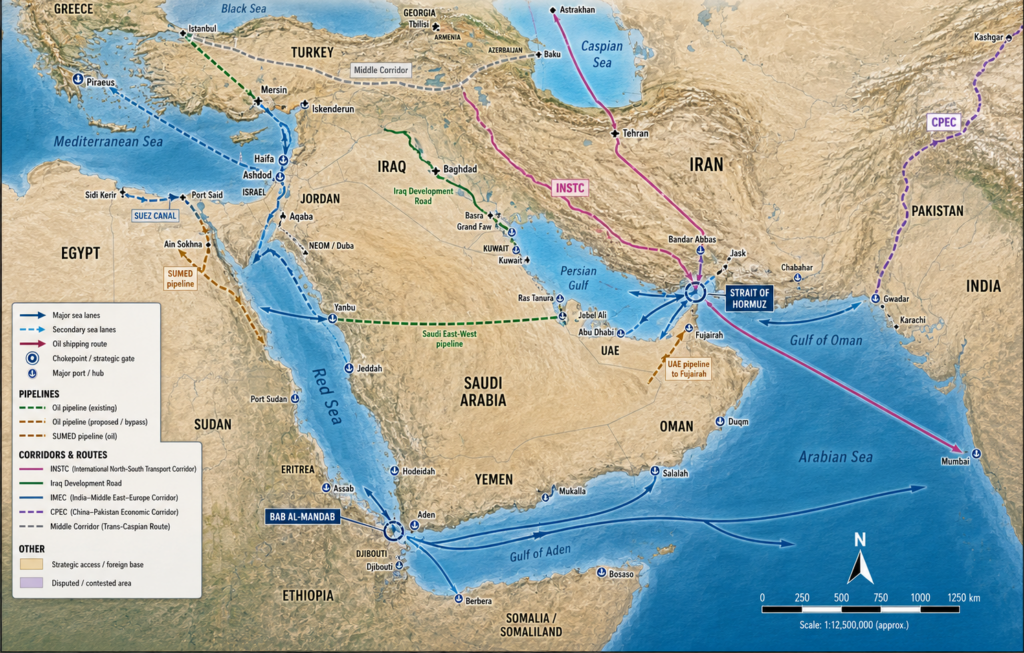
The immediate ladder includes strikes on bases that host U.S. forces, attacks on Gulf infrastructure, drones aimed at ports and desalination plants, and harassment of commercial shipping. Each action is calibrated not only to punish adversaries but also to frighten neighbors into pressuring Washington to stop.
The next rung involves widening target sets. This can include attempts against shipping lanes beyond the Strait of Hormuz, covert sabotage operations, cyber disruptions against financial systems or energy logistics, and the activation of sympathetic militant networks where the local state has limited control.
The final rungs are the most dangerous because they create miscalculation cascades. A drone that hits the wrong facility can produce a domestic political demand for retaliation in the country struck, even if that country wanted to stay out. A missile intercepted over a city still forces leaders to act as if their sovereignty has been challenged. As more actors become “in,” the conflict becomes harder to stop because nobody wants to be the first to accept humiliation.
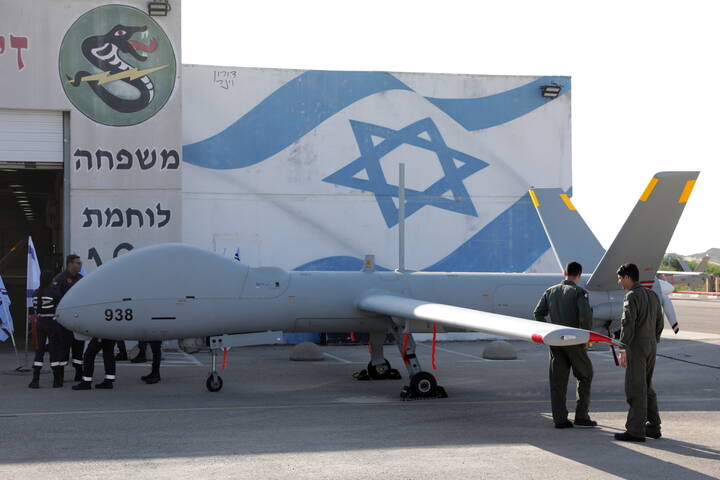
This is why low-cost drones matter. They compress decision time. They impose psychological and insurance costs that are not proportional to their price. They also exploit a modern vulnerability: defense systems can be excellent and still be overwhelmed by quantity and ambiguity.
5. The oil market’s early calm is not evidence of low risk
Market pricing in the first days of a crisis often reflects a narrow probability judgment: “Is there an immediate physical disruption?” It rarely captures the second-order dynamics: insurance costs, rerouting delays, risk premiums on shipping, investor behavior, and policy responses that come after one spectacular incident.
The Strait of Hormuz remains a classic chokepoint, but the real vulnerability is broader than the strait itself. Tanker owners and insurers can create a de facto disruption without any formal blockade if the perceived risk crosses a threshold. In that scenario, supply still exists, but it cannot move at normal cost or speed. The price shock comes from fear, not scarcity.
There is also an asymmetry in circumvention. Oil can be partially rerouted via pipelines, within limits. Liquefied natural gas is far less flexible because export routes and terminals are not easily replaced in real time. A disruption that mostly affects LNG can hit specific economies hard while leaving global oil headlines deceptively stable.
Finally, a “contained” conflict can still create a macroeconomic drag. Higher energy prices operate like a tax. They slow growth, complicate inflation control, and strain fragile currencies, particularly in import-dependent states. A Middle East escalation layered onto existing economic fragilities becomes a global growth story, not merely an energy story.
6. Europe’s dilemma is agency, not sympathy
European governments can dislike Iran’s regional behavior and still recoil at the method and implications of the strike. Their problem is not moral confusion; it is strategic constraint.
Europe has limited coercive leverage on Washington and limited capacity to shape outcomes inside Iran without being accused of interference. Yet Europe bears disproportionate exposure to second-order consequences: refugee flows, terrorism risks, energy and insurance costs, and the precedent erosion of international law that smaller states rely on more than great powers do.
If European bases or deployed forces are struck, the political space narrows quickly. “Defensive” support can slide into operational involvement, particularly through air defense, intelligence sharing, or the use of bases for sorties. The risk is incremental commitment without strategic ownership, which is the most expensive form of participation because it produces responsibility without control.
Europe’s most underappreciated comparative advantage may be experience with sanction design, legal accountability tools, and sustained diplomacy that is less performative than American domestic politics often requires. But those instruments take time, and time is precisely what escalation threatens to remove.
7. Russia and China read the precedent through their own vulnerabilities
Moscow and Beijing are unlikely to see the strike primarily as an Iran story. They will see it as a template.
Russia’s immediate incentives are mixed. Higher energy prices can benefit its revenues. U.S. distraction can reduce attention on Ukraine. Yet the demonstration that a leader can be targeted and killed with high confidence is psychologically destabilizing for systems that place personal security at the center of governance. It also highlights limits of Russian power projection and protection of partners, which can weaken Moscow’s standing in other relationships.
China’s interests are similarly mixed. Instability threatens energy flows and can inject volatility into global markets. But China’s strategic planners will also watch the munitions expenditure, the intelligence integration, and the political willingness to use force. Taiwan’s leadership will watch it too, for the opposite reason: they want the United States to remain well stocked, well focused, and politically capable of long-term deterrence.
In both Moscow and Beijing, the most important takeaway may be this: norms are not only legal; they are expectations about what adversaries will not do. When expectations collapse, deterrence calculations change. That can make crises elsewhere more likely, even if nobody intends the linkage.
8. Turkey’s fear is the vacuum, not Tehran
Turkey’s position is often misunderstood as ideological affinity or rivalry theater. It is more basic: Ankara fears disorder on its border and a regional balance tilted toward an unconstrained Israel.
A destabilized Iran raises three Turkish anxieties at once: refugee pressure, trade and energy disruption, and the empowerment of Kurdish militancy through new spaces of autonomy or lawlessness. Turkish leaders do not need to admire Tehran to prefer a predictable adversary over an unpredictable collapse.
At the same time, Turkish-Israeli rivalry can sharpen in this environment because both states interpret regional shifts in zero-sum terms. If Israel emerges as the dominant military actor, Turkey worries about strategic marginalization across Syria, the Eastern Mediterranean, and the broader Middle East. That rivalry can remain political, but in a crisis environment it can become operational through proxy alignments and competing security footprints.
Turkey will likely seek an off-ramp not as a favor to Iran, but as a hedge against a postwar order it cannot control.
9. India and Southeast Asia are exposed through people and shipping, not ideology
States far from the front lines can still be deeply implicated because modern globalization creates concentrated points of failure.
India’s exposure runs through diaspora safety, remittances, energy imports, and maritime commerce. Any sustained disruption in Gulf stability becomes a domestic political issue in New Delhi because millions of Indian citizens live and work in the region. Evacuation planning, shipping insurance, and energy procurement quickly become national security questions.
Southeast Asia’s exposure is often overlooked until it is too late. The maritime economy depends on safe passage through key straits. A conflict that normalizes harassment of shipping, sabotage, or the weaponization of commercial routes can spill far beyond the Middle East. Even the perception that such tactics are now “in play” can increase costs across the global supply chain.
There is also a legal and diplomatic dimension. Many mid-sized states depend on the U.N. Charter framework not because it always stops wars, but because it raises the political price of coercion. When great powers visibly step outside that framework with limited international pushback, smaller states lose protective structure and strategic room.
10. The U.S. domestic constraint: war powers, time horizons, and coalition discipline
The strike’s operational success does not resolve its political sustainability. Washington faces a familiar pattern: initial unity during shock, followed by contestation as costs rise and objectives become blurry.
If the objective is regime change, the demand for clarity becomes unavoidable. How is success defined? What constitutes an acceptable successor? What happens if the successor is worse? Is there a plan for stabilization if the state fractures? Air campaigns can destroy, but governance requires presence, partners, or both.
If the objective quietly narrows to a deal with whoever takes over, the rhetorical commitment to liberation becomes a liability. Iran’s new rulers can exploit that contradiction by portraying Washington as indifferent to Iranian lives and interested only in compliance and oil.
War powers questions amplify the problem. A military action that expands without legislative authorization invites legal and political backlash, especially if U.S. casualties mount or energy prices rise. Sustained conflict requires a domestic mandate, and mandates require coherent explanations.
Coalition discipline is also fragile. Israel may favor maximalist aims, the United States may prefer a quicker political exit, and regional partners may prioritize protecting their infrastructure over long-term transformation in Tehran. Divergent aims are not merely diplomatic; they shape target selection, escalation thresholds, and bargaining strategy.
11. Three plausible strategic pathways, and the trap inside each
The temptation in crises is to pick a “best case,” “middle case,” and “worst case” as if they were separate roads. In reality, crises evolve through decisions made under uncertainty, and pathways can merge.
Pathway A: The security succession with a bargain.
A consolidated security elite takes control, suppresses dissent, and signals willingness to negotiate limits on nuclear activity or regional behavior in exchange for an end to strikes and partial economic relief. This can look like pragmatism, but it may also be a tactical pause that buys time to rebuild deterrence. The trap is believing that a deal equals transformation. A regime can become quieter and still remain fundamentally coercive and revisionist, especially if it concludes that only nuclear capability prevents future decapitation.
Pathway B: The prolonged air war with regional spillover.
U.S.-Israeli strikes continue in waves, Iran retaliates across the region, and third parties are drawn in through base attacks, infrastructure hits, or maritime incidents. This pathway does not require Iran to “win.” It only requires Iran to impose enough distributed pain to fracture coalition unity. The trap is escalation without ownership: the interveners become responsible for regional security while lacking a viable political end state.
Pathway C: The internal fracture.
Elite competition turns violent, peripheral regions test autonomy, armed groups proliferate, and the state’s administrative capacity erodes. This pathway is often described as “collapse,” but the more realistic version is patchwork sovereignty, with zones controlled by different coercive actors. The trap is humanitarian and strategic at once: migration surges, extremist opportunities expand, and neighbors intervene to protect their interests, creating a multi-sided conflict that can persist for years.
None of these pathways produces clean victory. The strategic goal should therefore be narrower and more realistic: prevent the crisis from turning into an uncontrollable regional war while preserving leverage for a political settlement that reduces long-term proliferation risk.
12. Policy choices that match the reality, not the slogans
The core requirement now is coherence: ends, means, and narrative must align, or adversaries will exploit the gaps.
First, define the political objective publicly in terms that can survive contact with reality. If the goal is to prevent nuclear breakout and reduce regional attacks, say so and design strategy accordingly. If the goal is regime change, acknowledge the governance burden and prepare for second-order consequences. Ambiguity is not flexibility; it is an invitation for mission creep and coalition fracture.
Second, build an escalation management framework that treats third parties as the center of gravity. Protect Gulf infrastructure and shipping not as a side task but as the key variable that determines whether the conflict stays limited. Maritime security, air defense integration, and clear signaling about red lines should be designed to prevent the “accidental widening” scenario.
Third, pair military pressure with civilian instruments that target the regime’s coercive nodes while expanding space for Iranian society. That includes information resilience, anti-censorship capabilities, and accountability measures against individual perpetrators of repression. The point is not romantic regime engineering; the point is to avoid turning national resistance into the regime’s strongest asset.
Fourth, restore diplomacy as a parallel track rather than a reward after escalation. Backchannel communications reduce miscalculation and allow exploration of off-ramps without public humiliation. In a crisis, diplomacy is not a concession; it is a safety mechanism.
Fifth, treat legal precedent as a strategic asset. Even great powers benefit from restraints when they are not the ones striking. If the norm against leadership targeting becomes fully normalized, today’s tool becomes tomorrow’s vulnerability. Managing the narrative around legality and proportionality is not a public relations exercise; it is long-term self-interest.
Closing judgment
The killing of a leader can feel like a hinge of history. Sometimes it is. More often, it is a hinge that opens onto a corridor, not a door, and the corridor is full of choices made by frightened elites, impatient publics, and allied coalitions that discover they were never fully aligned.
Iran’s rulers, whoever they become in the weeks ahead, will interpret this strike as proof that survival requires deterrence that cannot be decapitated. That belief can push them toward rebuilding asymmetric reach, tightening domestic control, and seeking the ultimate insurance policy. Meanwhile, the global system will interpret the strike as proof that political assassination has returned as a normalized instrument of statecraft, and that lesson will not remain confined to the Middle East.
Avoiding a regional war now requires discipline that is rarer than firepower: disciplined objectives, disciplined escalation control, and disciplined respect for the difference between breaking a regime and building a stable order. The danger after the strike is not only what Iran will do next. It is what everyone else will learn from it.